
The Mediterranean has warmed up sharply in recent days. If scientists do not consider the situation alarming at this stage, they do not rule out a new marine heat wave this summer, with potential consequences on ecosystems, similar to that of 2022.
Christian Tamburini, research director at the CNRS and the Mediterranean Institute of Oceanology in Marseille, told ICI Provence that « the sea rose six degrees in six days to reach 24 degrees on June 24″. However, he believes that these values are not alarming since « deep water keeps warm but usual temperatures for this time of year. It is 16 degrees at 10 meters deep, 15 degrees at 20 meters« . He does not rule out a new marine heat wave this summer in view of the expected successive heat waves.
Indeed, for several days, France has been hit by an unprecedented heat wave, accumulating temperature records. The Minister of Ecological Transition confided to the microphone of France Inter that there is « high probability » that France will experience a new heat wave at the beginning of July, which « could take us until July 14« .
Losers and winners
IF for the moment it is too early to observe precise consequences of the current episode, the 2022 marine heat wave has been the subject of in-depth studies. « We can imagine that the current heat wave will have similar consequences to that of 2022, » says Charles-François Boudouresque, professor at Aix-Marseille University.
The scientist distinguishes two types of ecosystem responses to heat. On the side of the losers, there are fixed cash, unable to flee the heat and who paid the most. « Fish that are mobile can move to look for more favorable environments, » he explains, stressing that gorgons have experienced a high mortality. « In Marseille, the mortality rate of red gorgon was more than 90 to 100% and that of commercial sponge was 100%, » he says.
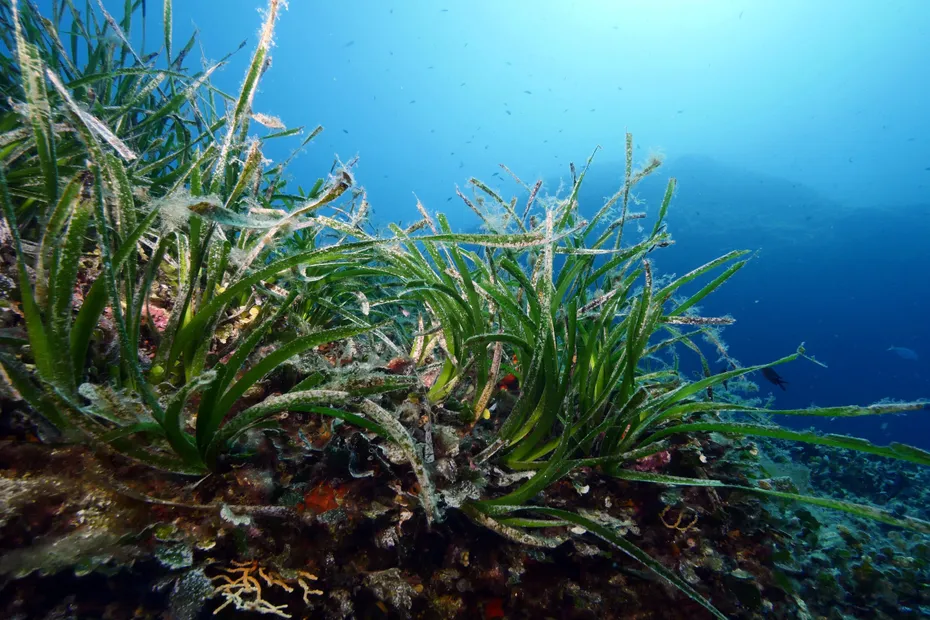
On the other hand, thermophilic species have benefited from this heat wave. This is the case of green algae, which have particularly proliferated. He also refers to posidonia, this plant with flowers and seeds « which has flowered, followed by absolutely exceptional fruiting« . A phenomenon that, according to the professor, « translates the resilience of ecosystems in natural environments« .
« We will end up with an algae-free underwater desert »
But the most worrying part of his analysis is the progression of species native to the Red Sea that are gradually colonizing the Mediterranean, via the Suez Canal. If they have not yet reached the French coasts, Charles-François Boudouresque is formal, their advance is inevitable. He first talks about the rabbit fish, described by the researcher as « a voracious herbivore that eats everything« , a real « sea goat capable of transforming the seabed into deserts« . The scientist explains that his progress continues, heat wave after heat wave. « It will eventually arrive at our place and we will eventually see the same thing as in Greece or Turkey: an underwater desert without algae, » he regrets.
There is also the lionfish, described as « beautiful fish, very aesthetic to look at, whose brooms are a fascination to observe« . On the other hand, he is a « redible voracious predator who eats everything, and whose arrival at home will be annoying, » adds the professor. And it will pose another problem, since contact with this fish is extremely painful, reports Charles-François Boudouresque. He adds that this pain requires hospitalization in case of involuntary contact.
The last species that the scientist mentions is the giant jellyfish (Rhopilema), whose umbrella is one meter in diameter. « It’s not the little jellyfish that bothers us on our coasts, » ironizes the researcher. His sting, much more serious than a « simple unpleasant burn« , sends directly to the hospital. In regions where it is already present, beaches are closed and artisanal fishing is prohibited, says the professor. For the researcher, we could see these species appear on our coasts in the coming decade.
« We must be more active and reactive to global warming »
Faced with these prospects, Charles-François Boudouresque sees only one real lever of action: fighting greenhouse gases and slowing down global warming. According to him, efforts are insufficient and especially late. « We do them, but too slowly, backwards sometimes and even backwards, » regretting what is happening in the United States. However, he notes an evolution on the Chinese side, who have long been little concerned about the climate issue and today more aware of the issues. Conversely, he deplores the role of leaders like Donald Trump, who « make us take a step back when we were already not going very fast« .
Committed to the climate issue, Charles-François Boudouresque nevertheless wants to nuance his point. « I want us to be more active and reactive to climate change, but I also campaign so that we do not attribute everything to it, » he insists heavily. Because his fear is that by systematically attributing all phenomena to global warming alone, we risk completely discrediting scientific discourse.
source : franceinfo