
The Atlantic is an ocean somewhat forgotten in recent years by strategic reflection. He pays the price of the illusion of the « end of History » but also of its economic downgrading in favor of the Indian and Pacific Oceans where the center of gravity of our world has largely shifted.
However, the Atlantic retains a major strategic dimension, mainly for Europe but also the United States whose interests are always closely linked to this ocean, whether they like it or not.
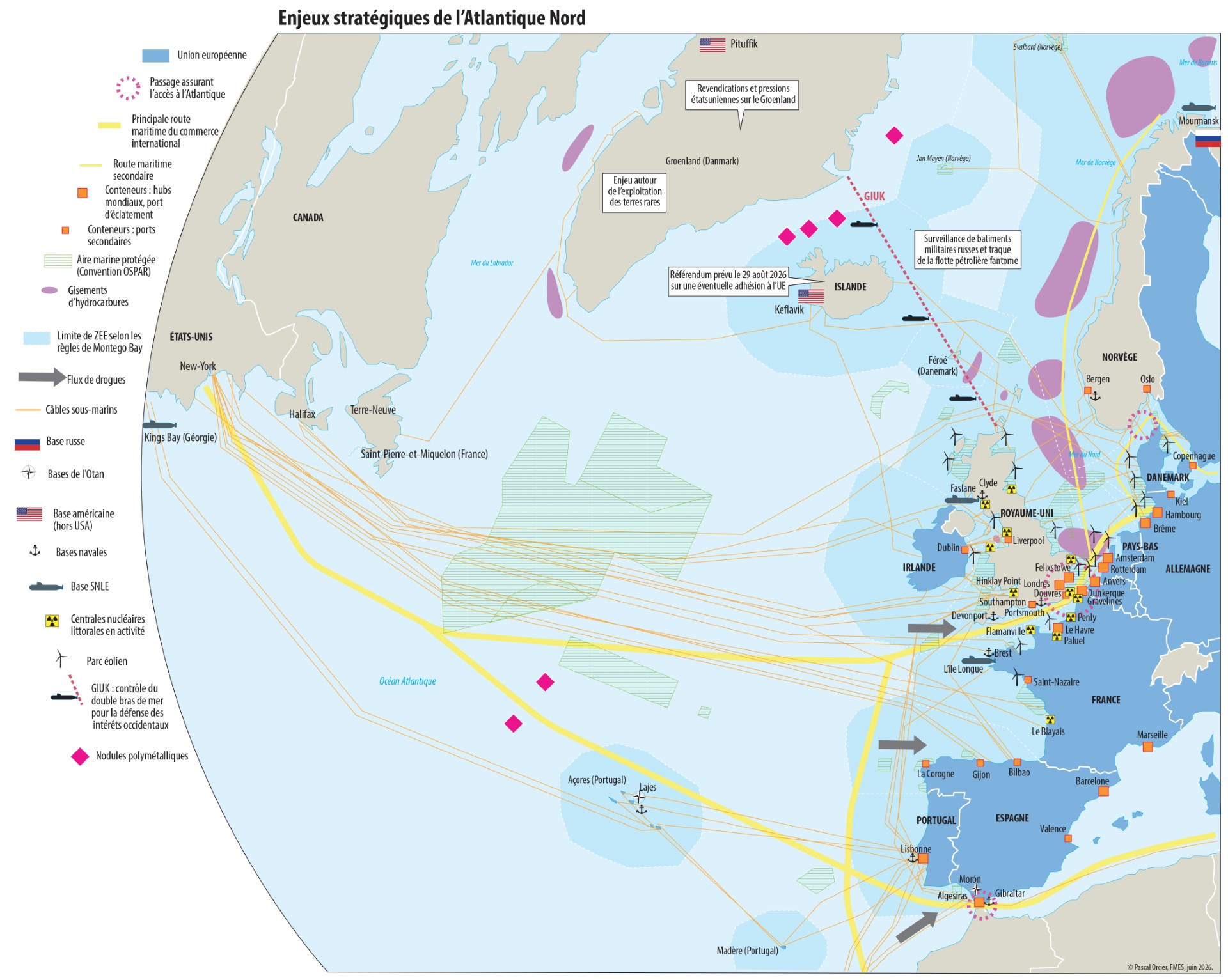
The Atlantic is crossed by important sea routes connecting North America to Europe and Africa. Threats to maritime traffic in the Red Sea have greatly increased the Atlantic’s share of global maritime trade due to the bypass of ships by South Africa. Currently, 20% of world maritime trade passes through the North Atlantic, illustrated by the strong dependence of Europe, of which 90% of energy and industrial supplies pass through the sea.
The Atlantic is also the historic sea where the first submarine cables were created at the time of Queen Victoria. This ocean accounts for 30% of the world’s digital submarine cables. More than 50% of transoceanic internet traffic passes through the North Atlantic.
The Atlantic is the cradle of the largest military alliance the world has ever known, with the North Atlantic Treaty (NATO) signed in 1949. NATO countries spend $1.5 trillion on military spending (+20% since 2024), which represents 50% of global spending. With a maritime command (MARCOM) based in Northwood (GB), NATO’s main priorities are now deterrence against Russia, the preparation of a conflict in the Arctic, missile defense especially in the pole region and the mine war.
The Russian submarine fleet is the big challenge of the moment in the North Atlantic given the threat it poses to Western nuclear components, the logistical links between North America and Europe and the security of the European continent. The control of the Atlantic, extended to the underwater environment, is the great mission of NATO navies. It is to this end that NATO ensures that the GUG (Greenland-Iceland-United Kingdom) which is a strategic bottleneck in the North Atlantic. By monitoring this sea crossing, the Western navies control the movements of Russian submarines based on the Kola Peninsula to exit the Arctic. This control is ensured by the permanent deployment of naval and air resources, but also by SOSUS (Sound Surveillance System) submarine sensors under American control, making it possible to detect the presence of submarines through the analysis of emitted noise.
The North Atlantic is also characterized by being a highly territorialized area. This characteristic dates from the 1970s with the first massive oil and gas exploitations at sea in the North Sea such as the giant deposits of Ekofisk (1969) and Frigg (1978). The North Sea’s peak carbon production was reached in 2000 and these farms are now in decline. They are replaced by a new production of marine energy, even more space-hungry but cleaner, offshore wind. The North Atlantic now represents the highest concentration of wind farms with considerable projects. Of the five largest offshore wind energy producing countries, four are in the Atlantic with Great Britain, Germany, the Netherlands and France. The United Kingdom has become the world leader in this energy with huge parks (including Hornsea One, the world’s largest offshore wind farm, or London Array) and a large number of sites under construction. These facilities have significant vulnerabilities in the face of the hybrid attack hypothesis.
The territorialization of maritime areas is also the marine protected areas (AMP). Thus, the OSPAR Convention (for the protection of the North-East Atlantic) allowed the creation of six marine protected areas in deep water in 2010, covering approximately 285,000 km². Another 600,000 km² AMP was added in 2021. They are in addition to the many other LMPAs covered by European (Natura 2000) or national regulations such as nature reserves or marine natural parks for France.
The last major issue of this ocean is that of drug trafficking. The Atlantic is the ocean most affected by the maritime transit of narcotics which, in particular, is flooding Europe (traffic to Europe is estimated at 1000 tons of cocaine). To deal with this « white tsunami » from Latin America, Europe and France are deploying considerable resources that are unfortunately largely insufficient. Indeed, only 20% of the « targets » identified at sea can be actually intercepted. The fight against this trafficking, which is exploited by certain powers and criminal networks, has become existential for our democracies.
source : FMES