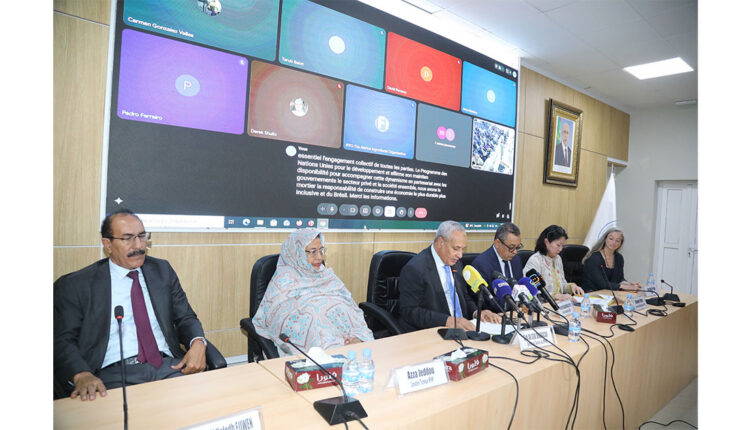
The headquarters of the Mauritanian Institute for Oceanographic and Fisheries Research (IMROP) hosted, on Wednesday, the regional launch workshop of the project « Integration of sustainable marine fisheries value chains in the blue economy of the Grand marine ecosystem of the Courant des Canaries (CCLME) », better known as « Global Marine Commodities 2 (GMC2) ».
Organized in person and by videoconference, the workshop brings together high-level government delegations, researchers, representatives of the private sector and civil society from Mauritania, Morocco and Senegal. It is part of a partnership between the United Nations Development Programme (UNDP), the Global Environment Fund (WFM/FG) and the Sustainable Fisheries Partnership (SFP), to support efforts for sustainable fisheries management and the development of the blue economy in the region.
In his opening speech, the Secretary General of the Ministry of Fisheries, Maritime and Port Infrastructure, Mr. Sidi Ali Ould Sidi Boubacar, stressed that the fisheries sector is one of the main pillars of the national economy because of its contribution to food security, job creation and increased value for the economy.
He indicated that the interest given to this sector reflects the place it occupies in the development vision of the President of the Republic, His Excellency Mr. Mohamed Ould Cheikh El Ghazouani, as expressed in his program « My ambition for the Fatherland », implemented by the government of Prime Minister, Mr. El Moctar Ould Djay, through policies and programs aimed at modernizing the sector and strengthening its competitiveness.
The Secretary-General also highlighted the particular importance of this project for Mauritania, given the strategic role of octopus fisheries and small pelagics in the national maritime economy. He stressed the need to sustainably preserve these resources through a strengthened partnership between public administration, scientific research institutions, the private sector and civil society organizations.
For his part, the Director General of the IMROP, Mr. Mohamed El Hafedh Ould Ejiwene, welcomed the organization of this regional meeting in Mauritania, welcoming the participating delegations and recalling that scientific research is the basis of effective policies to protect marine ecosystems and ensure the rational and sustainable exploitation of fisheries resources.
He expressed the hope that the work of the workshop would lead to concrete guidelines for the implementation of the project in the service of sustainable development and the preservation of common maritime resources.
In turn, the UNDP’s assistant resident representative in Mauritania, Ms. Hyewon Jung, reviewed the main challenges facing marine ecosystems under the effect of climate change, recalling that about a third of the world’s fish stocks are under pressure related to unsustainable exploitation.
She stressed that Mauritania, Morocco and Senegal share an exceptional marine ecosystem, that of the Canary Islands, where small pelagics represent nearly 75% of total catches and are an essential source of food and income for millions of people.
Ms. Jung said that the « Global Marine Commodities 2 » project is receiving funding of more than US$58 million, and the support of the Global Environment Fund and its partners. It also aims to improve the management of more than 1.4 million tonnes of fishery products for the direct benefit of some 374,000 beneficiaries.
She also insisted that environmental sustainability is inseparable from social justice, calling for increased participation of women and artisanal fishermen so that they fully benefit from the opportunities offered by the project.
The Deputy Director of Fisheries Governance within the Sustainable Fisheries Partnership, Cassandra De Young, stressed that the transition to sustainable fisheries requires a strong partnership with the private sector. She called for the voluntary commitments of companies and value chain actors to be translated into concrete, measurable and assessable mechanisms, thus contributing to the protection of the oceans and the sustainability of their resources.
The workshop program includes the presentation of the results of the first phase of the project (GMC1), the examination of the theory of change that underlies the second phase, as well as technical sessions for the exchange of experience with the participation of the Food and Agriculture Organization of the United Nations (FAO), the German Development Bank (KfW), the private sector and civil society, including the African Organization of Artisanal Fisheries (CAOPA).
Participants will also examine plans to improve octopus and small pelagic fisheries in Mauritania, as well as those for sardines and anchovies in Morocco. Presentations will be devoted to environmental and climate scenarios, as well as Mauritania’s experience in the implementation of the Fisheries Transparency Initiative (FiTI).
The opening ceremony took place in the presence of the Secretary General of the Ministry of the Environment and Sustainable Development, alongside several officials, experts, researchers and actors in the fishing sector.