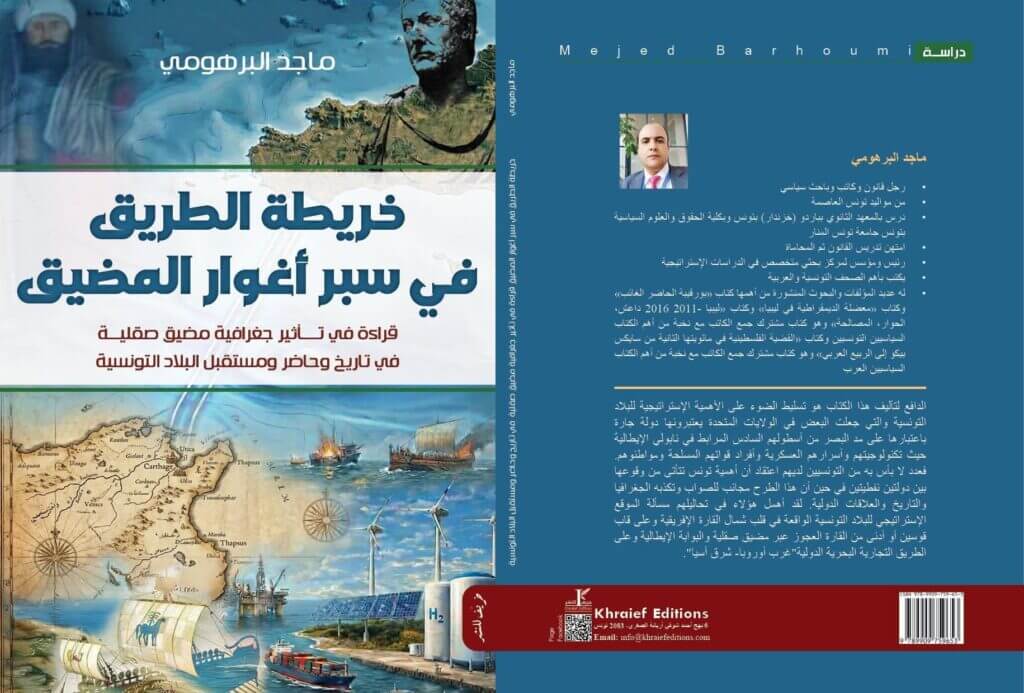

Khraief editions have just published a new book by writer and researcher Majed Barhoumi, entitled « Roadmap to probe the depths of the strait: reading the influence of the geography of the Strait of Sicily on the past, present and future of Tunisia ». This book proposes to re-examine a fundamental question that has long aroused the interest of historians and geopolitical specialists: what really gives Tunisia its strategic importance in the world?
The author starts from a central hypothesis that the importance of Tunisia does not stem mainly from its position between Algeria and Libya, as is often thought, but rather from its exceptional location on the shores of the Strait of Sicily, this vital sea crossing that simultaneously separates and connects the African and European continents, while being on one of the main maritime trade routes connecting Western Europe to Eastern Asia.
This new publication is part of an intellectual approach aimed at rehabilitating the role of geography in the interpretation of historical trajectories and in the understanding of political decisions. According to Barhoumi, the lack of knowledge of Tunisia’s strategic position has led to incomplete readings of the country’s place and the nature of the interest that foreign powers have shown in it through the different eras.
The book is structured in several chapters that establish a link between past, present and future. He traces the emergence of Carthage and its rise as a great Mediterranean power, then addresses the Aghlabid period marked by the reconquest of Sicily, before analyzing the loss of the island and its repercussions on Tunisian history. The book also examines the Spanish-Ottoman conflict, the role of the Chabite movement in the resistance to the invaders, as well as the action of Hammouda Pacha el-Husseini in the affirmation of the autonomy of the Tunisian decision and the restoration of the prestige of the Tunisian state in the Mediterranean.
The author is not limited to the narration of historical events. It seeks to highlight the deep links between geography and politics, showing how Tunisia has become, over the centuries, a major issue for the powers competing for control of the Mediterranean. In this perspective, he analyzed the influence of the Strait on the French occupation, as well as on the struggle for the evacuation of foreign troops, before addressing the contemporary challenges related to irregular immigration, maritime security and trade.
Among the most original ideas developed in the book is the claim that Tunisia and Italy are both « a gift from the Strait of Sicily », like the famous formula of the Greek historian Herodotus who described Egypt as a « gift of the Nile ». According to the author, the strait played a decisive role in building the geopolitical stature of the two countries and made them strategic anchor points in the heart of the Mediterranean.
Barhoumi also devotes several chapters to foresight and analysis of the future. It highlights the significant economic opportunities offered by Tunisia’s geographical position, provided that it is exploited as part of a long-term strategic vision. In this context, it proposes various projects and ideas aimed at strengthening the links between the African and European shores and transforming Tunisia into a large-scale regional logistics and commercial platform.
The book also has an assertive patriotic dimension, illustrated by the dedication that the author addresses to several outstanding figures in Tunisian history, including Imam Arafa Chabbi, founder of the Chabbi Emirate, Assad Ibn Al-Fourat, conqueror of Sicily, as well as Hammouda Pacha el-Husseini, whose name remains associated with a period of prosperity of the Tunisian state and independence from its political decision.
On the methodological level, the book is based on a wide range of Arabic and foreign sources and adopts a cross-see approach combining history, geography and international relations. This approach gives it more of a global strategic study than a simple historical narrative.
Through « Roadmap to probe the depths of the strait » (kharitet attarik fi sabr aghwar al madhik), Majed Barhoumi thus offers a renewed reading of Tunisia’s place in the world and invites us to rediscover the assets of its national geography. According to him, understanding the strategic value of Tunisian territory is an essential step in developing more effective policies that are better able to defend national interests in a world where competition for the control of maritime routes and strategic spaces continues to intensify.