
We are not talking here about natural islands revealed by eruptions or the retreat of water, but about masses of land built from scratch, with giant dredges and political influence. This project is one of the largest of its kind ever made at sea and transforms in depth one of the most strategic, most populated and disputed maritime areas on the planet.
1,300 hectares emerged from nothing
Since 2013, China has been conducting unprecedented dredging and building artificial islands in the Spratleys, an archipelago in the South China Sea. According to the Asia Maritime Transparency Initiative, a source of information and analysis on maritime safety issues in Asia, about 1,295 hectares of new land have been artificially created in the archipelago.
Added to this are major expansion work in the Paracels, a second archipelago disputed between China and Vietnam in the north. In December 2016, weapons systems including aircraft and missile defenses had already been installed on these new lands. This work carried out by China is gradually creating a « Great Sand Wall » and raises many questions about the intentions of the second world power.
From a technical point of view, the method is based on deaggregator suction dredgers (or Cutter Suction Dredger – CSD). These dredges cut the coral bottom, then pump the sediments through long floating pipes to pour them over shallow areas. This activity disrupts the seabed and generates clouds of abrasive sediments that suffocate marine life. Coral reefs, faced with these too dense clouds, fail to regenerate completely.
Maritime fortresses equipped with state-of-the-art facilities
The consequences of the operation are easily visible from space: Landsat-8 satellite data already confirmed between June 2013 and December 2015 that more than 15 km2 of submerged coral reefs were transformed into artificial islands. More recently, Sentinel-2 satellite images from the European Space Agency reveal a resumption of dredging at the Antelope Reef in the Paracels Islands at the end of 2025, with more than 30 dredging and support vessels visible in the lagoon. The surface surface thus expanded over the years, transforming the reef into a potentially militarized base.
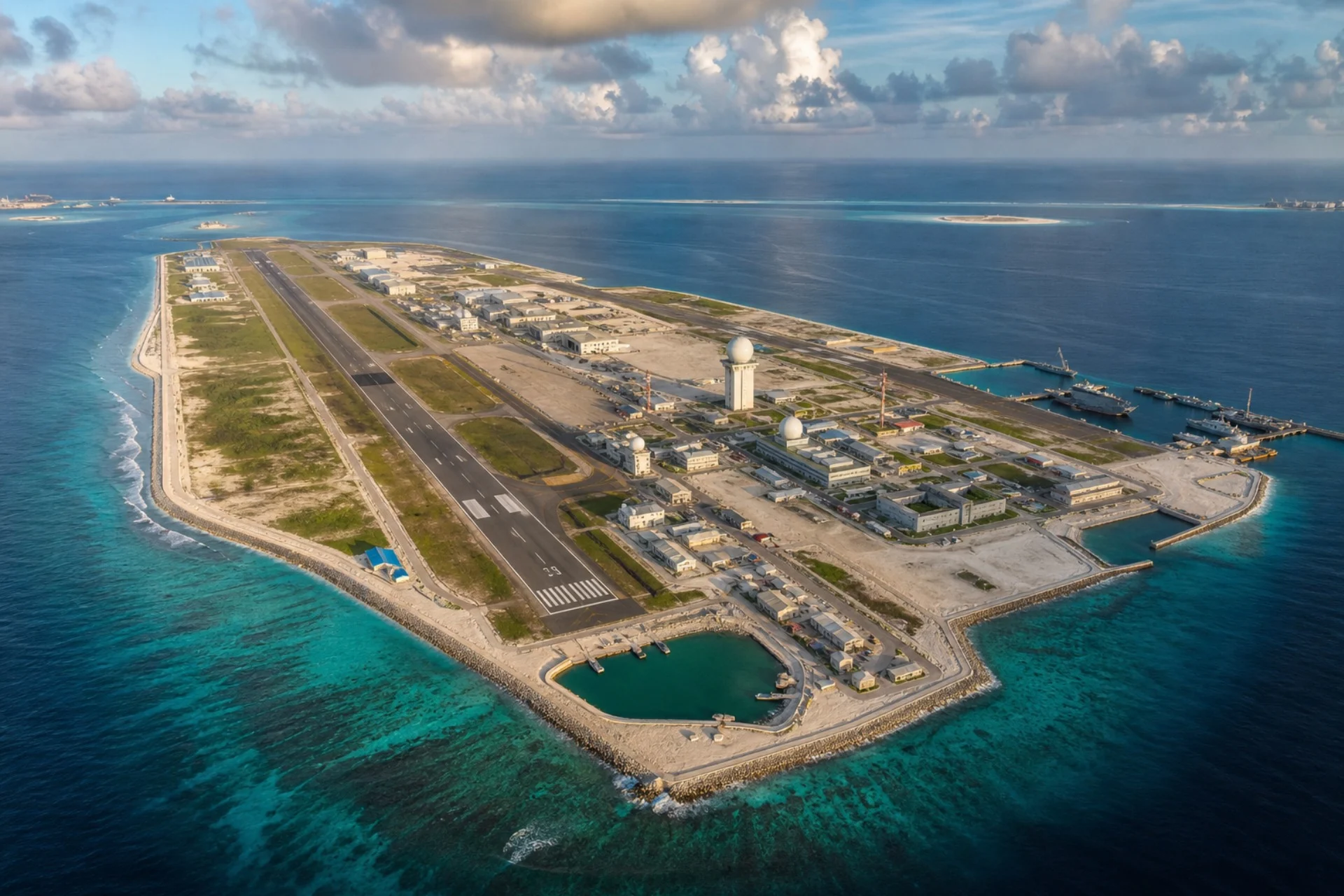
Satellite images document much more than just backfills. On three of the seven transformed reefs in the Spratleys (Mischief, Fiery Cross and Subi), Beijing has built leading military facilities. These three major islands form a triangle of strategic positioning against American bases in the Philippines. One of them even has a port whose body of water exceeds the area of Pearl Harbor in Hawaii.
Other satellite analyses conducted from 2023 to 2024 by the AMTI reveal the installation of new equipment probably intended for SRI (Intelligence, Surveillance, Reconnaissance) systems deployed on vehicles. On Subi Reef, two new radomes have been placed, almost identical to those built on Fiery Cross Reef and Mischief Reef since 2017. These facilities can thus offer wide radar coverage over the entire South China Sea.
International law in check
Faced with this expansion, international law tried to make itself heard. In July 2016, the Permanent Court of Arbitration in The Hague, seized by the Philippines, issued a massively favorable decision to Manila, declaring that China had violated the sovereign rights of the Philippines and caused serious damage to the coral environment through its backfill activities.
Beijing refused to participate in the procedure and immediately described the decision as « void and void ». In July 2025, for the ninth anniversary of the verdict, The Diplomat reports that the spokesman for the Chinese Ministry of Foreign Affairs once again described the sentence as « simple piece of illegal, null and non-binding paper ». In the absence of a real mechanism for the application of the sentence, it simply remains ignored.
The marine ecosystem sacrificed
Behind geopolitical conflicts, a silent catastrophe is emerging. Also according to the AMTI, at least 1,800 hectares of coral reefs have been destroyed by Chinese island-building activities, while an additional 6,500 hectares have been damaged in the region by giant gus fishing by Chinese fishermen. The giant cat, a protected species, has become a very popular resource because of its resemblance to elephant ivory, whose trade is prohibited.
A significant part of the reefs of the Spratleys archipelago have been damaged by the work, and the impacts unfortunately exceed the areas directly concerned. Researchers point out that these reefs, as well as those of the Paracels, play an important role as nurseries for many marine species. Their deterioration could then affect in the long term the fishing resources on which a large part of the population of the region depends.
A regional competition that worsens the situation
China is not the only one to claim these marine lands. Vietnam, Malaysia, the Philippines and Taiwan have also conducted dredging operations, so far using methods that are less harmful to the marine ecosystem. However, Vietnam has recently begun using disaggregator vacuum dredgers, the most destructive technique, so far mainly used by China. A kind of outbidding dynamic has taken place: each territorial claim fuels the following, and international law observes without being able to intervene in a concrete way.
source : journal du geek