
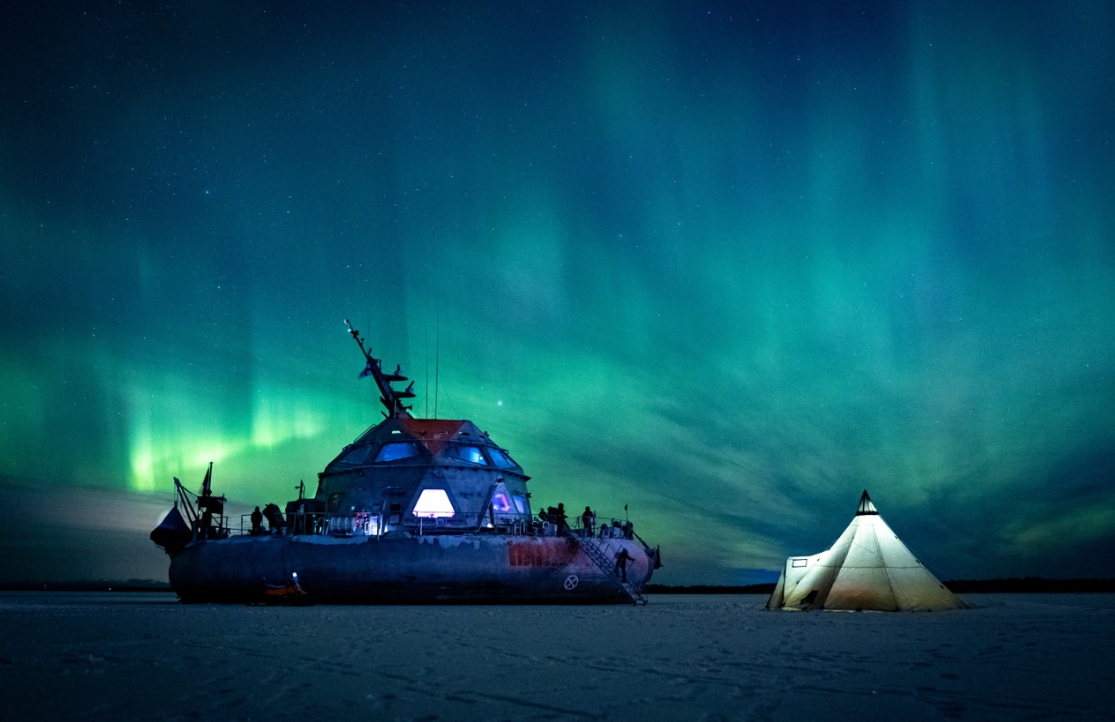
Six scientists and six crew members will go next month to Kirkenes, an isolated Arctic city in Norway near the Russian border, to begin an odyssey to one of the most inhospitable, inaccessible and least studied regions on the planet. There, they will board a futuristic floating laboratory – the Tara polar station, built in France.
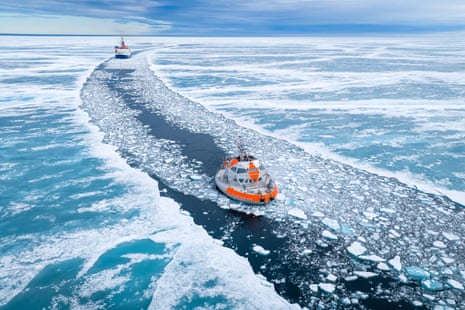
They enter a harsh and insulating environment: months of total darkness and temperatures up to -50°C (-58°F). Arriving in Norway on August 14, they will wait for good conditions and an icebreaker to open a road for them before leaving for an eight-month journey, wintering for long intense polar nights aboard a 26-meter-long by-meter-wide ship, designed to be frozen in the pack ice, which will drift slowly over the North Pole to Greenland.
Their mission is to collect data on the impact of climate collapse and pollution on the unique, complex and largely unknown ecosystems of the Central Arctic Ocean, one of the most fragile in the world, before they change forever.
« We lose species before we even have time to discover them, » says Romain Troublé, a microbiologist who became a sailor and executive director of the Tara Ocean Foundation, a French philanthropic organization. « So we’re here to document all this. In the next 20 years, everything will change. » Romain Troublé with his reward on board the polar station of Tara.Photograph: Martin Hartley
For his work on the development of the polar station, Troublé received the prestigious Shackleton medal this week.
In 2023, Nature magazine described him, as well as Étienne Bourgois, co-founder of the Tara Ocean Foundation, as « visionary thinkers ». An editorial compared the continuous two-year expedition of the first ship Tara, a squegee that crossed the coral reefs of the Pacific Ocean and generated research that helped develop theories on reef formation and biodiversity, to expeditions such as that of Charles Darwin aboard the HMS Beagle in 1831-36.
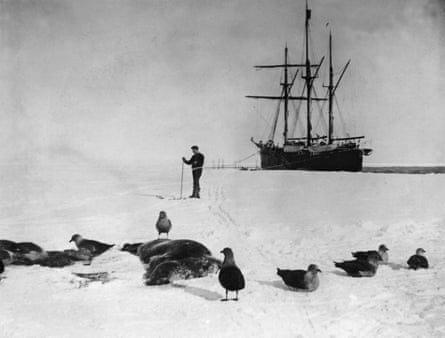
An earlier version of the Tara gonet traveled to the Arctic in 2006 to perform a transpolar drift, only the second such expedition in the central Arctic since Norwegian explorer Fridtjof Nansen carried out the first one aboard his ship, the Fram, in 1893-96.
« We decided to start over in the future, with more funding, with more resources, » says Troublé, nephew of Agnès Troublé, co-founder of the Tara Ocean Foundation and better known as fashion designer Agnès b. « We know the depth, the physics of the Arctic quite well. But we have no idea about life, about the biological aspect. It’s a blank sheet to discover. «
The design of the station was carried out by Agnès Troublé and Bourgois, while Troublé raised the 26 million euros (22 million pounds) necessary and organized the mission. This has posed several challenges, he says, including how scientists from 15 countries are brought together and the « human challenge » for the staff on board.
Scientists and crew will be very isolated and, although they can be rescued in an emergency, it may take a week to reach them. This will be the first step in a continuous expedition planned over 10 stages and 20 years, aimed at bringing about policy changes protecting the Arctic.
Double, I have never known the polar night. My biggest fear is darkness… [but] how often do you have the opportunity to do this kind of thing?
DR. NINA SCHUBACK
It is a race against time: the Arctic is warming three to four times faster than anywhere else on the planet and the ice that once protected the region is melting rapidly, exposing the sea to the threats of navigation, fishing, mining and pollution.
Dr. Nina Schuback, a biological oceanographer who will take leave from the Swiss Polar Institute to join the expedition, says: « We know that the Central Arctic Ocean is changing very, very quickly. We can see the conditions of the ice change, thanks to satellite data, but if you want to talk about the effect it has on biology, it is very difficult to get data. «
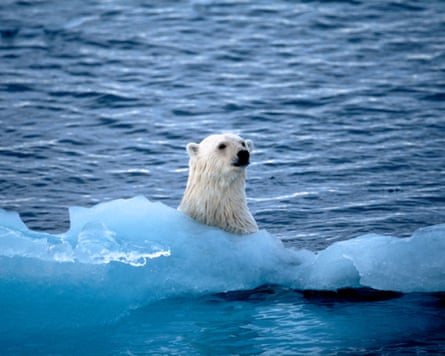
The Arctic Ocean and sea ice support an interconnected network of life, ranging from polar bears, walruses and belugas, to microbes such as ice algae, which form the basis of the food chain.
Schuback and his colleagues will take samples of microbes from seawater, via the station’s « lunar well », a central opening that will also serve as a starting point for divers, underwater drones and remote-controlled ships to descend into the icy depths. They hope to discover new species that have adapted to this unique region where, for almost half the year, the sun does not rise.
Schuback, who has undergone a rigorous selection process that a scientist compared to the evaluation for the International Space Station, admits to being both « excited and scared » at the idea of going through a polar winter.
« I have never known the polar night. My biggest fear is the dark. We get tired, » she says, adding: « And I exercise a lot, but it will be difficult on such a small platform.
« But time will pass very quickly. There is exciting science – and how often do you get the opportunity to do that kind of thing? I feel very privileged. «