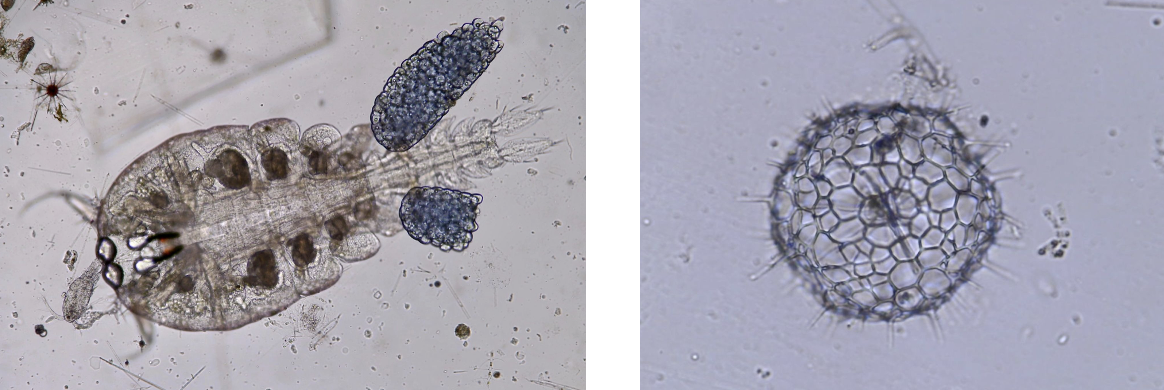
Almost three years ago, we embarked for a year aboard ships of the National Navy to participate in the launch of this mission. This first year aimed to study the still little explored planktonic ecosystems in the southwestern Indian Ocean. From the coasts of Kenya to the French Southern Lands, via Madagascar, we sampled a wide variety of environments, from coastal areas to the open ocean.
Now doctoral students, we continue our research on the study of plankton. Manon is interested in planktonic symbioses and relies in particular on genomic data collected since the beginning of the Bougainville mission.
In this article, we will first present the interest of metabarcoding approaches for the study of planktonic diversity, before exposing the first scientific descriptions from the data collected by the Bougainville mission.
DNA and molecular clock
In the early 1950s, James Watson and Francis Crick described the three-dimensional double-helix structure of DNA. They rely in particular on the work of Rosalind Franklin. This founding discovery paved the way for a new scale of living studies, which was followed by continuous advances over the following decades.
In 1977, Carl Woese discovered that part of the genome acts as a « molecular clock ». Present in all organisms of the same large group (for example bacteria) and evolving relatively slowly, this gene preserves the trace of the evolutionary history of species. This discovery allows Woese to reveal the existence of a third major domain of life: the archaea. Until that time, biologists took it for granted that all life on Earth belonged to one of two major lineages: eukaryotes (which include animals, plants, fungi and some unicellular organisms such as paramecia) and prokaryotes (which include all other microscopic organisms). Woese discovers that there are actually three major lineages among living beings.
This molecular clock concept is fundamental. By comparing the sequences of this gene between organisms, it becomes possible to trace their kinship ties and to position them on the tree of life. This discovery is one of the foundations of modern microbiology.
Metabarcoding and planktonic diversity
These DNA fragments also make it possible to identify the organisms from which they come: we then speak of « molecular barcodes » (barcodes in laboratory French). It is enough to collect the DNA present in the environment, target these short sequences and compare them with reference databases to get an overview of the biological diversity present.
This is called metabarcoding. The prefix “meta” is added to barcoding (identification of species thanks to a short standardized DNA sequence) because this technique is applied not to a single organism, but to a mixture of organisms or environmental DNA contained in a sample (in this case for the Bougainville mission of filtered seawater).
The use of these barcodes has profoundly transformed our vision of the microbial world. In fact, less than 1% of microorganisms can be grown in the laboratory. The direct analysis of environmental DNA has therefore provided access to a huge biodiversity that was previously invisible. In the marine environment, the Tara Oceans campaign revealed that about 30% of the observed eukaryotic diversity was not associated with any known organism. In other words, a considerable part of marine biodiversity remains to be discovered. Programs such as the Bougainville mission are essential to better understand this still largely unexplored diversity.
JEDI, a barcode for the tree of life
However, metabarcoding faces several technical challenges, related to the choice of molecular barcodes used. The number of copies of the gene in each cell, the length of the sequence analyzed or the ability to distinguish nearby species strongly influence the results obtained.
In recent years, several reference barcodes have emerged. Each has advantages, but until recently none allowed to cover all living things, from bacteria to animals. The analyses therefore require the use of different markers according to the groups studied.
Recent work has led to the development of the JEDI (Joint cellular life-Encompassing DIversity) barcode, designed to characterize the entire spectrum of life. It is this marker that we use in the Bougainville mission to explore the entire spectrum of biological diversity present in the samples collected.