

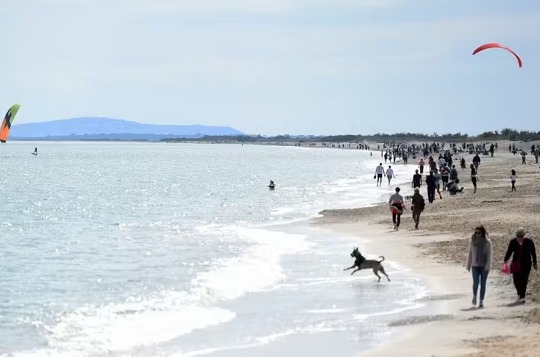
This is a new testimony to the extent of PFAS pollution: bathing waters are massively contaminated by eternal pollutants. And the coast is not spared. These are the surprising and worrying results of a study, published on Friday, July 3 by the Surfrider Foundation Europe association with the Eurofins laboratory, which Le Monde was able to consult before its publication. Until now, no large-scale study had documented in France the pollution of bathing waters by PFAS (per- and polyfluoroalkylated substances, also called « eternal pollutants » because of their persistence in the environment).
Oceans, sea, lakes, rivers: between June and July 2025, 80 volunteers from the NGO took samples from 107 bathing sites (80 coastal beaches and 27 freshwater). The analysis was entrusted to the Eurofins laboratory, which was already responsible for reference studies on the presence of PFAS in drinking water or rainwater. Eternal pollutants were found in all samples. In total, 23 different PFAS were quantified.
A molecule is distinguished by its omnipresence, trifluoroacetic acid (TFA). The European Chemicals Agency has just confirmed its danger by classifying it as « suspected toxic to reproduction ». Resulting mainly from the degradation of fluorinated refrigerant gases and certain pesticides, this ultra-short-chain molecule was found in all samples and at concentrations that surprised Eurofins experts. Average TFA levels reach 1,728 nanograms per liter (ng/l) for freshwater sites and 356.5 ng/l for marine sites.
« These results are confusing. Even the sea is not a sanctuary, comments Coralie Sassolat, CEO of Eurofins Hydrologie France laboratories. We expected to find PFAS sporadically but not almost systematically, let alone at such concentrations. Three hundred and fifty-six nanograms per liter on average for TFA in the sea is very high, given the dilution effect of large bodies of water. For Eurofins experts, additional investigations are now required to determine whether the concentrations identified are at risk to the environment or human health.
Swimming prohibited
« In terms of the risk posed by TFA alone to swimmers, these levels are a minor exposure to the chips or sandwiches they eat on the beach, » comments Hans Peter Arp, an environmental chemist at the Norwegian University of Science and Technology and internationally recognized expert on eternal pollutants. PFAS can accumulate on the surface of the ocean, in foam and spray, especially the most toxic ones such as PFOA and PFOS. I am sure that if we had measured the concentration in the spray, it would have been even higher, and this is what bathers inhale while swimming and lying on the beach. «
Behind the TFA, the two most found PFAS are precisely the PFOA (92.6% of freshwater sites and 71% of coastal sites) and the PFOS (92.6% of freshwater sites and 61.7% of coastal sites). In the current state of scientific knowledge, PFOA and PFOS are considered the most health-risk PFAS: the two molecules were classified as « carcinogenic for humans » and « possible carcinogen » by the International Agency for Research on Cancer in 2023.
Today, the European regulations on the quality of bathing waters do not take chemical pollution into account. Only bacteriological parameters (Escherichia coli and intestinal enterococi) are subject to surveillance to authorize or not bathing, as is the case for example for sites that must reopen from July 4 on the banks of the Seine in Paris. Surfrider has been calling for several years for regulatory reform to include the monitoring of toxic chemicals such as PFAS.
One country has already done it, the Netherlands, one of the most at the forefront in the management of the crisis of eternal pollutants. The Dutch National Institute of Public Health and the Environment has set a health threshold (280 ng/l) for PFAS in surface waters beyond which bathing is prohibited. It was calculated from the sum of 26 PFAS, including TFA, weighted according to their toxicity compared to a reference molecule, PFOA. A French bathing site tested by Surfrider far exceeds this threshold: the nautical and leisure base of Bédanne, on the Seine, south of Rouen, with a sample measured at 450 ng/l applying the method of the Dutch institute.
Exceeding the threshold
Today, PFAS are only taken into account in the environmental quality standards of the Water Framework Directive to measure the chemical status of surface and groundwater. Since May 11, they apply to 25 PFAS, including the TFA. When Surfrider and Eurofins performed their analyses, they concerned a single molecule, PFOS. Two thresholds were set by the legislator: 0.65 ng/l for continental waters and 0.13 ng/l for seawater.
About 78% of the continental sites and 44% of the coastal sites sampled by the NGO exceed these reference values and can therefore be considered in « poor chemical condition ». And sometimes in significant proportions. Thus the very busy beach of Bordeaux Lac – where the water quality is considered « excellent », according to the European bathing water directive -, with a sample measured with a PFOS concentration of 26 ng/l, 40 times higher than the environmental standard. Lake Bordeaux is also the site where the largest number of different PFAS have been quantified: 19.
PFOS levels also exceed the environmental quality threshold on bathing sites opened in 2025 on the Seine (3.3 ng/l in Bras-Marie, Paris) and on the Marne (2.3 ng/l at Joinville-le-Pont beach, in the Val-de-Marne). A total of 14 and 15 PFAS were quantified on these two sites. On the coast, the record goes to Courant beach, in Mimizan (Landes), with 4.10 ng/l quantified, ahead of that of Jaï Nord, in Marignane (Bouches-du-Rhône), with 2.7 ng/l, and Villeneuve-lès-Maguelone (Hérault), with 1.80 ng/l. These three coastal beaches also accumulate the largest number of quantified molecules (12, 12 and 11).
« In view of these alarming results, and beyond the threat to ecosystems, it is legitimate to question the risks involved when we swim or surf, » comments Lucille Labayle, in charge of water quality at Surfrider. The health of the ocean and [that] of its users should no longer be the blind spots of PFAS pollution. On the basis of its report, the NGO makes several requests to the European Commission. It first invites it to adopt, before the end of 2026, the project to restrict the universal PFAS, carried in particular by the Netherlands and Denmark and endorsed by the European Chemicals Agency, in order to « stop pollution at the source ».
The association then calls on the European Union to establish chemical quality standards for bathing water incorporating PFAS and to strengthen surveillance networks, especially in the marine environment, in order to be able to identify sources of pollution and implement the polluter-pays principle to clean up contaminated sites.