

As we more away from the coasts, the seabed is deeper and deeper. Beyond 200 to 300m, the deep ocean domain then opens. However, many animals live in this environment without light and without plants. Ifremer studies the biodiversity of these deep lands and the animal species that, to live there, have developed original life strategies.
What is at the bottom of the ocean?
The seabed near the coast forms what is called the continental shelf. This one is a few kilometers to a few hundred kilometers wide. When you move away again, the bottom descends abruptly: it is the « continental slope », often crossed by many underwater canyons. Then from 2,000 to 4,000 meters depending on the region, we arrive in the deep seabed. They include various landscapes: abyssal plains, underwater pits, ocean ridges, underwater mountains…
The sunlight does not reach these depths. And without light, no plants or algae. However, on continents and in shallow waters, plants are the basis of all food chains, because they produce matter from the light energy of the sun. The animals of the deep sea have therefore developed original strategies to live. Some feed on the matter produced on the surface by phytoplankton and which reaches the bottom (in very small quantities). Others, especially near hydrothermal sources or cold fluid sources, benefit from organic matter produced by bacteria, from chemical elements (see below). Food chains develop from these different sources of primary production, with carnivores, necrophages, suspensivores…
What is the impact of human activities?
If the coastline is strongly impacted by human activities, all parts of the ocean are also impacted by pollution, especially chemical and plastic. Some, even far from the coasts, undergo activities such as fishing (for example on isolated reliefs such as underwater mountains) or the exploitation of marine aggregates, or would risk being affected in the event of extraction of mineral resources (nodules rich in metals in abyssal plains, clusters of sulfides from hydrothermal sources, crusts on underwater mountains…).
The study of marine biodiversity and understanding the functioning of ecosystems are therefore essential to assess the impact of a possible exploitation of these resources, and to assess the resilience capacities of ecosystems.
How are deep-sea ecosystems studied?
Knowledge about deep ecosystems is still limited, mainly because of the difficulty of accessing these great depths. To observe these environments, Ifremer scientists map the funds to identify areas of interest and then use manned submarines, cable-connected robots or seabed observatories. They take photos, videos, take measurements in the environment or take organisms, sediment, rocks. Unlike terrestrial or coastal ecosystems, in the deep sea it is difficult to directly observe, to grasp species in their natural environment. Researchers also work a lot from images!
Scientific tools for deep seabed exploration
- Multi-beam sounders installed on ships for regional mapping or installed on robots for retail mapping.
- The Nautile. It is the only manned submarine of the French Oceanographic Fleet. And one of the few in the world to be able to go down to 6,000 meters deep.
- Victor 6000 and Ariane. These robots are controlled remotely, via a cable that connects them to a scientific ship.
- Underwater observatories. Similar to space stations, they are installed on the background, and record environmental conditions and various biological parameters. Researchers come on average once a year to retrieve photo and video data, change batteries and recondition sensors.
How does Ifremer study the biodiversity of these deep seas?
Due to the difficulty of access to these depths, many questions remain about these ecosystems and their biodiversity. Ifremer studies the presence of different populations of marine animals and their distribution on the seabed. Indeed, large areas of the seabed remain unexplored. Scientists are campaigning to explore new areas, identify species, and map their presence. Scientists are also interested in the biology of these animals: how do they withstand these very cold or very high temperatures? What do they eat? How do they reproduce? Researchers are also trying to understand how ecosystems work: who eats who? Who houses who? Who depends on whom to live? How do these ecosystems vary over time? How do species adapt to changes in their environment? How do they disperse?
Focus on 5 landmark ecosystems
In underwater canyons, cold water corals
While tropical water corals are well known to the public, their cold water cousins are less so. However, they are present everywhere in the seas and oceans, in waters ranging from 0°C to 15°C. Some are yellow, red or pink, but most are white or black!
Scientists are particularly interested in corals located in the underwater canyons of the Mediterranean and the Bay of Biscay (Atlantic).
I study the behavior of coral polyps: the rhythm at which they enter and exit, and I try to see if there is a link with the amount of suspended matter, with the surrounding fishing activity, or with the presence of other animals nearby.Julie Tourolle
The bottoms of the underwater canyons are not traveled by fishing trawls. However, trawling on their flanks puts the sediments back in suspension: this can suffocate the corals in the surrounding areas. Also, since 2017 bottom trawling has been prohibited below 800 meters in the Atlantic, and since 2022 below 400m in coral reef areas. In the Mediterranean, it has been prohibited below 1,000 meters since 2016.
In addition to the countryside at sea and an observatory installed in 2021, Lenaïck Menot and Julie Tourolle are conducting experiments in pressurized aquariums at the Océanopolis ocean discovery center in Brest. For example, they want to know the effects on corals of a rise in temperature and water acidification, in order to assess their resilience to climate change.
Who lives in the abyssal plains?
When you leave the plateau and the continental slope, the abyssal plain extends over thousands of kilometers. The water is between 0 and 4°C; the bottoms are often loose. Organisms are less numerous than near the coasts, but a great diversity of species live on the bottom or buried in the sediments: crustaceans, echinoderms, marine wrorms and sometimes bivalve shells. With each new oceanographic campaign, scientists discover still unknown species.
In the abyssal plains, diversity can be high. This is surprising in this stable environment, with few resources and few ecological niches.Lénaïck MenotIfremer | Marine biologist
The underwater mountains
The underwater mountains are found in the abyssal plains, because of their relief they are crossed by strong currents that carry the sediments: the rock is often bared. Species live there: corals, gorgons, sponges, etc. They feed on particles suspended in water or organisms migrating between the surface and the bottom, such as small crustaceans. The hard substrate and fixed animals form habitats for a lush diversity: fish, crustaceans, echinoderms. Cetaceans (whales, dolphins…) are also regular visitors to the summits of these underwater mountains probably because of the abundance of food.
With a few exceptions, the study of underwater mountains and their biodiversity is very recent, it began in the 2000s. The scientific community still knows little, especially since the species communities that live on the sides of the mountain change according to the depth gradient and the orientation of the flank. At the top, some mountains may even be close enough to the surface to receive light. They are then places rich in fish… and coveted for fishing!
From one underwater mountain to another, there are no similar species communities, even 100 kilometers apart.Karine OluIfremer | Deep Ecosystem Specialist Ecologist
Hydrothermal springs
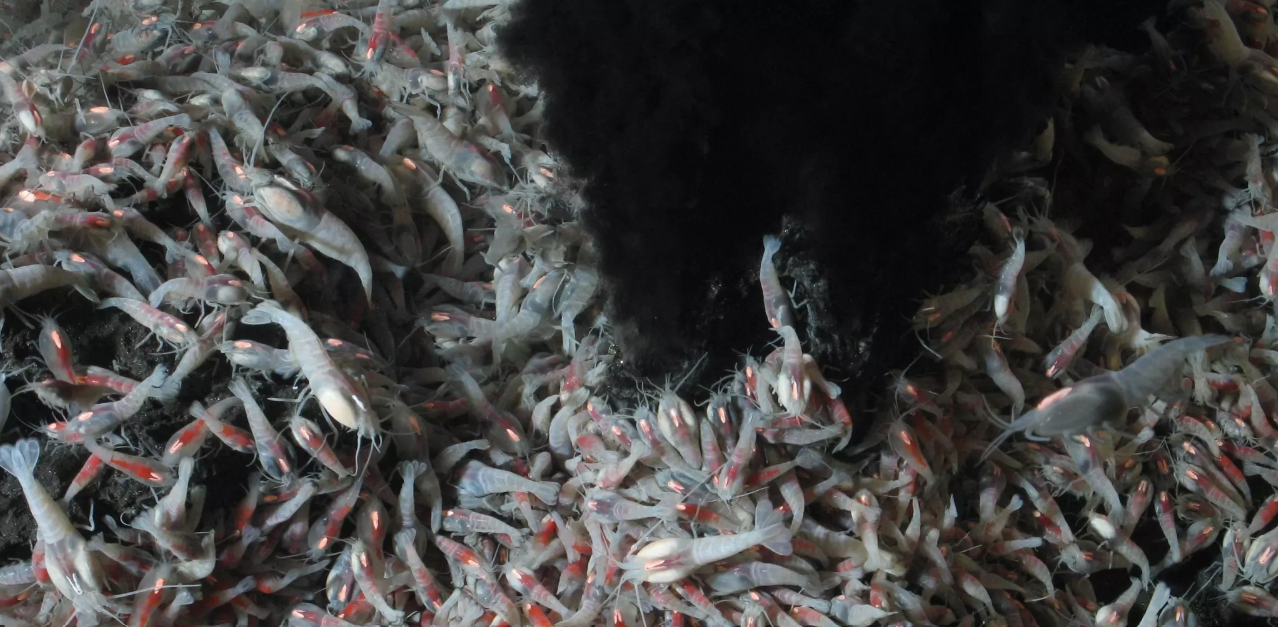
They are real underwater geysers! They are located along the oceanic ridges and near some underwater volcanoes. In these places, the seabed is fractured: seawater can penetrate deep. In contact with magma, water heats up and is loaded with gases and other chemical compounds such as methane, hydrogen, sulfide and heavy metals. The water rises to the surface and gushes into very hot geysers (sometimes up to 400°C) called black smokers. Today, more than 600 active hydrothermal fields are identified worldwide, but only a few are studied in detail, such as the one that houses the EMSO Azores Observatory.
The surroundings of these hydrothermal springs are environments considered toxic and far too hot for most living beings. Yet lush animal communities live there! Microorganisms have developed a lifestyle based on chemosynthesis and withstand heat up to about 120°C. They are the basis of the food chains of these ecosystems: other animals consume them, or shelter them within their bodies. These animals are therefore fascinating from a scientific point of view for their ability to adapt.
At Ifremer, scientists are also interested in the genetics and reproduction of these deep-sear organisms: indeed, the same species can be found on sites that are several hundred or thousands of kilometers away, separated by a cold abyssal plain. Conversely, some species are only present under very specific conditions (depending on the temperature, the composition of the fluids), so only the species of the sites studied are known; new sites could give rise to the discovery of new species.
Chemosynthesis, to live without sun
The majority of life on earth depends on photosynthesis: a process developed by plants and algae, which is based on the light energy of the sun to produce matter. But the discovery of hydrothermal springs in 1977 revealed another process: chemosynthesis. Near hydrothermal springs, microorganisms are able to use fluid compounds (methane, sulfur…) to create organic matter.
Cold oops
This is the name called areas where gases and hydrocarbons (oil, methane, etc.) can escape from the seabed and rise into the water. They are usually located where a tectonic plate passes under another plate. The fluids emitted are not hotter than the surrounding seawater, even if they can reach 40°C below the surface of the bottom, which earns them the name « cold », as opposed to hydrothermal springs which are extremely hot. Rich communities of organizations settle around these outflings. As in hydrothermal springs, ecosystems are based on microorganisms that produce matter by transforming energy by chemosynthesis. This material is transferred to other animals by symbiosis or as a source of external food.