By wanting to control the sea passage, the United States and Iran have reduced traffic in the Strait of Hormuz to nothing, or almost. The corridor, through which 20% of the world’s hydrocarbons transited, as well as all the goods imported into the Gulf before the war in Iran, is now just an arm of the sea with turquoise waters deserted by ships.
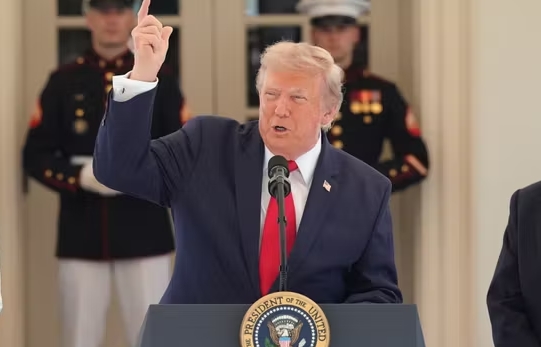
Donald Trump announced on Monday, July 13, the restoration of the naval blockade of Iranian ports and the introduction of a 20% tax on « the value of all cargo transported » on sea freight passing through the strait to « cover all the costs necessary to carry out the mission to ensure the safety and security of this region of the world », without giving more details on the modus operandi. In the wake, the American military command in charge of the Middle East specified, in a statement, that the blockade would be effective from Tuesday, 10 p.m., Paris time.
According to data from the specialized website Marine Traffic, traffic decreased by 52% from Friday 10 to Sunday 12 July, shortly after the resumption of hostilities between Iran and the United States, which ended their ceasefire signed in early April. Even if five or six ships continue to use the Strait on the Omani side daily by turning off their transponders, so as not to be spotted by the Revolutionary Guards, they are much less numerous than before the war in Iran, where there were an average of 120. On Sunday, only 14 ships, half of which were commercial ships, crossed the strait, according to data from maritime tracking company Kpler.
« Sey freedom of navigation »
On the night of Saturday to Sunday, Tehran announced the closure of the strait after attacking four ships near the Oman coast in a week, while declaring this corridor « illegal ». « Ormuz is more important than dozens of nuclear bombs and the Islamic Republic of Iran will protect it, » Supreme Leader’s military adviser Mohsen Rezaï said this weekend. A « protection » that actually equates to a control of the strait by Tehran. The Iranian regime only allows a navigation corridor along its coasts.
Donald Trump, who until now defended the opening of the strait, frams his speech on that of Iran, announcing control by the United States, as well as the establishment of a maritime toll. Statements contrary to the principle of freedom of navigation which was so far respected by all States. The International Maritime Organization, the UN agency for maritime affairs, meeting in London from July 6 to 10, reaffirmed in a resolution that « the right of passage in transit through the straits used for international navigation should not be threatened, hindered, prevented, restricted, compromised or suspended ». « Freedom of navigation must be respected, » recalled European Commission Vice-President Kaja Kallas on Monday.
Since the beginning of the conflict, bypass routes have been put in place to reduce dependence on the Strait of Hormuz. Saudi Arabia and the United Arab Emirates have significantly increased their exports of black gold via pipelines, Red Sea ports and even tankers. But the volumes sold are far from reaching the 20 million barrels per day that used the strait before the start of the war in the Middle East, and this does not concern either gas or refined products.
According to the economic daily Financial Times, the logistics giant DP World, controlled by the government of the United Arab Emirates, plans to invest hundreds of millions of euros in port infrastructure on its coast of the Gulf of Oman, in order to reduce its dependence on the strait. Container traffic has been diverted via land corridors that pass through Syria, Iraq, Turkey, or Saudi Red Sea ports.
However, access to the Red Sea and the Suez Canal through the Bab Al-Mandeb Strait is increasingly fragile. It is controlled by the Houthi rebels in Yemen, supported by Iran. However, the Yemeni government, supported by Saudi Arabia, said on Monday that it had hit the airport of the capital Sanaa located on their territory, rekindling tensions, after years of respite. The Houthis have promised to fight back. They could carry out attacks and disrupt ship crossings on the strait as in December 2023, which would have regional and global repercussions on maritime traffic.