Shipping companies are on the lookout for the long-awaited privatization of the Kenyan port against a backdrop of strong regional growth and the growing role of African ports in global trade. The main gateway to a gigantic hinterland, Mombasa is also characterized by the saturation of its infrastructure.
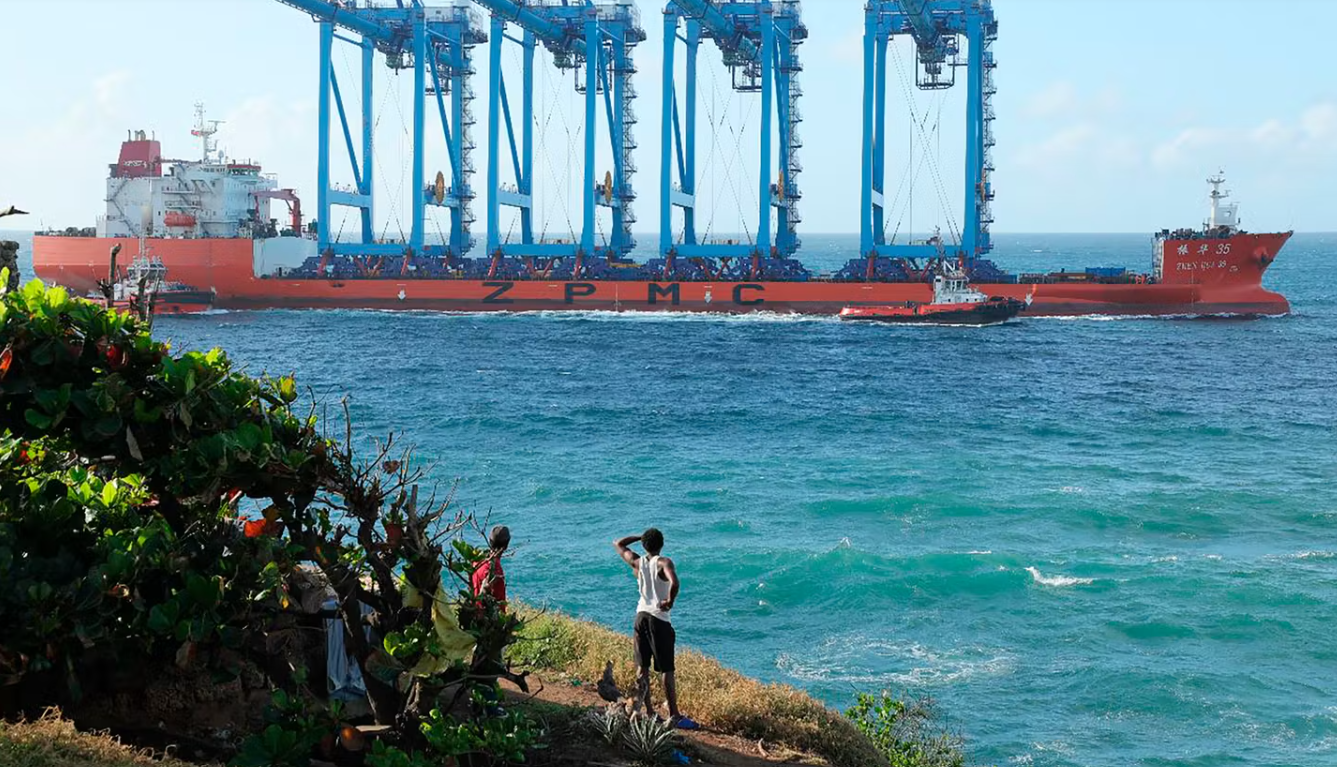
It is a forest of metal and concrete that arouses immense interest, just a few kilometers from beaches planted with coconut palms, facing the Indian Ocean. At the Kenyan port of Mombasa, all operations at the two container terminals, from the piloting of heavy ships to the management of unloading areas and gantry cranes at cathedral heights, are managed by the Kenya Ports Authority (KPA), a state-owned company.
This situation has become rare in Africa, where most of the major port infrastructures are now conceded to private groups. So, in Mombasa, all the major port operators are « on the starting line », admits a source – the people whose names are not given requested anonymity – of this particularly competitive industry, agreeing to the term « battle ».
Kenya’s main port is a thousand-year-old trading post, long under Omani influence, where centuries ago ivory, spices and even slaves were traded. But the dhows, traditional wooden boats, have largely given way to unsinkable container ships several hundred metres long. Their colourful boxes – yellow for the Italian-Swiss MSC, white for the Danish Maersk, blue for the French CMA CGM, the three world leaders – spill over into the old town, crisscrossing the streets on trailers, piling up in storage sites, and sometimes even being converted into shops. The port is a cornerstone of Mombasa, but its potential is now taking a major turn, like the other major hubs on the continent.
Mombasa / KENYA
Port
Connection→ Origin
Jebel Ali
Singapore
Salalah
Fujairah
Dar Es Salaam
Destination
→ Dar Es Salaam Salalah
Durban
Singapore
Mogadishu
Ship
Types Container Ships 40%· Bulk carriers 19%
Sectors of activity
Plant Minerals
Agri-food
Annual traffic, calls 1,714
Worldwide, container 50–100
Sources: IMF PortWatch (2025) · World Shipping Council (2024)First,
there is the market, which is growing strongly today, but is expected to skyrocket tomorrow. We are still a long way from Europe-Asia volumes, but some Asia-Africa routes are already growing by around 20% per year, among the highest in the world. Domestic consumption, which is growing stubbornly, is far from being satisfied by low industrialization, boosting import needs.
Kenya is representative of this: the economic powerhouse of East Africa, with a population of 55 million and annual gross domestic product growth of between 4% and 7.5% since 2021, imports manufactured goods and other fuels on a massive scale. But the country exports its black tea, flowers and avocados.
Workers unload a cargo of rice from the « Amira-Sophie-II » in the port of Mombasa, Kenya, July 11, 2025. LABAN WALLOGA/REUTERS
Mombasa is therefore a crucial bottleneck locally, but also, and above all, regionally. Kenya is the main gateway to a gigantic hinterland, including Uganda, Rwanda and as far east as the Democratic Republic of Congo. A densely populated region (nearly 200 million inhabitants), landlocked, which also imports massively, and exports its rich minerals.
Serious inefficiencies
This regional demand has not seemed to dry up despite the recent global crises. The Covid-19 pandemic, then the threat of the Houthis in the Red Sea and, more recently, the closure of the Strait of Hormuz due to the war in the Middle East since the end of February, have strengthened the logistical appeal of major African ports. « Faced with these crises, shipowners are increasingly interested in ‘whitewater territories’, where you can arrive from one side, leave from the other, without constraints, » says Yann Alix, director of Sefacil, a foundation dedicated to port logistics. The expert insists, in this sense, on the advantages of East African stopovers: well located on world routes, but also few in number. Mombasa is currently only in competition with Dar es Salaam, in Tanzania, to a lesser extent Djibouti or, much further south, Maputo.
Secondly, there is the saturation of the infrastructure. This is a challenge that is known in developing countries where installations are constantly chasing growth. In Mombasa, the volume handled by the two container terminals was already close to the maximum capacity of 2.2 million 20-foot equivalent units (TEUs, the reference unit for containerized transport) in 2025, according to official figures.
In addition, despite investments in recent years, particularly in the digitisation of systems, the port is marked by serious inefficiencies. The World Bank’s 2025 annual report on the efficiency of the world’s 400 largest container ports – the Container Port Performance Index – although sometimes criticized in the sector, is eloquent in this respect: Mombasa is ranked 396th.
Even within the continent, it does not really shine: « In Africa, mature terminals reach about 25 CMPH [container moves per hour, a key performance indicator]. In Mombasa, it’s 15 CMPH at best, » laments a seasoned operator. Others even mention an average of 7 CMPH. Knowing that the most efficient automated terminals, such as in Shanghai, can exceed 40 CMPH.
On the ground, this congestion is reflected at every stage. First of all, upstream of the access channel, about twenty ships are splashing around at sea on June 15, waiting to be able to dock. Once at the dock, there is a list behind the scenes, there are administrative hassles, the availability of equipment, the congestion of the unloading areas. Three times, the Le Monde vehicle was forced to turn back, blocked here by trucks stationary on the tracks, there by a pile of cable reels. Things are not getting any better outside: the access road is congested with dozens of heavy goods vehicles. « At the beginning of the year, it took a week for a truck to enter and leave the port, » says a witness to these delays. In Dubai, it doesn’t even take an hour! »
Between surprise and feeling of déjà vu
However, Kenya is far from being defined by these disabilities. Most of the administrative procedures for citizens are done online. Mobile payment has been established there since 2007 with the pioneering advent of the M-Pesa service, on which an overwhelming part of the gross domestic product passes. Nearly 80% of Kenyans have access to electricity, according to the World Bank, well above the average for sub-Saharan Africa, which is 50%.
In this country that is deeply open to the market, a privatization of Mombasa’s port operations has long been on the table. It was already mentioned during the term of former president Uhuru Kenyatta (2013-2022). His successor, William Ruto, who has embarked on a wave of privatizations, has included the port in a long list of assets to be invested by the private sector (more precisely the second container terminal, and a future third terminal, in deep water, to finally accommodate large ships).
When asked about its priorities, KPA’s management confirmed in a short email that its model is « major ports operated under concessions such as Rotterdam [Netherlands] or Antwerp [Belgium] ». « The Kenyan state is being caught up a bit by history, » says Mr. Alix, of Sefacil, recalling that, as elsewhere on the planet, most African ports were put under concession from the 2000s.
Except that nothing comes. The major European companies and their port operations subsidiaries, but also, it is said, the Emiratis, are waiting. For years. Admittedly, a call for expressions of interest has been circulated recently, but its terms and scope are changing. Lamu, the new port in northern Kenya, would also be in the balance, and finally, no, it is whispered. « That’s the big secret. The authorities are a little confusing in their statements, » says the first source quoted. Shipping company Maersk unloads containers from the vessel « Cabo-Verde », in the port of Mombasa, Kenya, on January 9, 2025. LABAN WALLOGA/REUTERS
A paving stone was thrown into this pond in mid-May. At the opening of the Africa Forward summit co-organized by France and Kenya in Nairobi, a €700 million investment by CMA CGM was announced for Mombasa. Initially mysterious, the contours of this « strategic partnership » have since become clearer. In an interview with Le Monde at the end of June, the French giant of the seas said that it was a question of building and operating the long-awaited future terminal, as well as a land logistics component. A project at the preliminary agreement stage, illustrating CMA CGM’s African offensive.
The sector oscillates between surprise and a feeling of déjà vu. Several times, large-scale projects have been announced in Mombasa without materializing. « Everyone tried, » the first source continues. Everyone has a little document signed by the [Kenyan] authorities in their boxes. Others note that over-the-counter initiatives for strategic assets are often challenged in Kenyan courts, which are known for their stubbornness.
Is the future of Mombasa about to change? On the one hand, the strings of reminder of the status quo are strong. KPA, first of all, is known, as one interlocutor puts it, to be a « state within the state » that has no fundamental interest in change. Kenya, then, is marked by a structural mistrust between Nairobi, far away in the highlands, and the coast, which has its own economic interests, its own barons, described as very influential in the port’s destiny. In addition to these deep dynamics, there is a problem of timing. The country is entering an election year, with a high-stakes presidential election in August 2027. Times are often suspended for major projects.
On the other hand, time is running out. « We are very, very late (…). And the whole country is suffering because the port is suffering, » adds the previously mentioned operator, stressing that at the end of the chain, it is the end consumer who pays the extra cost of this lack of efficiency, and not the maritime operators. « The Kenyans’ observation is, I think, that if they do nothing, they will be overtaken, » says Olivier de Noray, managing director of ports and terminals at Africa Global Logistics (a subsidiary of MSC, formerly Bolloré), for whom Nairobi will end up putting various lots under concession.
It must be said that the competition is sharpening. Dar es Salaam, the other major historically public port, has now entrusted one terminal to the Emirati DP World, the other to the Indian Adani. Its volumes, still far from Mombasa, are increasing. Tanzania is also working on a gigantic project: to build a 20 million TEU deep-water transshipment hub (twice the size of Tangier Med, Morocco, currently the largest in Africa) in Bagamoyo, a fishing village conveniently located between Dar es Salaam and Mombasa.