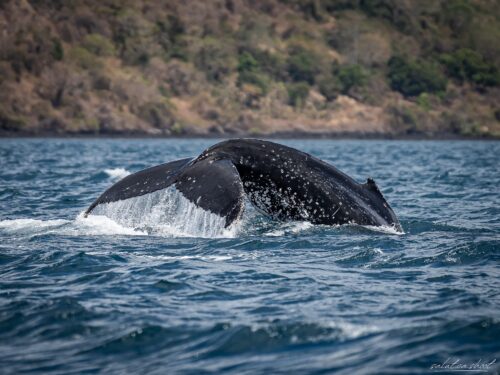
Between July and October, humpback whales make their annual return to the Mayotte lagoon to give birth and breed. On this occasion, the Mayotte Marine Natural Park and the French Office for Biodiversity remind the public of the strict regulations governing approaches to marine mammals.
After spending several months feeding in the cold waters of Antarctica, humpback whales migrate to the warm waters of the Indian Ocean. The Mayotte lagoon provides a vital refuge where females come to give birth and nurse their calves during their first weeks of life. Maintaining a tranquil environment is essential to ensure the adults’ rest and the young’s survival.
The French Office for Biodiversity (OFB) emphasizes that human presence and failure to respect distances considerably increase the stress of animals: whales are thus eight times more likely to flee a ship that approaches below the authorized threshold, and the avoidance rate climbs to 63%.
To regulate whale-watching activities and ensure the tranquility of marine wildlife, the observation of marine mammals is subject to strict national regulations.
In practice, approaching the animals is strictly prohibited within 100 meters, a safety distance roughly equivalent to the length of a football field or two barges. Within this restricted zone, users must remain on board their vessels; launching is strictly forbidden. Furthermore, between 100 and 300 meters from the cetaceans, boaters enter an observation zone where speed is strictly limited to 5 knots and where only two boats are permitted to remain simultaneously.
Finally, maneuvers must be carried out with the utmost care: the approach is made only from the rear three-quarters, never crossing the whales’ path or approaching them head-on. It is also forbidden to pursue the animals if they move away, and if they spontaneously approach the vessel, the captain must immediately disengage the engine and maintain course without attempting to interact with them.
The Marine Natural Park reminds everyone that intentionally disturbing protected species is a violation of the environmental code. Checks will be carried out at sea throughout the season. Those who fail to comply with the rules regarding approach and quiet conditions are subject to fines of up to €750 for individuals and €3,500 for legal entities. The authorities therefore call upon all sea users to act responsibly in order to maintain Mayotte as a prime habitat for marine biodiversity.