
The Mediterranean is undoubtedly, with the China Sea, the sea most affected by the changes in our contemporary world, which take on a special dimension because of its small area. At the crossroads of three rapidly changing continents, the Mediterranean has become more than ever a space of strategic and military but also maritime issues that are the subject of this article. The discovery of large gas deposits in the eastern Mediterranean and the laying of many submarine cables have considerably strengthened the territorialization of this space and aggravated tensions between riparian states. The Mediterranean has also experienced a sharp increase in crime with the expansion of drug and migrant trafficking requiring the establishment, by the states of the north shore, of adapted control tools. The protection of fisheries resources and the marine environment has, on the other hand, been a real space for cooperation and consultation that could inspire new avenues such as those covered by maritime space planning.
The Mediterranean is not spared by the many upheavals that illustrate the challenges of our contemporary world. From Gibraltar to Suez, the Mediterranean is the place of power rivalries, economic and energy appetites and significant commercial traffic like the globalization of our economy. It does not escape demographic pressure, the growth of licit and illicit activities, or the arrival of new technologies. But where other Oceans can show a form of resilience, this space, which represents less than 1% of the world’s seas, has less capacity.
In this space structured by asymmetries between the north and the south banks in terms of development, stability and maritime capacities, riparian states have been able to invent or set up spaces for consultation and cooperation to promote the adoption of common rules. Failing that, the states of the north bank have put in place, in recent years, coordination and control structures designed to face particular threats of destabilization.
Beyond the aspects related to the strategic and military dimension, the examination of the main maritime issues of the Mediterranean is an excellent illustration of the responses that can be provided by coastal states. This « laboratory » side of the Mediterranean deserves to be studied to better understand the nature of the new maritime challenges of our contemporary world and to identify reproducible measures in other maritime areas.
1. The challenges related to the territorialization of Mediterranean maritime areas
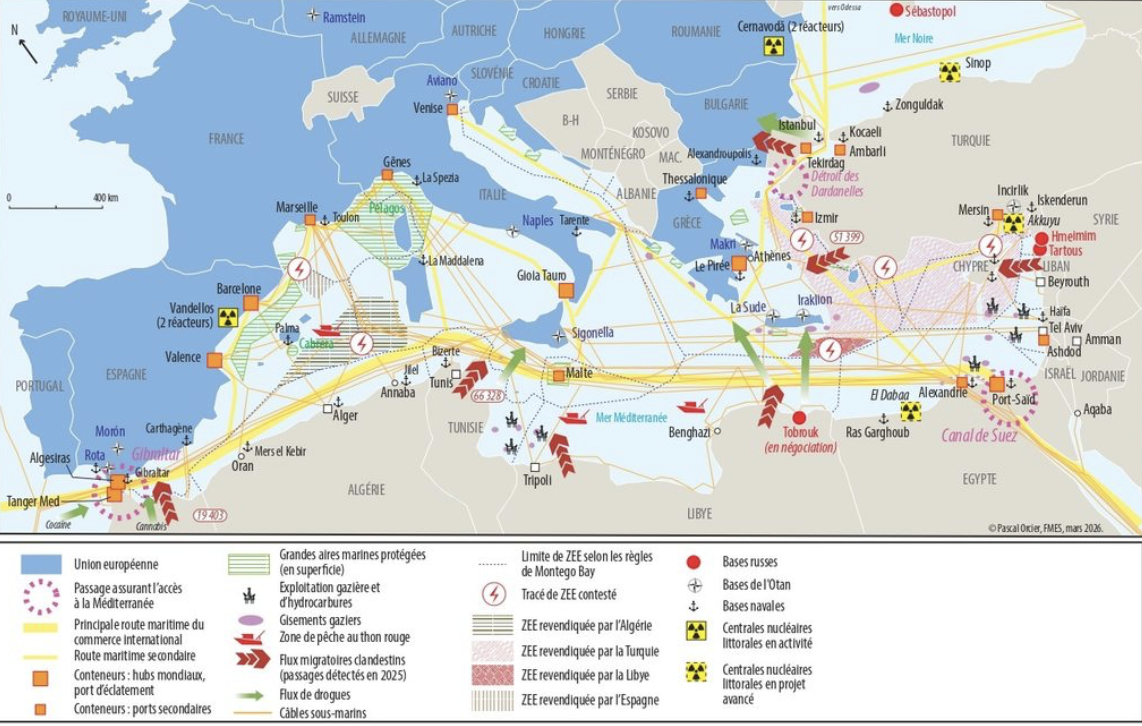
It was in 2009 that gas and hydrocarbon exploration began in the Eastern Mediterranean, the most promising area. The forecasts proved to be justified because, very quickly, large reserves of natural gas were discovered with the fields of Tamar and Leviathan, off Israel, and Aphrodite, off Cyprus. In 2015, the discovery of the huge Zohr gas field (reserves estimated at 850 billion m3) followed by that of Nour, made Egypt, in a short time, a regional gas power.
It was the presence of these gas and oil deposits that put an end to the tacit consensus of the Mediterranean states not to take EEZ into their maritime waters. On February 17, 2004, Cyprus was the first Mediterranean state to break this genlteman by claiming the first EEZ, anticipating new gas discoveries in the Levantine basin. Quickly, other states such as Israel, Egypt and Lebanon, toold it. These delimitations have, in particular, triggered strong tensions with Turkey, which does not recognize the Cypriot and Greek EEZ; claiming rights on the same waters.
Turkey did not hesitate to conduct exploration missions in the waters under the jurisdiction of these two states, causing major diplomatic crises and Greek and European military deployments. To strengthen its position, Turkey signed, on November 27, 2019, a memorandum of understanding (MoU) with Libya on the delimitation of their respective EEZs and continental shelfes. Even if these two states rely on the United Nations Convention on the Law of the Sea, this delimitation ignores not only the maritime delimitations of the Greek islands but also those relating to the EEZ already proclaimed by Cyprus, Greece and Egypt. This Agreement allows Turkey to claim a vast area of the eastern Mediterranean, including the gas blocks explored by Cyprus.
As could therefore be feared, the adoption of EEZ in the Mediterranean has revived many latent conflicts between Mediterranean states. This situation accentuates tensions between states in this area, as is happening in the China Sea.
The Western Mediterranean, even if the stakes are less important for the moment, is not spared by these new conflicts of delimitations at sea. France and Spain have still not been able to agree on the delimitation of their respective EEZs. As for Algeria, by creating a huge EEZ in 2018, it came to encroach on the EEZs claimed by Spain and Italy, creating a new dispute that the Mediterranean would have done well without.
Nevertheless, in this context of strong tensions, small miracles can arise such as a maritime delimitation agreement between two enemy states. This is what happened for Israel and Lebanon, which signed, on October 27, 2022, in Naqoura, on the Lebanese-Israeli border, a historic maritime delimitation agreement. Nevertheless, this unexpected Agreement was only possible thanks to a strong commitment from the United States and France’s major support in the negotiations.
The Mediterranean has also strengthened the territorialization of its spaces with the presence of more than 600 active submarine cables in 2025. A figure in strong growth since only 260 submarine cables were laid in 2014.
Submarine cables are critical infrastructure, vulnerable to sabotage, espionage and geopolitical conflicts. From this point of view, the Mediterranean, with its many zones of tension and straits (Gibraltar, Suez, Bab el-Mandeb[1]), is a particularly sensitive area that is subject to increased surveillance by the riparian powers.
In reality, what is less known is that the most recurrent difficulties come from accidental cuts of underwater cables that are frequent and are related to either human activities or natural or biological phenomena. In a context of ultra-reliance on digital links, the rapid repair of severed cables takes on considerable sensitivity.
The Mediterranean is part of the MECMA (Mediterranean Cable Maintenance Agreement) zone, one of the four major underwater cable maintenance regions in the world. This agreement allows cable operators to request the rapid intervention of a cable ship, as part of a maintenance contract, in the event of a breakdown or damage. The charge of this permanence of means is financed by the cable owners of the area, grouped in a consortium. In the Mediterranean, the cable ships requested are those of the French company Orange Marine that intervene, either from the port of La Seyne-sur-mer (France) or from the port of Catania (Italy).
These zone agreements work well from a technical point of view. The mobilization of resources is rapid, in less than 24 hours. The problem comes from the fact that operators are increasingly facing difficulties in intervention related to the new requirements of some coastal states. Indeed, after having made a declaration of intervention in the maritime space under the jurisdiction of a coastal State, the operator may be imposed abusive delays or conditions on the intervention or find himself in a situation of insecurity in the absence of any response.
Sometimes, the conditions issued by a coastal state are exorbitant of international law which is based on the principle of freedom of laying and repair of submarine cables in the EEZ, on the continental shelf and on the high seas[2].
This situation is quite representative of the increasingly « extensive » interpretation of international law of the sea and the growing difficulty of the international community in enforcing the Treaties. If these restrictions put in place by coastal states can be explained by the growing threat of certain technologies of espionage or sabotage under the sea, they participate in this movement of « territorialization » of the maritime space which constitutes a new corner embedded in the principle of freedom of the sea on which, however, many maritime activities are based.
2. Maritime challenges related to the development of criminal activities at sea
Due to its position at the crossroads of three continents, European, Asian and African, the Mediterranean is a zone of convergence of population flow movements that seek to join the safest and richest countries; those of the European Union.
In 2024, of the 239,000 illegal arrivals in Europe, those corresponding to migratory movements through the Mediterranean Sea represented 153,000 people (FRONTEX figures).
These passages by sea are dangerous. In 2024, nearly 2,300 people would have lost their lives in the Mediterranean according to figures from the International Organization for Migration (IOM).
Rescue operations in the Mediterranean are conducted under the conditions provided for by the International Convention on the Search and Rescue of the Sea (SAR) adopted in Hamburg in 1979[3]. According to these rules, each riparian state is responsible for the coordination of assistance to people in the search and rescue sector (SRR) entrusted to it by the international community. Operations are coordinated by the Rescue Coordination Centre (MRCC) of each country (Maritime Rescue Coordination Centre) which manages distress calls and organizes relief.
It was in order to control these illicit flows that Europe created, in 2004[4], the FRONTEX Agency, which was notably transformed in 2016[5] to respond to the migration crisis. It has become the European Border and Coast Guard Agency, with a mandate and resources that have been strengthened. With these new means, FRONTEX coordinates throughout the year maritime operations to combat illegal immigration by sea (Themis in the central Mediterranean, Poseidon in the eastern Mediterranean and Indalo in the western Mediterranean). But they fail to significantly reduce the number of migrants using the sea; for two reasons.
First, because the humanitarian dimension in European law always takes precedence over the security dimension, making it very complicated to push back illegal migrants. Secondly, because the use of force and judicial repression remains a prerogative of each State. Without its own power, Frontex can only act through the European States.
Frontex’s interest therefore lies mainly in its role in stimulating and coordinating European migration policy and supporting States through funding and the provision of surveillance systems such as Eurosur. Its other asset is to be able to collaborate with other major European institutions such as Europol[6] through exchanges of information or the European Union Asylum Agency (AUEA)[7] which deploys operational assistance to European Union countries subject to strong migratory pressure.
As with migrant trafficking, the Mediterranean is also a sensitive crossroads for drug trafficking. Criminal networks have established maritime routes whose operating procedures are constantly changing.
The cannabis road starts mainly from Morocco, which is the world’s leading producer of this drug. It is mainly destined for Europe and is largely transported by sea via Spain.
Cocaine, coming from South America, is increasingly transiting through West Africa and the Sahel before reaching the shores of the Mediterranean. Criminal networks also use the sea route to transport this drug to Europe, especially through Libya, Algeria and Tunisia.
The fight against drug trafficking in the Mediterranean is based on the action of States that, like France, Italy or Spain, are implementing significant resources to slow down as much as possible the development of these criminal flows that have become an existential threat to our societies. However, the fight against drug trafficking cannot be effective without strong international cooperation, especially in the field of intelligence and judicial action.
The first international organization responsible for collecting information on drug trafficking and triggering interception operations at sea is the MAOC-N (Maritime Analysis and Operations Centre – Narcotics). This organization, based in Lisbon, is an international center for the coordination and analysis of maritime intelligence, specializing in the fight against drug trafficking by sea and air. Its geographical area of privileged interest is the North-East Atlantic but it also covers part of the Western Mediterranean, including the transit areas between the Strait of Gibraltar, the Spanish, French and Italian coasts, through which cannabis and cocaine trafficking transits
The MAOC-N collects, evaluates and shares real-time information on suspicious vessels and, if necessary, coordinates interception operations with the naval aircraft of the member countries. Operations are carried out on the high seas, often in collaboration with agencies such as the US DEA, the British NCA, or other intelligence services. The MAOC-N does not conduct the interpellations itself, but facilitates cooperation between States to allow interception operations through the means of the various States.
3. Challenges related to the protection of marine resources and the environment
Nearly 1.2 million tons of fish are caught each year in the Mediterranean. Three countries represent half of these withdrawals: Turkey, Algeria and Tunisia. However, the Mediterranean has experienced a real collapse of its fish resources due to overexploitation of fish stocks.
The first resource restoration measures were adopted by the Commission Générale des pêches en Méditerranée (CGPM) which is an organization of the FAO (Food and Agriculture Organization of the United Nations). It brings together the twenty-three Member States bordering the Mediterranean and the Black Sea.
To restore the resource, the CGPM first introduced multi-year fisheries management plans for priority species. But it has also created regulated fishing areas. Ten of these areas are intended to protect the species and ecosystems of the seabed over more than 1.7 million km2 in the Mediterranean.
This policy of the CGPM is beginning to bear fruit since we are witnessing a reduction in the overexploitation of stocks (still 75% in 2018) but also an increase in biomass for certain species followed (hake, Black Sea turbot, mullet, sole, anchovies).
The other measures taken are those of the International Commission for the Conservation of Atlantic Tuna (ICCAT), responsible for the management of bluefin tuna, an emblematic and very popular species in Asia. In the 2000s, this resource was completely collapsed due to legal and illegal catches, going far beyond the possibilities of reconstitution of the species. Faced with this situation, ICCAT implemented (2006) an ambitious 15-year plan to restore bluefin tuna with drastic fishing quotas and a limited number of fishing days.
These efforts will be successful since, in 2017, the resource was considered to be no longer overfished. In September 2021, the International Union for Conservation of Nature (IUCN) was able to remove bluefin tuna from its red list of endangered species.
The other measures adopted are those adopted by the European Union within the framework of the Common Fisheries Policy (CFP). Indeed, by membership of the European Union, the Member States have agreed to no longer have their own competences in the field of fisheries management. These decisions are now taken by Brussels for all European states.
Each year, the Council of Fisheries Ministers of the European Union defines allowable catch totals and fishing quotas, taking into account the recommendations of the GFCM. It is within the framework of the Common Fisheries Policy that Europe has established plans for the restoration of fish stocks in the Mediterranean. These are based on several multi-year programs and targeted initiatives.
These measures contributed greatly to the restoration of fish stocks that were threatened with collapse. But these measures would not make sense if the European Union did not also have a global approach to the Mediterranean. This is what it does by coordinating with the CGPM to harmonize rules and controls between the Mediterranean States.
In the field of the marine environment, we can date back to 1976, the awareness by riparian states of the need to protect the Mediterranean. It was, in fact, on February 16, 1976 that the Mediterranean coastal states adopted the Convention for the Protection of the Mediterranean Sea against Pollution, known as the « Barcelona Convention ». For the first time, the ecological emergency made it possible to overcome political rivalries since this Regional Agreement is the only one to bring together both the states of the south and the north, but also Israel and Palestine.
The Barcelona Convention is the main legal instrument for preserving the marine environment under the Mediterranean Action Plan (WFP). This Convention aims to prevent, reduce and combat pollution of the Mediterranean and to protect and improve the marine environment. Since its amendment in 1995, its scope has been extended to promote sustainable development in the Mediterranean. The Convention was supplemented by seven protocols[8] which aim to implement the general principles in particular areas.
But, in the field of the environment, the greatest evolution has come from the creation of new maritime spaces, marine protected areas that are changing our relationship with the sea.
The concept of a protection zone was born in 1962 at the first world conference on national parks, organized in Seattle by the International Union for Conservation of Nature (IUCN). The Mediterranean is also a pioneer in this area since the first marine protected areas in the world were created in 1960 in the former Yugoslavia (Mljet Island National Park) and, in 1963, in France, with the Port Cros National Park in France.
The creation of marine protected areas will accelerate considerably at the end of the Rio conference, which will see the adoption of the Convention on Biological Diversity on June 5, 1992. This Convention makes the protected area the cornerstone of its policy of conserving terrestrial and marine biodiversity.
It is on this basis that many marine protected areas with very different administrative statuses will be created. Now, nearly 1100 marine protected areas cover the Mediterranean, representing 6% of the surface of this sea.
But, beyond marine biodiversity, the new environmental dimension is becoming more and more ecosystemic. At sea, air, water and living organisms, including humans, interact together to form an ecosystem that is the basis of the environment. Tomorrow’s next environmental battles will be fought on this new front line as for air quality with the reduction of sulfur emissions (creation of a SECA – Sulfur Emission Control Area by the International Maritime Organization in December 2022) and the regulation of nitrogen oxide emissions (also project to create a NECA – Nitrogen Emission Control Area).
Conclusion
In the face of these challenges, significant progress has already been made through the strengthening of international cooperation, efforts to properly conserve its resources and major initiatives to protect its environment.
But, from now on, the main challenge that this sea will face is that of the territorialization of its maritime areas. The development of new technologies for access to the sea has resulted in the need for ever-increasing space and the exploitation of new resources that were hitherto inaccessible.
The grabbing of maritime spaces by certain States or interest groups has already begun. To cope with this, the Mediterranean needs strong planning of its maritime activities to be able to reconcile all the needs. This planning has already begun successfully on the northern shore of the Mediterranean under the impetus of the European Union[9] which has imposed it on the Member States. This tool has already considerably improved, pacified and oriented the management of maritime activities. It is in this direction that the Mediterranean States must strive, in consultation with neighbouring states, to appease situations that will inevitably become conflictual.
source : FMES