
Dedicated to the protection of marine mammals in the French West Indies, the Agoa Sanctuary is a marine protected area managed by the French Office of Biodiversity.
The Agoa Sanctuary for Marine Mammals
- One third of the world’s cetacean species in the Agoa Sanctuary
- Many threats
- The Agoa Sanctuary, guarantor of the protection of cetaceans in the French West Indies
- Regulation in the Agoa Sanctuary
- Go further
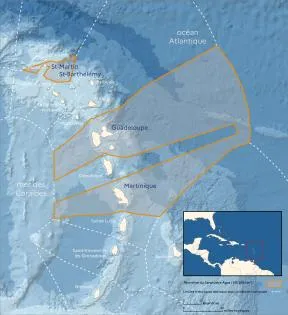
The Agoa sanctuary is one of the largest French marine protected areas, encompassing the marine areas of the islands of Martinique, Guadeloupe, Saint-Barthélemy and Saint-Martin, on a total area of 143,256 km².
Created in 2010, the Agoa Sanctuary was officially recognized as a specially protected marine area under the SPAW protocol (Specially Protected Areas and Wildlife) of the Cartagena Convention in 2012 and thus obtained international status.
The Agoa Sanctuary is governed by a Conference of Actors, composed of 32 members representing the various stakeholders in the protection of cetaceans in the French West Indies:
- The State,
- local authorities,
- marine protected areas,
- partners from the Caribbean region,
- the scientific council of the Sanctuary,
- professionals in the maritime world and actors in tourism promotion,
- associations committed to marine mammals.
One third of the world’s cetacean species in the Agoa Sanctuary
The objective of the Agoa Sanctuary is to ensure the protection of marine mammals and their habitats against the direct or indirect, potential or proven impacts of human activities.
Whales, sperm whales, dolphins, orcas, pseudorques, globicephals… No less than 26 species of cetaceans have been identified within the Agoa Sanctuary, or nearly 1/3 of the cetaceans found on the surface of the globe. While some of these species permanently reside in the waters of the Sanctuary, others, migratory, are only present during reproduction; this is particularly the case of the humpback whale (Megaptera novaeangliae).
Among the cetaceans observed in the Agoa Sanctuary, two species are considered threatened in the French West Indies and are on the IUCN Red List at the regional level: the humpback whale, classified as « Vulnerable », and the sperm whale, « In danger ».
Umbrella species, essential for the good health of ecosystems
Cetacans play major ecological roles and thus contribute to maintaining the balance of marine ecosystems.
At the end of their lives, whales sequester at the bottom of the oceans all the CO2 absorbed by food during their lives, 33 tons on average. Their diet and digestion also make it possible to put back into circulation nutrients essential to the production of phytoplankton, which is the basis of marine trophic networks. More generally, because of their position at the top of the food chain, cetaceans contribute to the stability of ecosystems.
Cetaceans are thus described as « umbrella species », their presence being essential to the preservation of other species dependent on the same ecosystem.
Many threats
The cetaceans in the Agoa Sanctuary are subjected to a whole set of pressures:
- Collisions with ships, especially large merchant ships;
- Hunting and fishing for cetaceans;
- Acoustic pollution and physical and chemical pollution generated by human beings;
- The effects of climate change on the habitats and food resources of species;
- Poor observation practices at sea disrupting the activity of marine mammals, and in particular the reproduction phase taking place in the warm waters of the Agoa Sanctuary.
The Agoa Sanctuary, guarantor of the protection of cetaceans in the French West Indies
Faced with these pressures, the missions of the Agoa Sanctuary are multiple:
- Deepen knowledge of the cetacans in the Sanctuary, their habitat and the threats to which they are subject;
- Support human activities, in order to limit their negative impacts on marine mammals;
- Raise awareness, inform and educate users of the marine protected area;
- Cooperate with neighboring states that share the same cetacan populations
In order to better understand marine mammals and thus better protect them, the Sanctuary develops or participates in knowledge acquisition programs, in particular through sea observation campaigns and acoustic monitoring.
The Sanctuary also strives to limit interactions between human activities and cetaceans and accompanies in particular the activity of whale watching, by training cetacean observation professionals.
The Sanctuary also trains State service agents in the procedures and control protocols put in place to ensure compliance with cetacan approach regulations. It is also responsible for issuing notices on projects that may cause nuisance or harm marine mammals in the marine protected area.
In December 2023, the new management plan of the Agoa Sanctuary was officially launched. It determines the objectives of protection, knowledge, development and cooperation of the Agoa Sanctuary for the period 2023-2037 and serves as a guiding principle for all the daily actions implemented.
This management plan contains 8 strategic axes and 25 operational measures divided into 80 management measures and 141 actions:
- Improve knowledge on cetacean hunting in the Caribbean, assess its impact and support territories wishing to develop sustainable alternatives;
- Improve knowledge of collisions and strengthen the application of current regulations;
- Analyze the sources and the fate of pollution due to contaminants and waste, document the impacts and implement targeted actions;
- Improve knowledge on noise pollution, evaluate its impact on cetacans and support actors in reducing noise emissions;
- Deepen knowledge on interactions with professional fishing, reduce potential impacts and strengthen collaborations with fishermen;
- Accompany whale watching actors towards a practice of environmental excellence;
- Structure the acquisition of knowledge on species, strengthen collaborations with research organizations and local universities and enhance the work of the Sanctuary internationally;
- Strengthen cooperation efforts at the Caribbean level and participate in relevant international bodies.