
From rising sea levels to food systems that fuel climate change, experts have made 10 findings requiring urgent action.
Past emissions have already « locked » some of the future climate impacts, but the extent of this damage still depends on the measures we are taking now, according to a new major study.
The report « 10 New Insights in Climate Science » is the result of the work of more than 70 scientists from nearly 30 countries and aims to translate complex research into accessible and concise analyses to « enlighten high-stakes decisions ».
Published on October 6, it warns that exceeding the threshold of 1.5°C, as provided for by the legally binding Paris Agreement, leads to « rapidly increasing risks of irreversible impacts » for the oceans, glaciers and parsogaze, and that the economic and social costs of this overrun are higher than previously thought.
10 avenues to prevent new climate damage
« The evidence is irrefutable, » explains Johan Rockström, director of the Potsdam Climate Impact Research Institute, co-chair of The Earth League network and member of the editorial board of the report.
« 1.5°C is a limit that we cross at our own risk. Beyond that, the risks of cascading and potentially irreversible climate impacts are increasing, with each additional tenth of a degree making them more serious. »
The key points of the « 10 New Insights », developed by Future Earth, The Earth League and the World Climate Research Programme, describe a « window of action that narrows » but remains open, showing what is already locked, what can still be avoided and where public policies can have the most effect.
Heat absorption by the oceans darkens long-term prospects
The ocean continues to absorb record amounts of heat due to human-made climate change, thus locking in additional warming for years to come.
In August, the average sea surface temperature reached 21.1°C — the highest level ever recorded. Last year, experts warned that the acidification of the planet’s oceans – i.e. the decrease in the pH of water due to the absorption of CO2 – had entered the danger zone for the first time.
The new report says that profound reductions in greenhouse gas emissions are « urgently needed » to avoid a lasting accumulation of heat.
« The ocean has been the shock absorber of our planet, » says Wendy Broadgate, director of the Global Hub of Future Earth and member of the editorial board of the report.
« Because it takes decades for heat to penetrate the depths of the sea, today’s emissions are actually blocking further warming and rising sea levels. Deep and rapid reductions in emissions are the only way to limit these risks. »
Sea level continues to rise
The melting of glaciers and ice caps fuels rising sea levels, exposing more populations to severe flooding.
The report warns that part of this increase is already irreversible due to the impact of past emissions, but that its magnitude still depends on how quickly the world will reduce its greenhouse gas emissions.
Freshwater resources are being rare
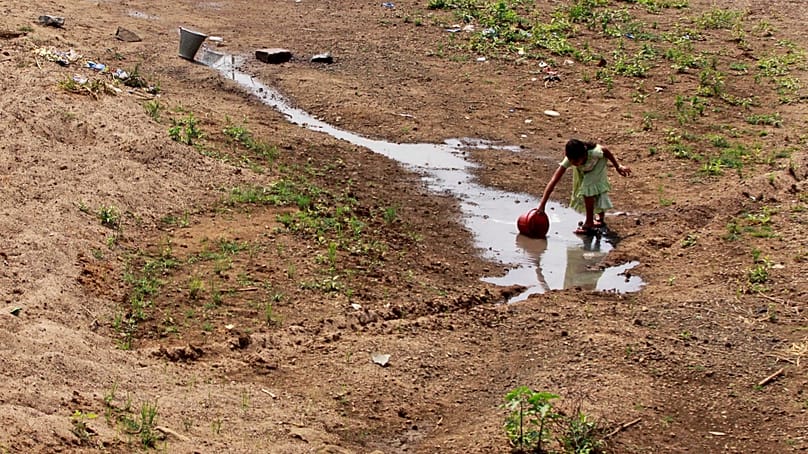
Water shortages are growing as the drying of the continents — the sustainable, large-scale decline in the availability and storage of fresh water — accelerates. According to the UN, by 2030, one in two people is expected to face severe water shortages.
« Climate change and increased water consumption are causing a rapid loss of fresh water on the continents, threatening water security, ecosystems and food production, » the report said.
« The consequences of inaction range from the threat to local livelihoods to cascading impacts on the entire Earth system. »
Governments are encouraged to develop comprehensive water management plans, known as Integrated Water Resource Management, that take into account the entire water cycle: from source to distribution, treatment, reuse and return to the environment.
Nature-based solutions, such as the restoration of wetlands, rivers and forests, can also help capture the fresh water that remains on land rather than allowing it to evaporate or spill directly into the ocean.
The consequences of a 1.5°C overrun
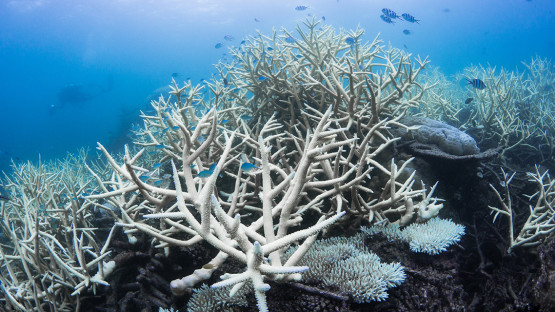
A recent report from the United Nations Environment Programme (UNEP) warns that the rise in global temperature will exceed 1.5°C, probably in the coming years. This would accelerate much of the environmental degradation already at work, from the reduction of ice caps to the rise of water and the « unprecedented withering » of coral reefs and tropical forests.
UNEP believes that there is « no good solution if we stay above 1.5°C » and that governments must strive to make this overrun as limited and short as possible.
Food systems still fuel climate change
The report stresses that the transformation of food systems, especially through diets richer in plants, can bring major benefits for the climate, biodiversity and health, but that it must be done « with caution and fairness ».
Globally, food and agriculture account for a third of total greenhouse gas emissions, just behind fossil fuel burning, and meat has been identified as the main responsible.
In Europe, animal products account for between 81% and 86% of greenhouse gas emissions related to food production in the European Union (EU), while they provide only about 32% of calories and 64% of protein.
According to the CO2 Everything carbon footprint calculator, a 100 g serving of beef is equivalent to 78.7 km by car and emits 15.5 kg of CO2 equivalent.
Better understand the « social cost » of carbon
Experts warn that the economic damage caused by carbon emissions is « substantially higher » than previously estimated, adding that each additional ton of CO2 carries « an additional risk ».
« The use of more realistic and up-to-date climate models reveals a social cost of carbon up to four times higher, » the report says.
Reinforced arguments for compensation claims
Advances in science now make it possible to trace climate impacts to the emissions that caused them.
This means that scientists can now link a single company or a large given transmitter to warming and perhaps even to specific losses or damage.
In the future, this new evidence could strengthen climate-related lawsuits and compensation claims.
« Climate clubs » can help industries decarbonize
« Climate clubs », which bring together countries working together on climate and trade policies, can be a collective force to reduce carbon emissions.
These clubs can, for example, agree on carbon taxes at borders that prevent companies from relocating their production to countries with weaker climate policies, a phenomenon known as « carbon leakage ».
But there is a flat. While climate clubs can accelerate industrial decarbonization, they can also have a punitive effect on developing countries that lack the tools, money or technology to reduce their emissions.
That is why the authors believe that the richest countries may have to combine stricter rules with technical or financial support for other economies.
Climate obstruction is becoming more difficult to spot
Advances are hampered by much more than just climate skepticism.
The report explains that highly emitting industries are slowing down effective policies, no longer just by denying the existence of climate change. Their lobbying efforts also involve a whole range of more subtle tactics, from greenwashing to the digital dissemination of misinformation.
To combat this more sneaky form of climate obstruction, the report calls for greater transparency on lobbying and political donations, stronger rules against misleading environmental allegations and coordinated action against disinformation.
Conflicts increase inequalities in the energy transition
Wars, trade disputes and fierce competition for energy resources complicate the global decarbonization effort.
Concerns about energy security, such as those caused by the war in Iran and the war in Ukraine, have not elicited a single response. Many wealthy countries have invested in renewable energy to protect themselves from shocks in the oil and gas markets, while others have relied more on fossil fuel production or sought new sources abroad.
The report explains that global instability could make the energy transition even more uneven than it already is.
Some country blocs could cut themselves off from neutral or politically unstable nations, which would eventually slow down global efforts to get out of fossil fuels. And since, most often, the most vulnerable are those who suffer the most from price increases, the authors believe that there are serious reasons to worry about climate justice in the future.