
The eastern Libyan parliament approved on Tuesday a contested maritime agreement with Turkey, turning years of opposition to a pact that supports Ankara’s demands in the Eastern Mediterranean, Reuters reported, citing two parliamentarians.
Libya is divided between a UN-recognized government in Tripoli to the west and a rival administration to the east, supported by military commander Khalifa Haftar. Turkey supported the government of Tripoli against the Haftar forces during their 2019-2020 offensive on the capital, but has since forged links with its camp.
This decision marks a new rapprochement between Turkey and the Haftar camp.
The House of Representatives also unanimously revoked two decisions adopted in 2020: one rejecting maritime and security agreements with Turkey and another breaking political relations with Ankara.
The maritime pact was signed in November 2019 with the then internationally recognized government of national unity (GNA) of Libya, based in Tripoli.
It then raised objections from Greece and Egypt as well as the rival leadership of Libya in the east.
MP Tarek al-Jeroushi told Reuters that the agreement would strengthen Libya’s position as a political, military and economic partner to the major powers.
« Some countries may be upset by this agreement, but what matters to us is our national interest, » he said.
Another MP, Aisha al-Tabalqi, said the approval followed a detailed explanation of the agreement’s provisions by specialized parliamentary committees.
The public news agency Anadolu reported separately that parliament announced the unanimous approval of the maritime agreement in a statement published in Benghazi.
The pact draws a maritime border between Turkey and Libya, supporting their claims on offshore resources in a region where competing claims have fueled disputes over oil and gas exploration.
Greece claims that the border ignores the maritime rights of its islands, including Crete, which is located between the Turkish and Libyan coasts. Egypt also rejected the agreement when it was signed.
The European Union reiterated in June 2025 that the pact violated the rights of other countries and did not respect the law of the sea. Turkey rejects this position and affirms that the agreement complies with international law and protects its legitimate maritime interests.
Tuesday’s vote eliminates opposition in the eastern parliament in Libya, but does not resolve the competing demands of neighboring countries.
This overthrow follows a sustained effort by Turkey to establish relations with the Haftar camp while maintaining support for the Tripoli government.
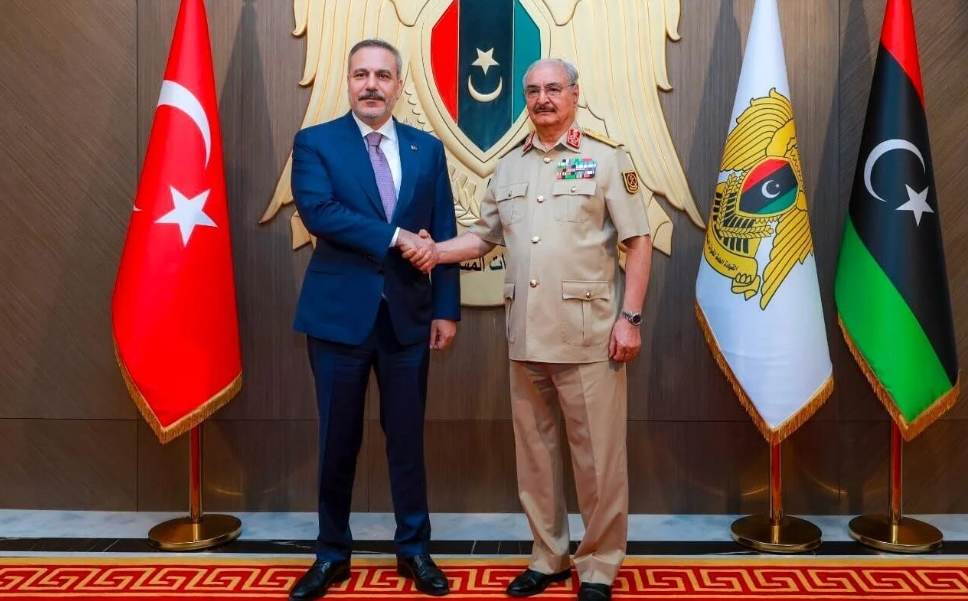
Foreign Minister Hakan Fidan met Haftar in Benghazi in August during his first official visit to the city. The head of the Turkish intelligence services, İbrahim Kalın, also held talks with leaders from Eastern Libya, while Haftar’s son, Saddam, made several visits to Turkey.
Ankara reopened its consulate in Benghazi in 2024 as part of this process. His interests include trade opportunities, energy cooperation and broader support for the maritime agreement.
These contacts represent a substantial change from the conflict that placed Turkey and Haftar on opposing sides. Turkish troops, drones and air defense systems helped the government of Tripoli repel the Haftar offensive, supported by Russia, Egypt and the United Arab Emirates.
Libya remains divided between the Government of National Unity in Tripoli, which succeeded the GNA, and a rival administration in the East supported by Haftar. A ceasefire negotiated by the UN ended the fighting in 2020, but the national elections scheduled for December 2021 never took place.