
At the end of 2026, the « Spirit of Toulouse », the largest rotor-sail cargo ship in the world, begins its tests in China. Airbus intends to use it for a specific mission.
There are Airbus aircraft that can be recognized at a glance: the Beluga for its size and livery, the A380 for its two floors or the Concorde for its elegant finesse. From now on, the aircraft manufacturer based in Toulouse, has another building identifiable in less than a second: the « Spirit of Toulouse« . In view of the name that does not include the codes of the aircraft, you will have understood, it is not an aircraft, but a boat. And not just any one, because it is the largest cargo ship in the world equipped with rotor sails. Here is what you need to know about this giant that will soon begin its tests in the East China Sea at the end of 2026.
One name, two tributes
If the boat derogates from the traditional Airbus designations, its surname owes nothing to chance. By choosing to baptize this giant of the seas « Spirit of Toulouse », the aircraft manufacturer directly pays tribute to his cradle, the Pink City, but hides another reference.
The name of the cargo ship is also a nod to the « Spirit of Saint-Louis« , the single-seater aircraft on which Charles Lindbergh crossed the Atlantic for the first time in 1927.
In the wake of this first baptism, the two future « sister-ships » will also adopt the same geographical logic by taking the names « Spirit of Mobile » (in reference to the American assembly site of Mobile, Alabama) and « Spirit of Mirabel » (for the Canadian base).
A technology monster propelled by the wind
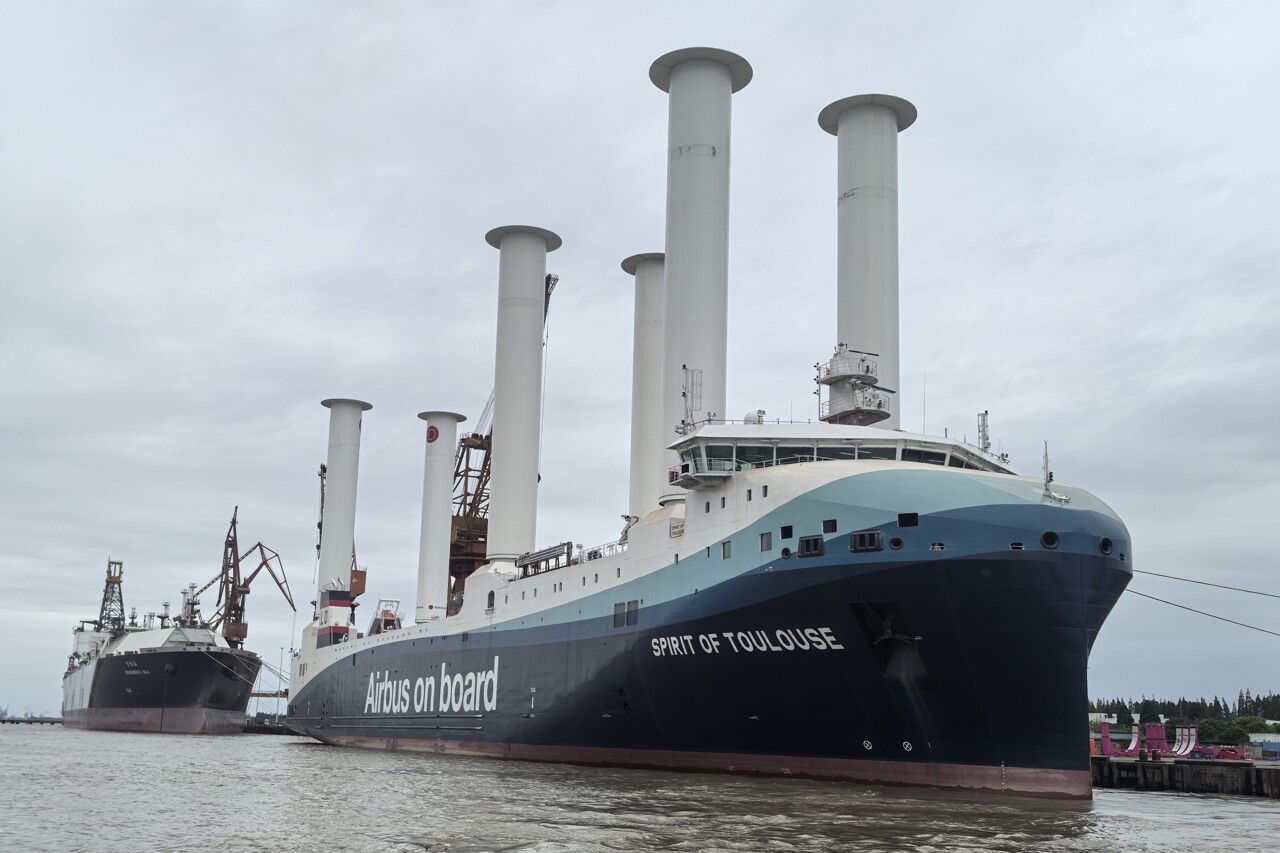
In terms of measurements and architecture, the 24,000-ton ship is simply out of the norm. Designed as a new generation ro-boat (boat specialized in loading and unloading), the Spirit of Toulouse has a length of about 169 meters for a width of 24 meters, all for a service speed of 14 knots (about 26 km/h).
But its true singularity lies in its futuristic silhouette, topped with six gigantic vertical cylinders. These rotor sails are each 35 meters high by 5 meters in diameter. Their principle is based on the Magnus effect: by rotating on themselves thanks to an electric motor, these columns take advantage of the wind to generate a powerful perpendicular aerodynamic thrust.
In addition, there are two engines capable of running on e-methanol, biomethanol and marine diesel, as well as a fatal heat recovery system, a device that captures the thermal energy lost by the ship’s engines or equipment for reuse. The objective? Reduce fuel consumption and improve energy efficiency throughout the journey.

Reduction of CO2 emissions
For Airbus, the ecological transition of maritime transport is no longer an option, and this giant of the seas intends to prove it.
Thanks to the combination of its six rotor sails and its green methanol bicarburet, the Spirit of Toulouse should halve CO2 emissions on transatlantic routes compared to cargo ships of the previous generation.
What will it be used for and to whom does it belong?
Owned by the French shipowner Louis Dreyfus Armateurs (LDA) – a historical player in maritime logistics – the ship is being chartered over the long term by Airbus.
Its mission is highly strategic: it will provide the link on the transatlantic road to transport up to six sets of A320 (fuselage sections, wings, sinks) between the various European production sites and the final assembly line located in Mobile, United States.
With a capacity doubled compared to the old cargo ship and better environmental performance, the Spirit of Toulouse promises to be one of the centerpieces of Airbus’ plan to halve the carbon footprint of its maritime transport by 2030.