
Nador West Med’s first container terminal is due to go into service in the coming days. The Palace also puts back in the program the gas terminal, whose tender was frozen in February, while Maersk won the concession of the future third Tangier port.
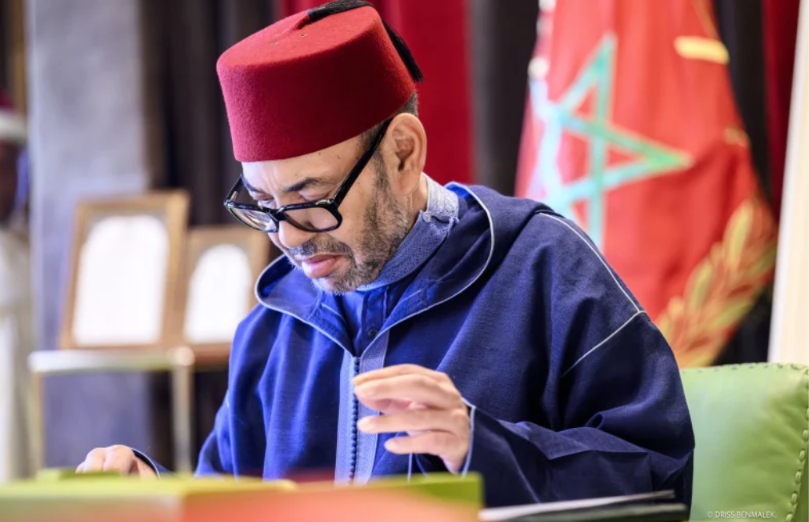
King Mohammed VI presided this Wednesday, October 28 at the Royal Palace of Rabat, a working session devoted to the two major port complexes on the Mediterranean facade: the entry into service of Nador West Med and the development of Tanger Med, called to have a third port. Fouad Brini, chairman of the supervisory board of Tangier Med Special Agency (TMSA) and the board of directors of Nador West Med, presented the progress of the two projects and their next steps. Royal Councillor Fouad Ali El Himma attended the meeting, along with four ministers: Abdelouafi Laftit (Interior), Fouzi Lekjaa (Economy, Finance and Public Performance), Nizar Baraka (Equipitment, Water and Forests) and Ryad Mezzour (Industry, Trade, Investment and Economic Inclusion).
The session extends that of January 28 at the Royal Palace of Casablanca, devoted to the only project of Nador. The Royal Cabinet had then set the operational launch of the port for the fourth quarter of 2026. The press release of October 28 places the two projects in the same strategy: to provide the country with a port system capable of taking advantage of the recomposition of global value chains, better distributing public investment among territories and mobilizing private capital.
INVESTMENTS OF 54 MMDH IN NADOR WEST MED
Designed to complete the offer of Tanger Med, the Nador West Med complex combines port infrastructure, industrial and logistics platforms and the energy component. To date, it has mobilized 54 billion dirhams of public and private investments, compared to 51 billion announced in January.
The initial phase of the first container terminal is to be put into operation in the next few days. Eventually, this terminal will offer a capacity of 3.5 million containers. Named Terminal Est, it is granted to West Med Container
Terminal, a joint venture of Marsa Maroc and Terminal Investment Limited, a subsidiary of the MSC group, whose Swiss shipowner had recovered the concession alongside the public operator. The dealer had announced on September 10 that it had completed its tests in real conditions.
A second terminal, with a capacity of 1.8 million containers, is due to enter service in April 2027. This West Terminal will be operated by a company owned 51% by Marsa Maroc and 49% by CMA Terminals, a subsidiary of the French shipowner CMA CGM, and will eventually be equipped with eight doch portries. Concessed for twenty-five years, it extends over 1,440 meters of doch, including 900 meters dedicated to containers and 540 meters to various goods. Marsa Morocco was there
announces an initial investment of 280 million euros. The two terminals together represent 8 billion dirhams of private investment. One terminal for solid bulk and another for miscellaneous goods will complete the port supply.
THE GAS TERMINAL RE-REGISTERS
The energy component of the communication is the most notable. The Palace announces the commissioning of the hydrocarbon terminal, backed by a storage area with a potential capacity of 4 million cubic meters, as well as a liquefied natural gas terminal that can treat up to 5 billion cubic meters per year. Such equipment receives the gas delivered by Lng tanker in liquid form and gasifies it before injecting it into the network.
This terminal was already included in the January press release, which presented it as the first gas terminal in the Kingdom, in the presence of Leila Benali, then Minister of Energy Transition. Five days later, on February 2, Morocco suspended its LNG terminal project at Nador West Med. The ministry froze the calls for competition on the terminal and on the gas pipelines to connect it to the Maghreb-Europe Gas pipeline. This program was valued at nearly $1 billion and its outlines were unveiled in April 2025.
The press release of October 28 now links these investments to the energy security of the Kingdom, « in accordance with the Royal High Instructions ». It does not specify a timetable, technical format, or relaunch of operator selection procedures. No energy ministers were among the participants. Fouzi Lekjaa, whose department had been designated as the origin of the frost, was attending.