
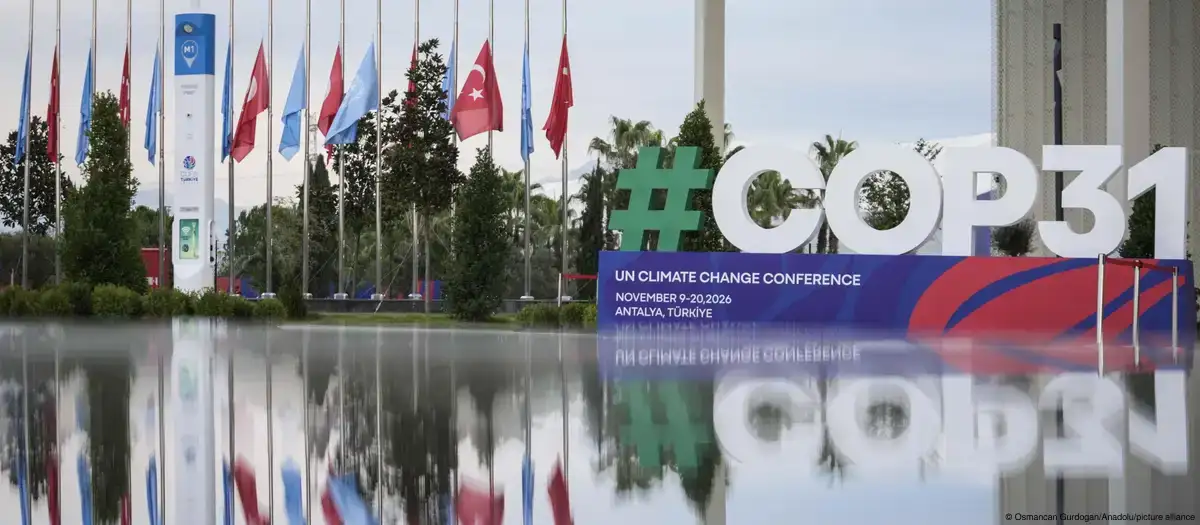
The Cop31 continues until November 20, in Antalya, Turkey. This is Antonio Guterres’ latest Cop as Secretary-General of the United Nations. He took the opportunity to estimate that « like dinosaurs, fossil fuels must disappear ».
Africa, on the other hand, has a fairly unified position that revolves around a message: to obtain more funding for climate adaptation and the energy transition, without aggravating the debt of African countries.
Polluters paying
Initially, there is one observation: Africa produces less than 4% of global greenhouse gas emissions, but it is among the regions most exposed to climate disasters.
Meeting in September in Addis Ababa, African leaders estimated the continent’s needs to finance its climate plans at $277 billion per year, until 2030. However, current financing covers only about 11% of it.
At COP31, African countries are therefore asking for more accessible funding, in the form of grants rather than loans.
So as not to deepen their debt. They also want to triple funding for climate adaptation and strengthen the Green Climate Fund.
Take into account the needs of populations
On the sidelines of the Antalya summit, NGOs demonstrated to defend this position. Among them, Baboucarr Nyang, of Can Africa notes that he « saw no commitment from global leaders to meet these needs and ensure that Africa and the countries of the global South receive the necessary funding to adapt to climate change. »
He said: « Our demand is simple: to obtain funding based on the real needs of the populations. We think of the communities affected by the floods, the populations affected by the drought, but also those who are suffering the heat waves. «
For a « fair transition »
The « fair transition » advocated by African representatives includes more renewable energy, in particular to meet the needs of the 600 million Africans still without electricity. They also highlight their assets, including solar, hydroelectricity and strategic minerals.
Faced with climate change in agriculture and in cities, they finally call for the development of early warning systems.
The goal is to make Africa a full-fledged actor in the energy transition, through industrialization, innovation and the local exploitation of its resources.