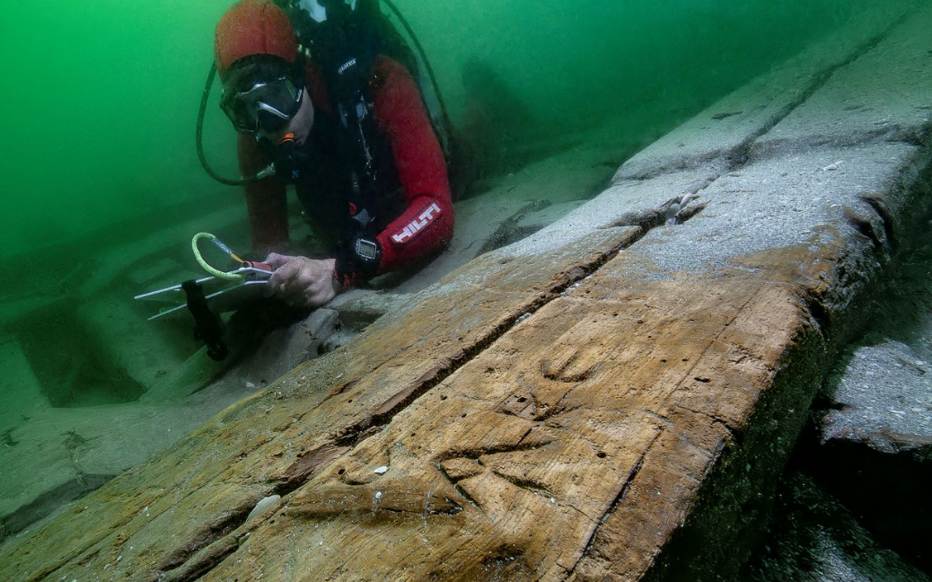
Divers have discovered the hull of the vessel—more than 35 meters long and about 7 meters wide—submerged in the harbor of Antirhodos Island.
Underwater archaeologists have announced the discovery of the 2,000-year-old remains of an ancient Egyptian pleasure boat off the coast of Alexandria, the former capital of Egypt during the Hellenistic period. Divers found the ship’s hull, over 35 meters long and around 7 meters wide, submerged in the harbor of Antirhodos Island, the European Institute for Underwater Archaeology (IEASM) said in a statement.
“Greek graffiti found on the central keel beam can be dated to the first half of the 1st century AD. This supports the hypothesis that the ship was built in Alexandria,” the statement explains. “The boat likely had a luxuriously decorated cabin and seems to have been powered solely by oars,” the Alexandria-based institute added.
A series of earthquakes and tsunamis submerged Antirhodos Island, which was rediscovered in 1996. Since then, divers have recovered statues, coins, and other treasures, some of which are on display at the Graeco-Roman Museum in Alexandria.
“Extremely exciting”
“This is extremely exciting, because it is the very first time such a vessel has been discovered in Egypt,” Franck Goddio, professor of maritime archaeology at the University of Oxford and director of the excavations conducted by the IEASM, told The Guardian.
“These boats were mentioned by various ancient writers, such as Strabo, and they also appeared in certain iconography, for example in the Palestrina mosaic (…) But none had ever been discovered before,” the researcher said.
The wreck lay at only 7 meters deep and 1.5 meters beneath the sediment. At first, Franck Goddio assumed he was looking at two overlapping ships “because of their very unusual construction.”
“Although research on the wreck is still in its early stages, it promises a fascinating journey into the life, religion, luxury, and pleasures of the early Roman waterways of Egypt,” the IEASM added.
Alexandria is home to ancient ruins and historical treasures, but Egypt’s second-largest city is particularly vulnerable to climate change and rising sea levels. In the most optimistic United Nations scenario, one-third of Alexandria will be underwater or uninhabitable by 2050.