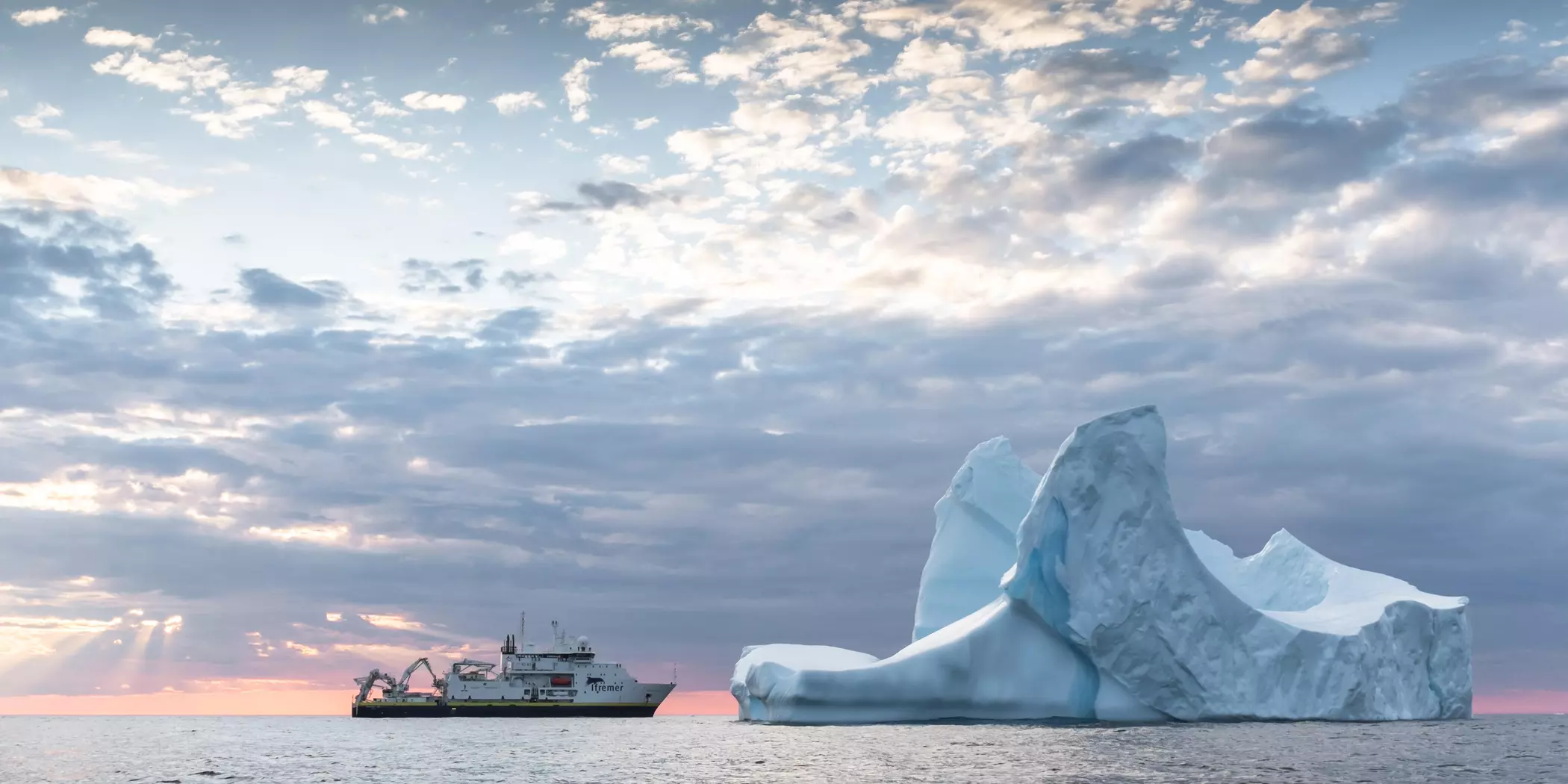
The polar regions, both in the Arctic and in Antarctica, are experiencing a marked decrease in their ice. In the north, this decline has been observed since 1979, with a loss of winter surface equivalent to that of Alaska. In the south, the phenomenon is more recent but particularly rapid: since 2015, the sea ice has decreased by an area comparable to 4 times the surface of metropolitan France. While atmospheric warming is often pointed out as the main cause of the reduction of ice, the ocean also plays a key role that is still poorly understood. This is the whole issue of the HEAT-UP project launched on March 19 and coordinated by Carolina Dufour, a researcher at Ifremer, with the support of the National Research Agency. Objective: to better understand how the ocean transports heat to the polar regions and improve climate models that make it possible to predict the evolution of sea ice in the coming decades. Scientists will be particularly interested in little-documented small oceanic structures (meso-scale) such as whirlpools and meanders.
Better describe the transport of heat from the Ocean to the ice pack
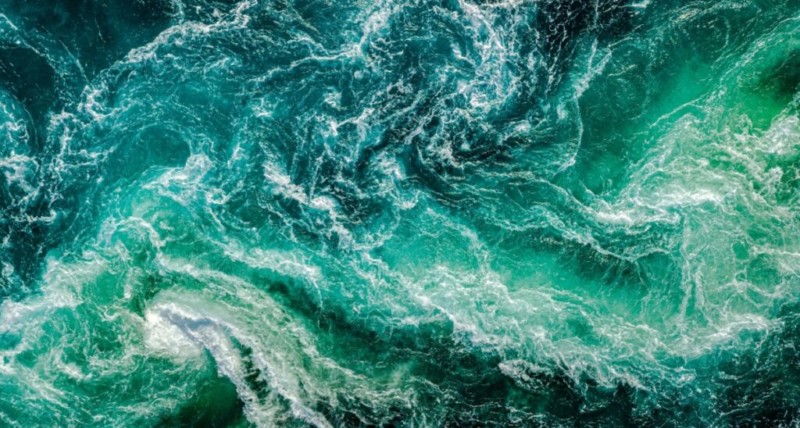
In the ocean, oceanic vortices and meanders – 10 to 100 km in diameter – concentrate a large part of the energy of the currents. They play a major role in the transport of heat from mid-latitudes to the poles. This heat, rising to the surface, contributes to the melting of the pack ice. However, these phenomena remain poorly observed: satellites do not allow them to be followed in depth, let alone under the ice. In the polar regions, where observations are scattered and conditions are extreme, climate models still struggle to faithfully represent these mechanisms.
To successfully understand and quantify the role of small ocean structures in the transport of heat to the poles, we will use very detailed numerical models – of high resolution – that reproduce the interactions between the ocean and the ice. These simulations are essential, but they require a lot of computing and storage power. We will therefore use it to identify the most important mechanisms, this knowledge will help develop simpler, low-resolution climate models. The objective is to obtain reliable results while limiting the use of computer resources.Carolina DufourIfremer | Researcher in physical oceanography at IfremerHEAT-UP Project Coordinator
An integrated approach between models and observations
To succeed in their bet, scientists will use models developed in particular by Mercator Ocean International, to simulate heat transport and interactions between the ocean and ice. The virtual data collected will be compared to the actual data acquired by satellites and at sea, including Argo floats – which measure the temperature and salinity of the water in the water column. The project uses an innovative tool developed at Ifremer: virtual Argo floats, which take their measurements in digital models. This deployment of virtual floats will allow teams to better understand and interpret the observations made by Argo floats that drift at sea under the sea ice and to help with future deployments.
This approach will make it possible to compare the mechanisms at work in both the Arctic and Antarctica, in order to identify their similarities and differences.
A crucial issue in the face of climate and geopolitical issues at the poles
Beyond the scientific issues, these two polar regions are of growing strategic and economic importance. In the Arctic, the melting of the sea ice opens up new maritime routes and could transform access to natural resources. In Antarctica, governance and preservation issues remain at the heart of international concerns.
Understanding the oceanic processes at work in the redistribution of heat in the ocean will allow us to bring climate models closer to polar reality and improve our ability to predict future developments in the ice pack which is crucial in the face of the climatic and geopolitical challenges at the poles.Carolina DufourIfremer | Researcher at Ifremer at the Physical and Space Oceanography Laboratory-LOPS
This project benefited from state aid managed by the National Research Agency under the Future Investment Program integrated into France 2030 bearing the reference ANR-25-CE01-5576.
source : ifremer