
On the surface, no sign of nervousness: however unusual it may be in these latitudes, life follows its course in Svalbard, ignoring the prophecies that potentially make this Norwegian archipelago a new object of lust, Russian or American, in the Arctic.
« Today Greenland, tomorrow Svalbard? « : the question often comes to the ears of Terje Aunevik, the mayor of Longyearbyen, the capital of this territory halfway between mainland Norway and the North Pole.
With his expansionist aims, Donald Trump has set the spotlight on the Arctic, where strategic and economic issues (minerals, oil, fishing, new sea routes, etc.) grow as the pack ice retreats.
« The Arctic is no longer a quiet corner on the map, but is at the forefront of the struggle for planetary power, » warned Kaja Kallas, the head of European diplomacy, at the beginning of February during a conference in Tromsø, northern Norway.
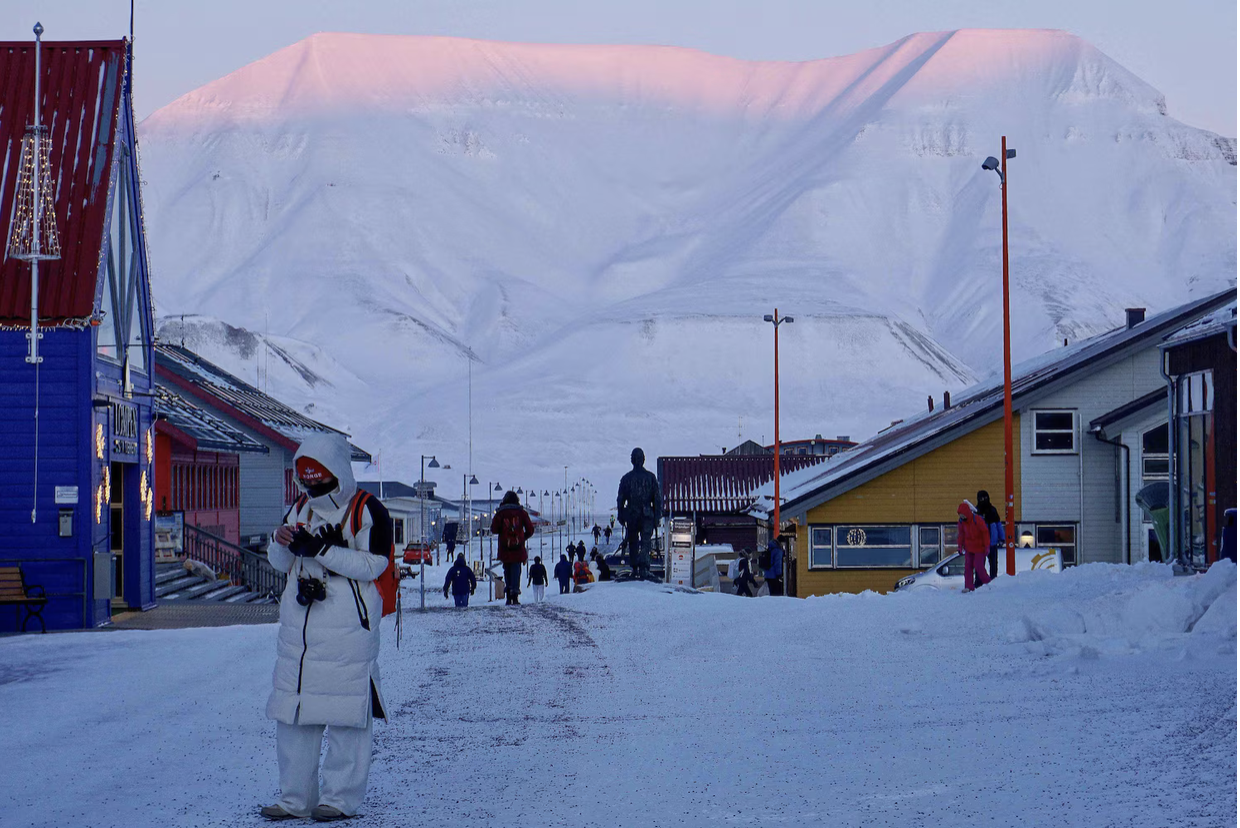
A former mining community transformed into a tourist destination and scientific observation site in the fastest warming region on the planet, Longyearbyen is out of the ordinary.
Deprived of sun for four months in winter, this locality of some 2,500 souls, one of the northernmost in the world, is bathed in permanent light in the summer.
When you get out of it, the carrying of the rifle is mandatory to ward of a fortuitous encounter with a polar bear.
Some fear that the American president’s appetite will spread in the future in Svalbard or that he will disinhibit Russia, which would, in turn, believe that it is authorized to seize this Norwegian archipelago.
In addition to the wealth likely to rest in and under its seabed, this territory as large as Belgium is twice as much as Belgium has a strategic position, because it commands the northern part of the « bear gap ».
The term refers to the maritime area that the submarines of the powerful Northern Fleet, based on the Kola Peninsula, in northwestern Russia, must use to disappear into the deep waters of the Atlantic.
Lenin
« The strategic importance does not necessarily lie in the island itself, but in the waters that surround it, » says Barbara Kunz, the director of the European Security Programme at the Stockholm International Peace Research Institute (Sipri).
« For Russia, it is a matter of protecting its nuclear deterrence and ensuring that no one approaches its north coast. (…) As for the United States, they would like to be able to prevent « the transit of Russian submarines to the Atlantic, » she says.
In Longyearbyen, where about fifty different nationalities live together, we remain serene.
« We may talk a little more about what is happening in Greenland, with Trump and all that, but, at the same time, I have the impression that we are no more anxious than usual, » says Charlotte Bakke-Mathiesen, a store employee. « We’re a bit like in a bubble. »
In his office where his mayor’s necklace rubs shoulders with a polar bear’s femur, Terje Aunevik says nothing else.
« The situation is as it is, but I don’t see any threats. I sincerely believe that both our allies and our neighbors live very well with the fact that Norway exercises its sovereignty over this island, « he assures.
The « neighbors »? Some 350 Russian-speaking Russians and Ukrainians living in Barentsburg, about forty kilometers as the crow flies.
It is difficult to believe that this mining community, under Russian control for almost a century, is located on NATO territory: a Lenin bust is enthroned in the middle of the village and the signs are in Cyrillic.
Hybrid actions
If it recognized Norwegian sovereignty over the archipelago, the Paris Treaty dating from 1920 has the particularity of granting nationals of all contracting parties the right to exploit Svalbard’s natural resources « on a level playing footing ».
Nearly 50 states have signed it, including Russia, the United States and China, and therefore benefit from ease of access.
Since the annexation of Crimea, which fueled tensions with Russia in 2014, Norway has been trying to tighten its control by preventing the sale of land to foreigners or by drastically restricting the right to vote.
But Moscow acts like a scratch-on by saying that Oslo does not respect the Treaty of Paris and multiplying provocations: quasi-military parade in Barentsburg to celebrate the victory over Nazi Germany, unauthorized erection of a giant Orthodox cross in Pyramiden, another small Russian community…
« The Russians have other more strategic priorities at the moment and have no interest in an escalation beyond the hybrid actions they have been conducting for a long time, » says Mikaa Blugeon-Mered, a researcher in pole geopolitics and the author of « Polar Worlds ».
« For Norway, the United States is more worrying today with regard to Svalbard, because it is more likely to take action that would destabilize the precarious balance of the territory, » he judges, arguing that « with the current Trump administration, we can expect everything ».
For a long time, experts have spoken of « Arctic exceptionalism », an idea that the Arctic operates with particular rules of cooperation, relatively preserved from strategic rivalries.
But, according to Barbara Kunz, « the Far North era, weak tensions is over ».
source : journal de quebec