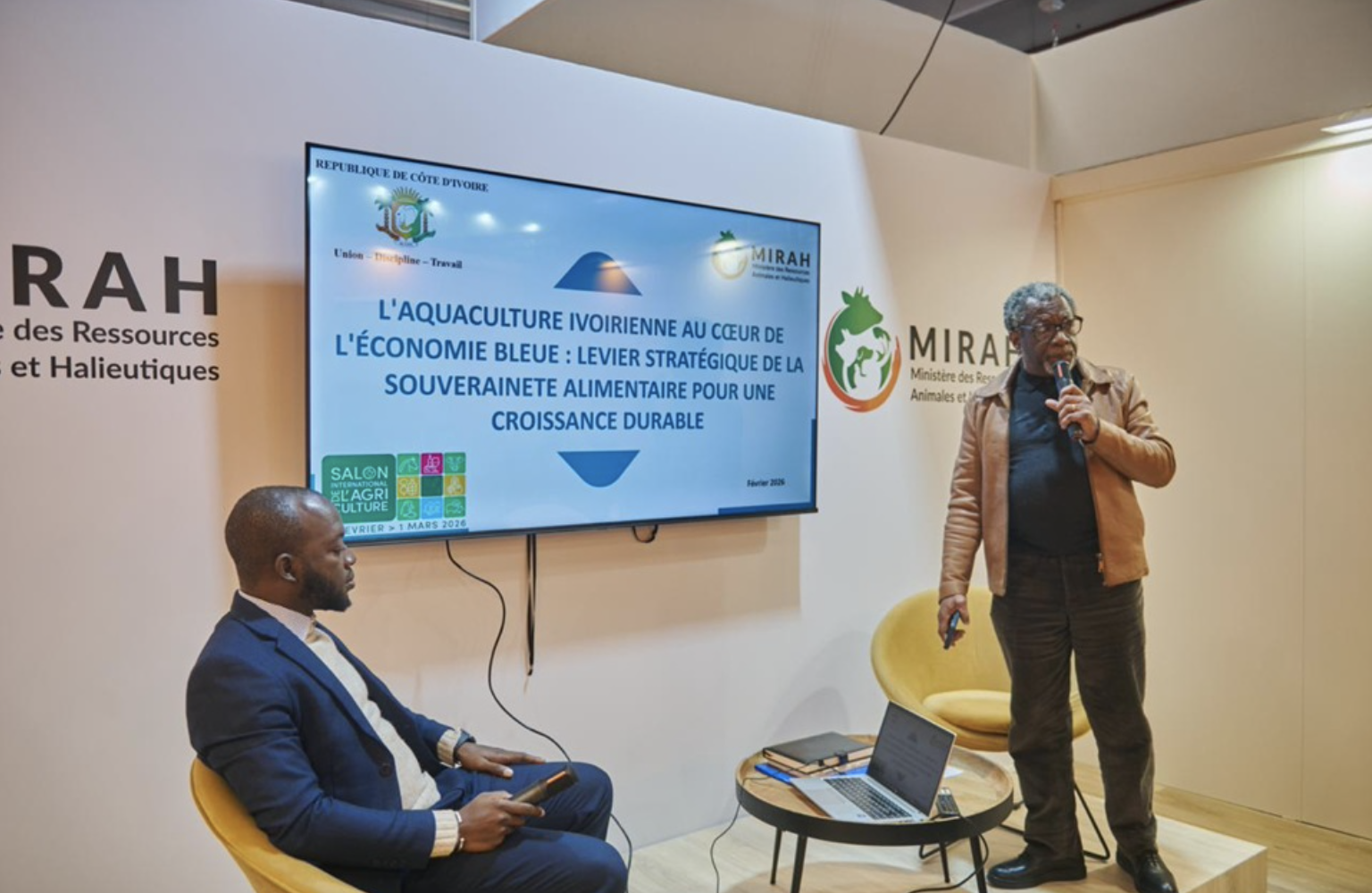
Abidjan, 26 Feb 2026 (AIP) – On Wednesday, February 25, Côte d’Ivoire highlighted its ambition to make aquaculture a strategic lever for food sovereignty and sustainable growth, on the occasion of a masterclass organized at the 62nd Paris International Agricultural Show (SIA 2026) of which it is the country in the spotlight.
Carried out by the Ministry of Animal Resources and Fisheries (MIRAH), under the impetus of Minister Sidi Tiémoko Touré, this meeting dedicated to the blue economy was moderated by the deputy coordinator of the Strategic Program for the Transformation of Aquaculture in Côte d’Ivoire (PSTACI), Ouattara Lacinan.
According to him, fishery and aquaculture products are the main source of animal protein in Côte d’Ivoire, with an average consumption of more than 20 kg per capita per year. However, domestic production remains largely insufficient in the face of an estimated demand of 650,000 tonnes per year, for a local supply of about 110,000 tonnes, a structural deficit of more than 80%.
This imbalance leads to a strong dependence on frozen fish imports, valued at nearly 400 billion FCFA per year, weakening food security and increasing the pressure on natural fisheries resources.
Faced with this situation, the government intends to reposition aquaculture at the heart of its blue economy strategy, focused on the sustainable valorisation of maritime and lagoon resources, the preservation of biodiversity, the creation of green jobs and the reduction of pressure on catch fishing.
Côte d’Ivoire has significant assets, including 550 km of seafront, 150,000 hectares of lagoons, 350,000 hectares of lakes and four major rivers, favorable to the development of various systems (ponds, floating cages, above-ground basins, dams). However, aquaculture production was only 9,915 tons in 2024.
The country currently has 1,076 fish farms and six public hatcheries, producing including tilapia, jaw, red carp, mullet, captain, as well as crustaceans and molluscs.
The masterclass highlighted investment niches covering the entire value chain: private hatcheries, local ands, magnification infrastructures, livestock modernization, processing (smoking, freezing, cannery).
The authorities reassured investors about the existence of a favorable framework, in particular through the National Policy for the Development of Livestock, Fisheries and Aquaculture (PONADEPA 2022-2026).
« Faced with the internal production deficit, the fisheries sector requires increased commitment to private initiatives, » recalled Minister Sidi Tiémoko Touré, stressing that aquaculture represents both an economic opportunity and a national project of food sovereignty.
source : agence ivoirienne de presse