

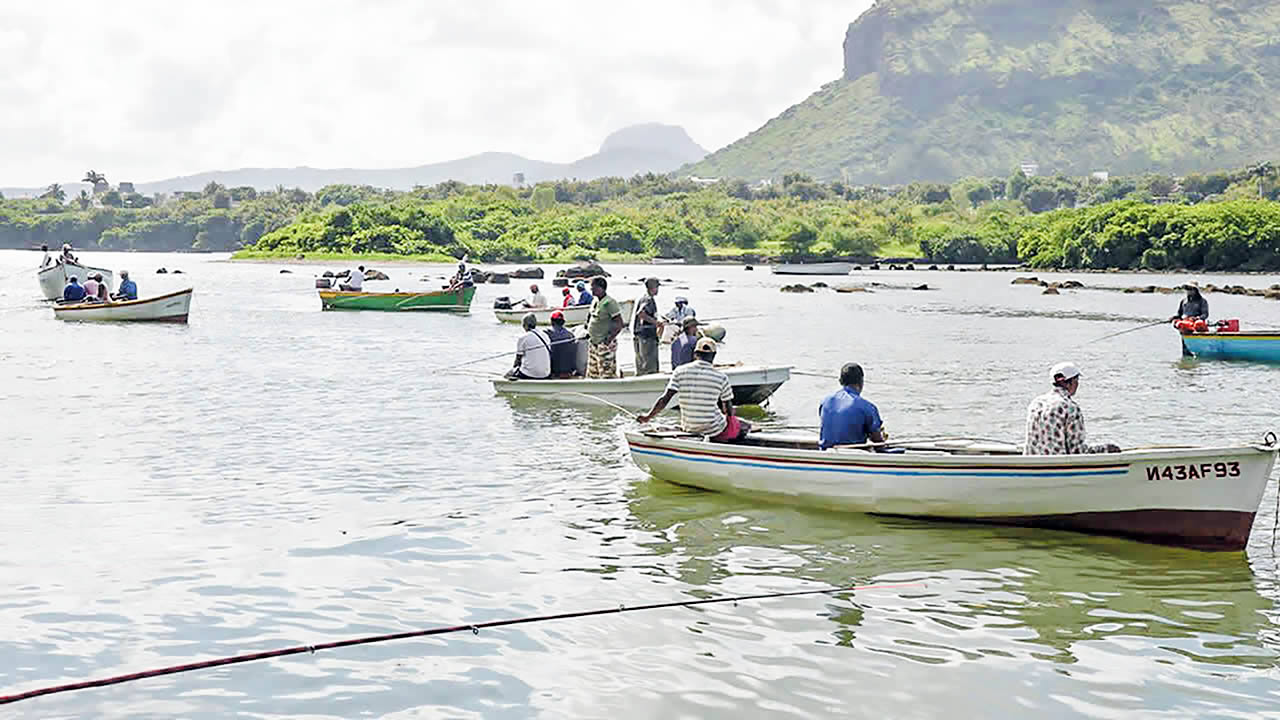
Allocations, subsidies, pilot projects, equipment… The Audit report highlights the same recurring flaw: public money is spent, but the real impact often remains unmeasured.
Bad Weather Allowance
During the 2024-2025 financial year, the Bad Weather Allowance (BWA) amounted to some Rs 384 million, paid to 2,524 registered artisanal fishers. However, the Audit highlights that the current system no longer guarantees that the allowance benefits only those fishers who are actually active.
The report’s wording is significant: the BWA’s administration « did not align with the scheme’s objective, which was originally designed to support the livelihoods of genuine artisanal fishers. » This means the mechanism has deviated from its intended purpose.
Another sensitive issue: eligibility was no longer linked to proof of fishing activity, but relied primarily on having the fisherman’s card stamped between the 16th and 23rd of each month, without any requirement to provide proof of actual activity. The ministry, the Audit noted, was unable to determine what proportion of the money paid out actually went to active fishermen contributing to the supply of fresh fish to the market.
Even more troubling, a verification exercise conducted in early 2025 identified at least 100 fishermen simultaneously engaged in another paid activity. The report even cites the case of a beneficiary who obtained a permit in July 2024 while already receiving a disability pension since March 2024, and who received Rs 71,000 from BWA.
The « Canotte Scheme »
The report is equally critical of the « Canotte Scheme. » By January 2025, 158 fishermen had benefited from this scheme, for a total amount of Rs 31.5 million. Yet, several years after the initial observations of the Audit, the ministry still lacked sufficient data to measure the program’s effectiveness.
The report clearly indicates that, as early as December 2018, the Audit Office had already reported that the effectiveness of the scheme was not being assessed. And in December 2025, the ministry was still not collecting information to determine whether beneficiaries were actually fishing outside the lagoon, improving their daily catches, or making beneficial use of the subsidy.
In other words, more than Rs 31 million has been committed without the administration being able to demonstrate in a solid manner whether this support has really changed production conditions, fishermen’s incomes or the supply of fish.
Fish Aggregating Devices: Rs 14.2 million maintenance
The same pattern is observed with Fish Aggregating Devices (FADs)—fish concentration devices installed offshore to attract migratory species, such as tuna. As of December 2025, 28 dedicated sites were in operation around Mauritius. Their maintenance cost approximately Rs 14.2 million over the last three financial years ending June 30, 2025.
However, the Audit notes that the actual number of beneficiaries involved in this fishery had not been established and that the profits generated had not been assessed by the Ministry.
Marine Ranching: no proof of effectiveness
The Marine Ranching Project also illustrates this culture of poorly monitored spending. The report notes that between 2012 and 2017, 2.1 million fingerlings had already been released at a cost of approximately Rs 4.2 million, without the ministry subsequently retaining the capture data necessary to assess the impact.
Then, between 2020-2021 and 2024-2025, some 84,000 fingerlings were caught annually in the lagoons, reared at the Albion Fisheries Research Centre, and then released into fisheries reserves, marine parks, and various lagoon areas. However, despite repeated recommendations from the Audit, the Ministry still did not maintain the catch data necessary to analyze and validate the project’s effectiveness.
A pilot project that ended in abandonment
One of the most telling cases in the report concerns the « floating cages » pilot project. The objective was clear: to demonstrate that more profitable and sustainable aquaculture could emerge and, in the long term, open this activity to more fishermen.
The project cost is estimated at Rs 11 million. However, the audit’s findings are unequivocal: the project was unsuccessful. The cages, designed to withstand harsh marine conditions, were damaged, causing fish losses, before being abandoned.
The Audit adds that monitoring of cage maintenance and fish growth was insufficient, as shown by the records kept.
Less than 10% of the aquaculture potential realized
This observation about floating cages is part of a broader picture. The 2007 Aquaculture Master Plan identified more than 20 sites and estimated an annual potential of 29,000 tonnes.
However, official production reached only 1,875 tonnes in 2024, less than 10% of the projected level. The report further specifies that pilot projects failed, that the lagoons managed by the ministry remained underutilized, and that only one industrial fish farm eventually became operational.
Even the reform of the system remains incomplete.
The report also notes that the administrative modernization intended to improve control and efficiency has not been fully effective. The digitalization of BWA processing was long overdue.
The project was completed in September 2024 and operational in parallel since January 2025. However, by December 2025, only 42 of the 100 officers involved had been trained, even though the training required only half a day. The audit concluded that the ministry had not taken the necessary steps to capture the expected efficiency gains from this computerized system.
Here again, the problem is not just the disbursement. It also lies in the inability to transform an expenditure into a tangible improvement in management.
Ultimately, what this Audit report reveals is not that spending should be avoided in fishing, aquaculture, or support for fishermen. The report says something else, something far more disturbing: Mauritius is spending on the Blue Economy without having built a sufficiently rigorous culture of assessment, monitoring, and proof of impact.
source : DEFIMEDIA