
Belgian shipowner Jan de Nul invests in two ships for trenching operations. They will be used to bury submarine cables used to export electricity produced at sea or interconnect electrical networks. Thus, Jan de Nul chose to order a new trench support vessel (TSV, usually used to dig trenches and install rocks) and will transform another, the Henry Darcy dredge.
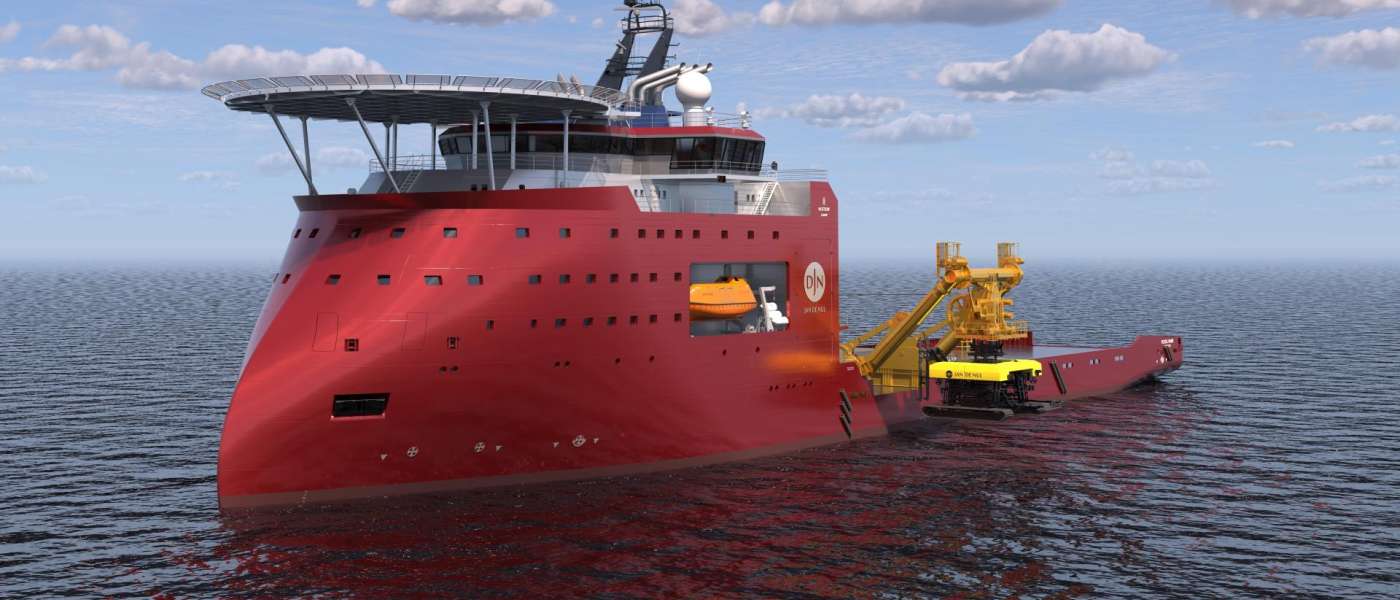
The first ship, custom-designed by Ulstein Design & Solutions AS, will be built by CMHI, China, with delivery scheduled for 2028. Technical specifications were not communicated, but Jan de Nul and Ulstein present it as a « ultra-modern » ship, with an X-Bow bow improving both on-board comfort, wave traffic and fuel consumption. It will be equipped with a slicer, which is an underwater robot piloted from the edge and capable of burying cables up to five meters deep. The ship’s engines will also be ready to use biofuel and methanol in the future.
The Henry Darcy is a water injection dredge 62.88 meters long, by 17.24 meters wide equipped with a dynamic positioning system. For its conversion to TSV, it will be equipped with a robot specialized in burying cables in shallow water that has been ordered from Osbit.
This investment is part of a broader strategy to provide Jan de Nul with a fleet capable of working on the installation and protection of submarine cables. Jan de Nul has a fleet of ships for the laying and protection of submarine cables. In particular, he also built very large cable wires at CMHI (the Fleeming Jenkin, William Thomson), as well as a rock-in-rock ship, the George W. Goethals.
The shipowner explains that, if he does not communicate a figure on these investments, the effort for him is « considerable ». It thus wants to be ready to respond to the strong future demand for renewable marine energy connection and interconnection, especially in Europe.
The Belgian group is already very present in the wind power with two self-rifting installation vessels (Voltaire and Vole au Vent), three floating crane ships (Alizés, Gulliver and Rambiz), four rock-roing vessels (Joseph Plateau, Simon Stevin, La Boudeuse and Tiger) and three multipurpose vessels.
source : mer et marine