
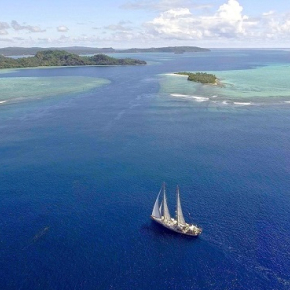
Ten years after the departure of Tara Pacific, and in a context of increasing coral bleaching, the scientific schooner Tara sets out on its next expedition: Tara Coral. For 18 months, Tara will sail through the Coral Triangle, often called the Amazon of the Ocean, to understand why and how some corals resist climate warming, and to inform future conservation strategies.

« The Tara Pacific expedition (2016–2018) allowed us to study reef biodiversity and their response to climate change and local human pressures. The Tara Coral expedition (2026–2028) continues this work in collaboration with local stakeholders, in a region that has not yet been studied, the Coral Triangle. What scientists will discover could have a fundamental impact on reef conservation strategies worldwide and in this ‘Amazon’ of biodiversity. »
— Romain Troublé, CEO of the Tara Ocean Foundation
CLIMATE-RESILIENT CORALS

« Unlike previous studies conducted at global or basin scales, Tara Coral focuses on the only major reef region where coral cover has remained relatively stable despite strong ocean warming trends. This constitutes an extraordinary natural laboratory for identifying resilience mechanisms. »
— Paola Furla, Scientific Director, Université Côte d’Azur
Although they cover only 0.2% of the ocean’s surface, coral reefs host 25% of known marine biodiversity. True oases of the ocean, they provide refuge, food, and habitat, while delivering numerous ecosystem services that support more than 500 million people, especially in the Pacific Ocean, with an estimated value exceeding $2.7 trillion per year (Costanza, R. et al., 2014).
More than 40% of coral species are threatened with extinction due to both global threats (rising temperatures, ocean acidification, sea-level rise) and local pressures (destructive fishing practices and overfishing, intensive coastal development, land-based pollution). Unlike other regions of the world where climate change has caused widespread coral bleaching, reefs in the Coral Triangle have maintained their coral cover.
This Western Pacific region, spanning six countries and 5.7 million km², is a true biodiversity hotspot. The Coral Triangle contains one-third of the world’s coral reefs and an exceptional diversity, with three-quarters of known coral species (around 600 different species). As a priority conservation area with fragmented scientific data, the Coral Triangle represents a strategic challenge for coral conservation in the face of environmental, social, and economic pressures.
To understand how this thermal tolerance works and to identify the corals of tomorrow, the Tara Ocean Foundation, together with more than 40 scientific partners, has designed the transdisciplinary Tara Coral expedition.