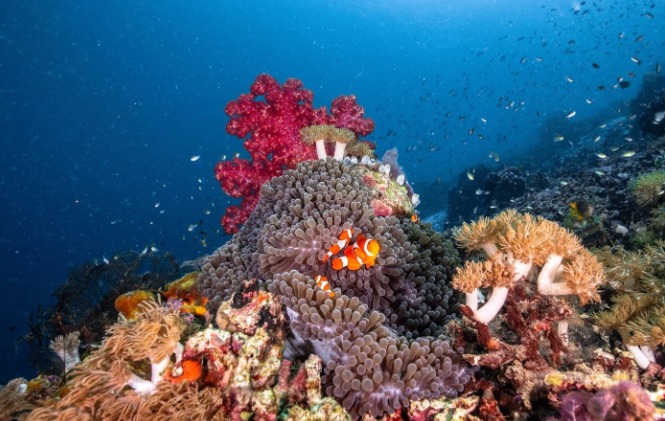
animals Underwater, corals build reefs that are among the richest ecosystems on the planet. True living architectures, essential to thousands of marine species.
Often mistaken for plants or rocks, corals are indeed animals. Each colony is made up of thousands of polyps that secrete a calcareous skeleton. Year after year, these structures accumulate and form reefs that are sometimes thousands of years old. Their growth is slow—from a few millimeters to a few centimeters per year—but continuous, allowing the emergence of veritable natural barriers visible from space.
Architecture at the heart of biodiversity
Coral reefs cover less than 1% of the ocean floor, yet they are home to nearly 25% of known marine species. Their three-dimensional structure provides shelter, breeding grounds, and food resources for a multitude of organisms: fish, crustaceans, mollusks, and sponges. The crevices, cavities, and overhangs create a mosaic of habitats. This architectural complexity is essential: without it, much of this biodiversity could not be sustained.
A fragile balance, threatened by climate
This biological feat relies on a symbiosis between corals and microalgae, which provide them with most of their energy. When water temperature rises or the environment is disturbed, this relationship breaks down: this is coral bleaching. Deprived of their partners, the corals wither and the reefs deteriorate. These structures also play a crucial role in protecting coastlines from erosion and storms. Their disappearance would therefore have major ecological and human consequences.

Coral bleaching at Ningaloo Reef, Australia. - Daniel Nicholson / Ocean Image Bank
Did you enjoy this article? Find » Le Monde des Animaux » magazine at newsstands and on monmag.fr (paper and digital versions, and subscriptions).
The World of Animals & Nature is a magazine dedicated to the wild fauna and flora of the world. Through captivating stories and sublime photographs, the magazine offers a true visual safari into the heart of nature.
source : 20 minutes