
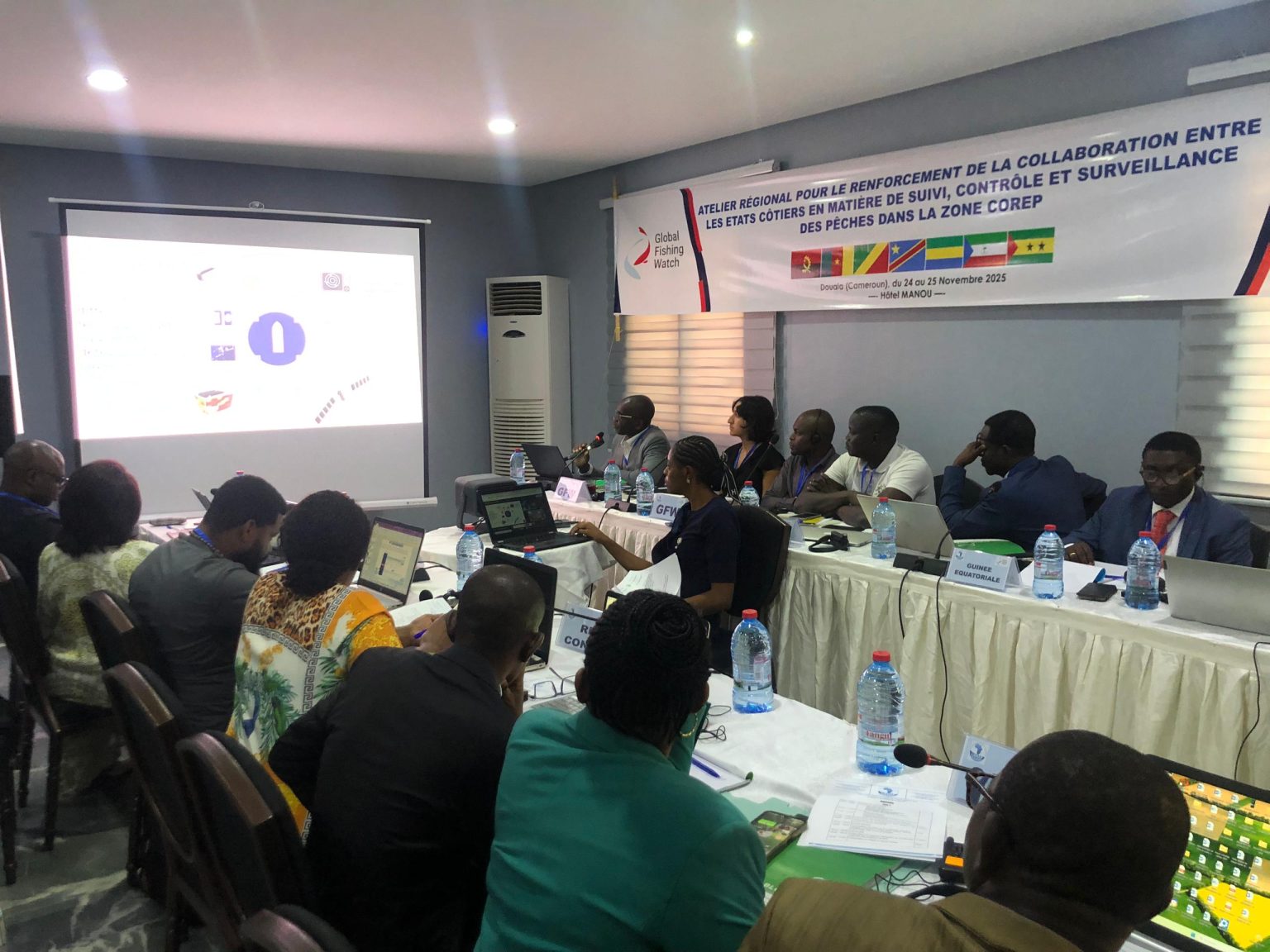
Gathered in Douala since November 24, 2025, seven coastal states members of the Gulf of Guinea Regional Fisheries Commission (COREP) are working to harmonize their Monitoring, Control, and Surveillance (MCS) systems in a region where over 40% of fish catches are estimated to be illegal. This illegal, unreported, and unregulated (IUU) fishing results in annual losses exceeding $1.9 billion for West Africa.
Opened on November 24, 2025, in Douala, the regional workshop organized by COREP and the NGO Global Fishing Watch marks a decisive step in revitalizing cooperation among the seven coastal states of the sub-region. According to the workshop’s terms of reference, participants are expected to relaunch the operationalization of national and regional industrial fishing vessel registers, harmonize surveillance data, and consider a shared platform for combating illegal fishing.
In his opening remarks, Emmanuel SABUNI KASEREKA, Executive Secretary of COREP, emphasized the need to build common tools and streamline information exchange between maritime administrations: “By the end of this workshop, we aim to identify ways to achieve the objectives set out in the memorandum of understanding. […] Facilitate relationships and information sharing among member states to promote transparency and direct management of fisheries resources, and utilize the tools available through our partners to improve our surveillance systems.” For him, the dual challenge is to strengthen regional cooperation and modernize MCS systems, which remain fragmented within the COREP zone.
Equatorial Guinea, which has one of the largest maritime zones in the sub-region (314,000 km²), sees this initiative as a strategic opportunity. Its Director-General of Fisheries, Mariano NGUEMA ASANGONU, highlighted the importance of collective action against foreign fleet incursions: “We hope that once the project is implemented, we will be well protected at the sub-regional level against illegal fishing. […] We rely on regional policy so that Equatorial Guinea can benefit from the solutions proposed by the experts in this workshop.” For Malabo, having a harmonized framework is essential to defend its resources and improve the management of industrial and semi-industrial activities in its waters.
This workshop comes as the Gulf of Guinea remains one of the global epicenters of illegal, unreported, and unregulated (IUU) fishing. According to several regional analyses (FAO, GFW, Stop Illegal Fishing), between 35% and 40% of catches in the area are of illicit origin. Direct economic losses for coastal states exceed $1.9 billion annually, not including impacts on maritime security, the collapse of small pelagic stocks, and the precarious livelihood of over seven million Africans dependent on artisanal fishing. The COREP zone is among the most exposed to incursions by unlicensed foreign trawlers, illegal transshipments, and vessel registry falsifications, highlighting the importance, stressed in Douala, of reliable registers, shared tools, and interconnected surveillance centers.
Source: environnementales