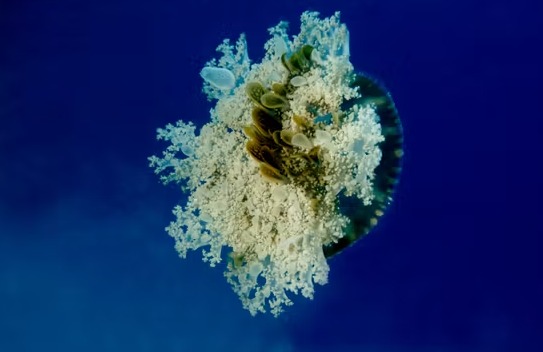
Are we closer to jellyfish and sea anemones than we might have thought? Although the origin of these gelatinous beings lacking a central nervous system dates back to long before the emergence of fish—and therefore, a fortiori, of the first complex brains—their sleep habits are nevertheless similar to those of humans.
This is the surprising discovery made by an international team of researchers who, by studying the behavioral activity of jellyfish and sea anemones, demonstrated that sleep plays an essential role in the maintenance of nerve cells in these animals. Their work, published in the journal Nature Communications on Tuesday, 6 January, sheds new light on the evolutionary history of sleep in these marine invertebrates.
To achieve these results, researchers from the teams of Lior Appelbaum and Oren Levy, specialists in neuroscience and marine biology at Bar-Ilan University (Israel), donned fins, masks and snorkels to observe upside-down jellyfish (Cassiopea andromeda)—a species that lives its life “upside down,” with the bell facing the seabed and the tentacles toward the surface—in the shallow waters of Key Largo, Florida.
Using hand counters, waterproof notepads and stopwatches, they recorded the number of pulsations of the jellyfish’s bell. The team also studied these jellyfish and starlet sea anemones (Nematostella vectensis) in the laboratory.
The researchers retained four behavioral criteria. For example, if the animal remains immobile for a defined period and shows reduced responsiveness to stimuli (water jet, light flash or presentation of food). Another indicator is sleep rebound: an animal kept awake for several hours quickly enters sleep as soon as the stimuli cease. They were thus able to identify that upside-down jellyfish slept when they slowed their pulsations to fewer than 37 per minute for more than three minutes. As for starlet sea anemones, they enter a sleep phase when they remain calm, in a state of quiescence, for more than eight minutes.
In total, these two gelatinous beings rest for about eight hours a day and spend a third of their lives sleeping, like humans. But the most surprising finding lies elsewhere. Indeed, the team was able to establish that if jellyfish and sea anemones sleep, it is because sleep repairs and protects the genetic material (DNA) of neuronal cells. In other words, sleep plays a role in neuron maintenance, essential for long-term functioning, as in humans.
“We were surprised to find that animals as distant from us as jellyfish and sea anemones actually sleep for the same fundamental reasons,” explains Raphaël Aguillon, a postdoctoral researcher in neurobiology at the Institute of Physico-Chemical Biology in Paris and co–first author of the study. “This shows that sleep responds to very ancient biological constraints, common to all nervous systems.”
A survival strategy
Jellyfish, which belong to the phylum Cnidaria (sea anemones, gorgonians or corals), appeared on Earth around 600 million years ago. A study conducted by the team of Ravi Nath at Caltech University (United States) had already shown in 2017 that jellyfish entered a sleep-like state at night. However, the function of sleep in these organisms lacking a central nervous system was not known.
The vast majority of animals have a circadian locomotor activity rhythm that follows the day (diurnal animals) or the night (nocturnal animals) over a twenty-four-hour period. According to researchers from the teams of Lior Appelbaum and Oren Levy, sleep is not regulated in the same way in jellyfish and sea anemones. In C. andromeda, sleep is influenced by the alternation of day and night. These gelatinous bells sleep once night falls and even take short naps in the early afternoon. By contrast, in N. vectensis, which sleep mainly during the day, sleep depends above all on an internal biological clock.
But one essential common point emerges: in both cases, sleep helps reduce DNA damage in neurons that accumulates during wakefulness. When jellyfish or anemones are deprived of sleep, this damage increases, triggering a sleep phase longer than normal.
These results echo numerous observations in humans, where sleep disorders are associated with cognitive decline and neurodegenerative diseases. For the researcher, sleeping is therefore not a luxury, but a survival strategy: “Sleep, in animals as in humans, is a biological necessity to preserve the long-term health of our neurons,” concludes Raphaël Aguillon.
Source : Le Monde