

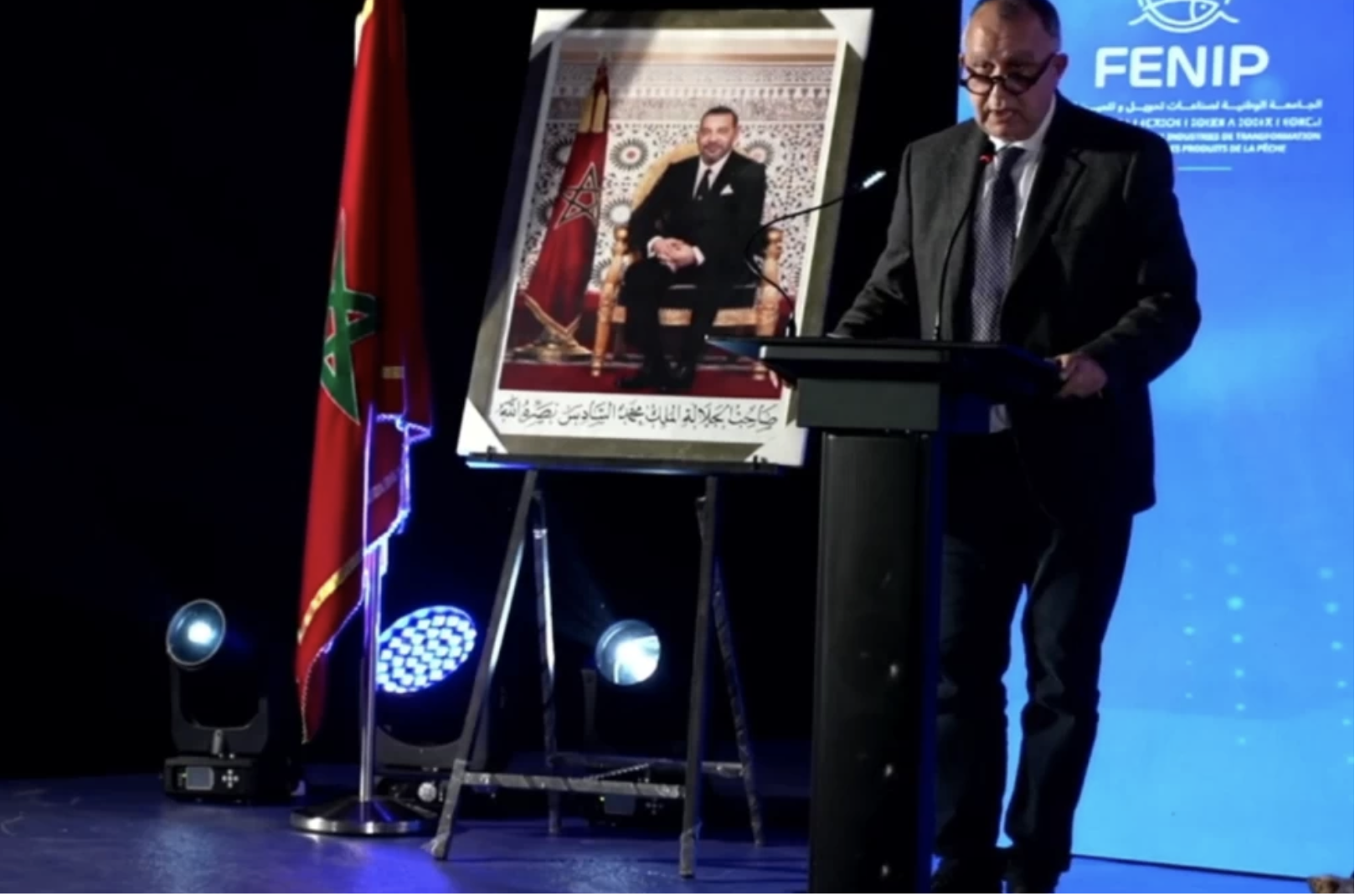
losed in Dakhla after three days of debate, the second « Seafood4Africa » led to a series of recommendations aimed at accelerating the local processing of seafood, structuring aquaculture and strengthening African value chains. Above all, the Forum recorded a change of course: making the blue economy an operational tool for sovereignty, regional integration and sustainable value creation.
It is a fence that marks a change of course. At the end of the second edition of Seafood4Africa held in Dakhla under the High Patronage of His Majesty the King
Mohammed VI, a clear inflection was recorded in the way of approaching the blue economy. « We have crossed a threshold, not a display threshold, but a threshold of collective maturity, » summarized Adnane Debbagh, an expert in geopolitics and global strategy, in charge of presenting the final summary of the forum on behalf of FENIP. According to him, the work showed that Africa was no longer « in the time of general observations or in that of discourses of intention », but that it was gradually entering « the time of architectures, tools and concrete mechanisms ».
This evolution is first reflected in a central recommendation: to accelerate local processing and the increase in the range of seafood industries. The forum insisted on the need to get out of a model still dominated by the export of raw products. « Transformation becomes a condition of economic sovereignty, » said Debbagh, calling for the development of products with higher added value and African brands capable of establishing themselves on regional and international markets.
Science and infrastructure as a foundation of competitiveness
The second recommendation from the work of this forum places science, data and traceability at the heart of the management of fisheries resources. Knowing more about stocks, understanding their evolution and sharing information at the regional level are, according to the rapporteur, the basis for modern and responsible fishing, both sustainable and economically viable.
This approach is accompanied by a third priority axis: the modernization of the cold chain, ports and logistics infrastructure. Participants stressed that reducing post-capture losses and improving quality directly conditioned the competitiveness of African sectors and their ability to access regional and international markets.
Aquaculture and financing, two strategic levers
The fourth recommendation from the closing summary concerns the structuring of aquaculture as a strategic pillar of African food security. The potential is considered considerable, but its realization requires rigorous planning, appropriate species choices, applied research and better market organization. « Producing only makes sense if you know how to transform and sell, » recalled Mr. Debbagh.
Fifth clearly identified priority: financing. The forum stressed that the challenge is not only to mobilize more resources, but to better structure projects and align financial instruments with the real needs of the sector. Mixed finance, thematic funds, guarantees and blue bonds have been presented as promising tools, provided they rely on solid project engineering.
Form, include, rebalance
The sixth recommendation emphasizes strengthening training, innovation and inclusion of field actors. The debates recalled that technology, whether it is digitization, artificial intelligence or new industrial processes, only has an impact if it is appropriate and integrated into uses. Investment in human capital thus appears inseparable from any modernization strategy. The seventh orientation calls for a rebalancing distribution chains so that the value created benefits more to producers, processors and African territories. This dimension appeared as a prerequisite for the development of a fairer intra-African trade, consistent with the objectives of the African Continental Free Trade Area (CAFC).
The last recommendation opens up a more industrial and long-term construction site: to initiate the development of an African naval industry dedicated to the needs of fishing and the blue economy. This link is considered strategic for the modernization of fleets, still largely dominated by timber, and for strengthening the industrial sovereignty of the continent.
Dakhla, showcase of a continental ambition
These orientations traced in Dakhla reinforce the vocation of this city as a hub of the African fishing ecosystem. For Yanja El Khattat, president of the Dakhla-Oued Eddahab region, « the holding of this major event confirms that Dakhla has become a privileged destination for the organization of international forums ». In a statement to the « Matin », he stressed that this edition, marked by the presence of several African ministers and high-level economic actors, was directly part of the vision of His Majesty King Mohammed VI aimed at strengthening economic integration between Morocco and its African depth. « It opens up concrete prospects for cooperation and partnership between Moroccan and African operators, making the fishing sector a real bridge for development in Africa, » he added.
This continental dimension was also highlighted by Jorge Santos, Minister of the Sea of Cape Verde. « This is my second visit to Dakhla and I am impressed by the development of the city and the growth of the maritime economy, » he told the « Matin ». « I am particularly surprised by the technological level of this exhibition, whether it is the techniques of capture, conservation or transport of products. It is no longer necessary to go far to find this technology, it is here in Morocco! » he added. For him, the challenge is now that Africa appropriates its destiny by investing in human capital, research and industrialization, « Seafood4Africa » constituting « an ideal meeting point between public policies, private actors and financial institutions ». nA forum called to be in the long run
The various recommendations are the result of two days of collective reflection, organized around five thematic panels. The exchanges initially focused on local processing and the recovery of seafood, with a focus on industrial innovation, certification and traceability. They then expanded to public-private partnerships and intra-African trade, in the perspective of the Zlecaf, before addressing the modernization of fishing and ports through technologies, digitization and the energy transition. Aquaculture occupied a central place in the discussions, considered a pillar of African food security, while a specific panel looked at the financing mechanisms necessary to make exploitation and blue economy projects bankable. Beyond the conferences, the trade show brought together nearly a hundred exhibitors from Morocco, Africa, Europe and Asia, counting on some 5,000 visitors. For Taha Chokry, deputy organizer of « Seafood4Africa », the event succeeded in combining exhibition and conference cycle, with the ambition of mobilizing industrial expertise in the service of the entire Moroccan Sahara region, in a logic of shared development.
The National Federation of Fisheries Processing and Recovery Industries (FENIP), organizer of the event, recalled the importance of the involvement of the private sector. Its director, Lamia Znagui, told « Matin » that the objective was to strengthen the creation of local added value, generate decent jobs and intensify intra-African trade, while making aquaculture a lever for transformation in the context of an environmentally friendly blue economy.
At the end of this second edition, « Seafood4Africa » appears as an appointment now installed in the African economic landscape. « The blue economy is, by nature, a collective project, » recalled Mr. Debbagh, stressing the importance of regional integration, South-South cooperation and knowledge sharing. As such, the foundations have been laid to inscribe this dynamic over time, with the ambition to make the forum not only a space for reflection, but a real tool for supporting concrete projects on a continent scale African
source : le matin

