

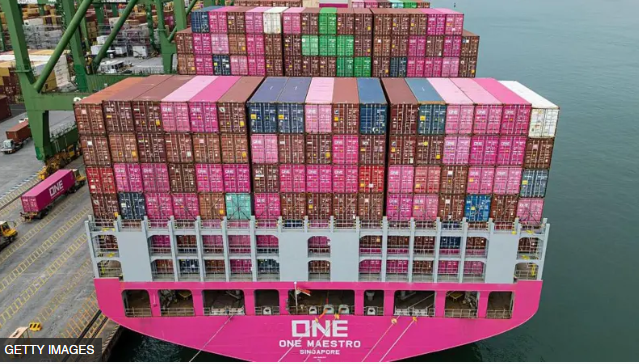
The conflict in Iran has disrupted energy and commodity markets. The country has effectively closed the Strait of Hormuz, a vital oil transit route, by attacking more than a dozen ships in the last two weeks that were attempting to use it.
Donald Trump pressured US allies in Europe to help secure the Strait of Hormuz, warning them that their refusal to support American efforts to reopen the channel would be « very damaging to the future of NATO. » But Iran vowed to keep the strait closed.
Disruption to maritime traffic in the Gulf has led to a surge in Brent prices, which have risen from around $70 a barrel before the crisis to over $100.
Global trade in a wide range of other goods, from consumer products to agricultural products, is also affected. But the crisis has also highlighted a broader problem: global trade depends on a surprisingly small number of narrow shipping lanes, often referred to as maritime « strategic chokepoints ».
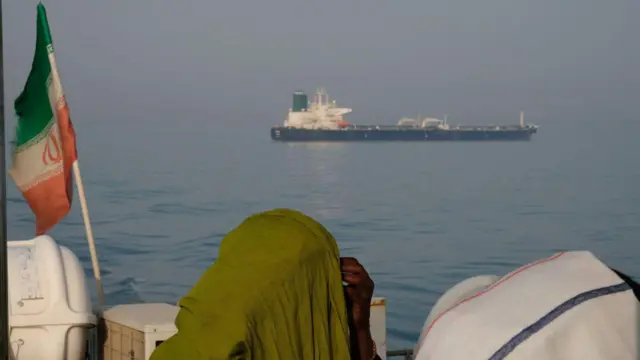
We present below a guide to the main bottlenecks in global trade and their vulnerability to potential disruptions.
1. Strait of Hormuz
The Strait of Hormuz is the world’s most important strategic energy transit route. It connects the Persian Gulf to the Arabian Sea and carries approximately 39% of the world’s seaborne crude oil and 19% of its natural gas.
Unlike most other strategic trade routes, there is no viable alternative to the Strait of Hormuz for Gulf States wishing to export their energy.
Iran has regularly threatened to close the Strait of Hormuz since the 1980s. However, the disruption to maritime traffic observed since the end of February, following the first air strikes carried out by the United States and Israel on Iranian territory, represents the most serious escalation in recent decades.
This situation has led to the most significant disruption to oil supplies in history and a surge in global crude oil prices.
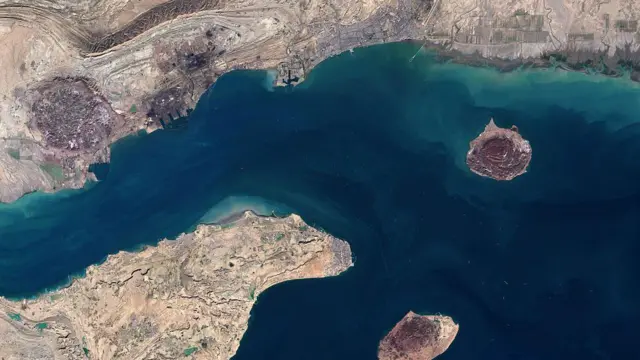
Image caption,The closure of the Strait of Hormuz has caused serious problems with the global oil supply.
The consequences of the current disruptions to maritime transport in the Gulf extend far beyond the energy sector. The Gulf region handles more than 26 million containers annually, and significant fertilizer exports transit through it.
Therefore, a prolonged disruption to maritime transport will have a direct impact on global food production costs.
2. Suez Canal
The Suez Canal connects the Red Sea to the Mediterranean, reducing travel time between Asia and Europe by at least ten days. This waterway carries 10% of global maritime trade, including 22% of container traffic, 20% of vehicle shipments, and 10% of crude oil.
Under Egyptian control, it is difficult to threaten directly. However, it is not immune to accidents, as demonstrated by the grounding of the container ship Ever Given in 2021. The ship blocked the canal for six days, disrupting nearly $10 billion in trade.
The greatest vulnerability of this strategic point lies in the Bab el-Mandeb Strait, located at the southern end of the Red Sea.
Attacks perpetrated against merchant ships by the Iranian-backed Houthi group in Yemen between 2023 and 2025, in retaliation for the Israeli war against Hamas in Gaza, forced many shipping companies to change their routes to avoid Africa.
Image caption,The day before hostilities began, the price of a barrel of Brent crude oil was around 70 US dollars.
This has reduced maritime traffic in the Suez Canal from over 26,000 ships in 2023 to around 13,000 in 2024.
Houthi leaders have recently threatened to resume attacks on commercial shipping in retaliation for Israeli and American attacks on Iran, warning in official communications that they were « ready to intervene ».
3. Panama Canal
The Panama Canal, which connects the Pacific and Atlantic Oceans, accounts for about 2.5% of global maritime trade – a modest proportion, but concentrated on strategic and high-value goods, such as containers, automobiles and grain.
The canal carries approximately 40% of U.S. container shipments, worth US$270 billion (153,286,182 million and 3 cents of CFA francs) annually.
Its vulnerability stems from both climate and geopolitics. In 2023 and 2024, severe droughts caused a dramatic drop in water levels in the canal’s freshwater reservoirs, imposing restrictions on the number and size of ships.
Then, in early 2025, Trump threatened to take control of the canal. He cited concerns about the management of some of its ports by Hutchison, a Hong Kong-based company.
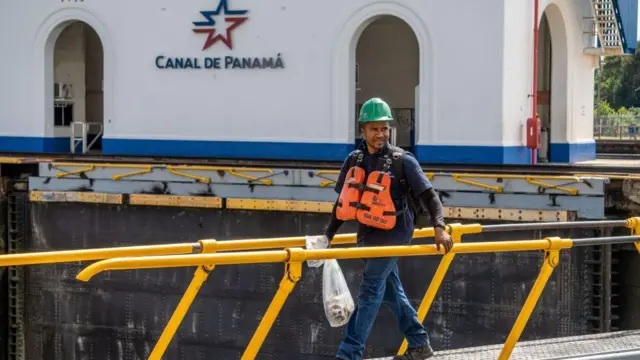
Image caption,The Panama Canal had a transformative effect on the planet even before its construction began.
4. Strait of Malacca
The Strait of Malacca is the world’s busiest shipping lane. It carries 24% of global maritime trade, including 45% of seaborne crude oil and 26% of automobiles. Singapore, home to the world’s second busiest container port, is also located on this waterway.
Malacca is the main entry point for energy imports from China, Japan, and South Korea. Nearly 80% of China’s oil imports transit through it, a dependence that Beijing refers to as the « Malacca dilemma. »
Piracy remains a constant concern, with more than 130 incidents recorded in the Strait of Malacca in 2025. But the main risk is geopolitical. Any escalation of tensions between China and the United States or India regarding maritime dominance in the region could seriously disrupt passage through the strait.
Malacca is also vulnerable to natural disasters, such as tsunamis and volcanic activity. The tsunami of December 26, 2004, for example, caused significant damage to coastal infrastructure at the southern entrance to the strait.
5. Turkish Straits
The Turkish straits – the Bosphorus and the Dardanelles – constitute the only maritime route between the Black Sea and the Mediterranean. They handle 3% of global maritime trade. While this proportion may seem small, it includes approximately 20% of global wheat exports from Ukraine, Russia, and Romania.
At only 700 meters wide at its narrowest point, and passing through the heart of Istanbul, Turkey, navigation is complex and minor skirmishes are frequent. Under the Montreux Convention, Turkey controls military access to the strait, a power Ankara has used since Russia’s 2022 invasion of Ukraine to restrict the movement of warships while keeping commercial traffic open.
A new escalation in the Black Sea region could disrupt this balance and upset global grain markets. The region’s high seismic activity adds a further risk.
The current crisis in the Strait of Hormuz has highlighted the extreme vulnerability of global trade to disruptions, due to its reliance on a limited number of narrow waterways. But the five canals mentioned above are not the only critical points for trade. There are up to 24 strategic maritime points worldwide, including other important waterways such as the Taiwan, Dover, and Bering Straits.
Each of these waterways is exposed to a particular combination of geopolitical tensions, climate change, piracy, accidents or natural disasters.
source : BBC NEWS AFRICA


