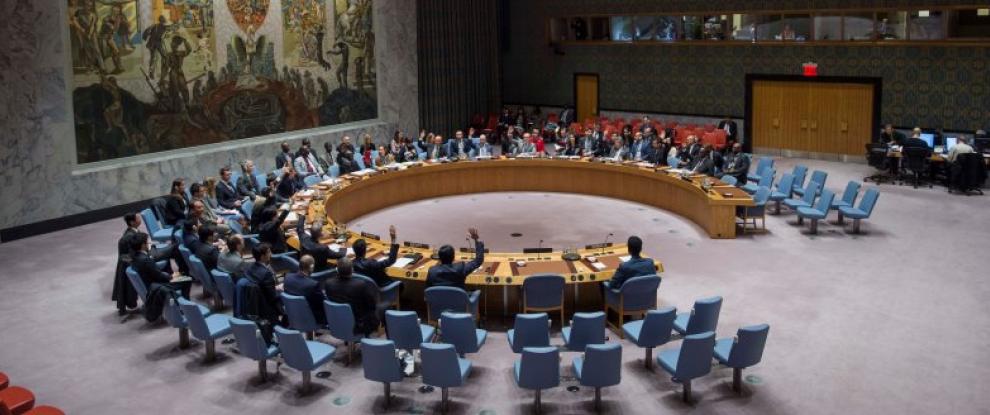
The General Assembly today concluded its consideration of matters related to oceans and the law of the sea, adopting four texts, including one on the entry into force in January 2026 of the Agreement on the Conservation and Sustainable Use of Marine Biological Diversity of Areas Beyond National Jurisdiction (BBNJ Agreement), adopted on 19 June 2023. At the request of the Russian Federation, the text was put to a vote.
The Assembly also took action, as it does each year, on the omnibus resolution of about sixty pages on oceans and the law of the sea, following the adoption of an amendment, on the resolution concerning the sustainability of fisheries, and the resolution mandating the Republic of Korea and Chile to organize the Fourth United Nations Ocean Conference in 2028.
After adoption by 168 votes in favor, with opposition from the Russian Federation and abstention by the United States, of the resolution on the entry into force of the BBNJ Agreement, the Russian delegation stated that the agreement threatens the legal framework established by the 1982 United Nations Convention on the Law of the Sea (UNCLOS), the 1995 Agreement on Straddling Fish Stocks, and the functioning of competent international organizations. Russia criticized the agreement’s main flaw as the lack of a stable and predictable mechanism.
At the start of the session, the President of the International Tribunal for the Law of the Sea, Mr. Tomas Heidar, welcomed that the resolution provides for the Conference of States Parties to UNCLOS to request an advisory opinion from the Tribunal on the implementation of the agreement.
The Assembly also adopted, by 169 votes in favor, with opposition from Argentina and the United States, a resolution on the United Nations conference supporting the achievement of Sustainable Development Goal 14 (life below water). The text decides to hold the conference in June 2028 in the Republic of Korea and welcomes the generous offer of the Governments of Chile and the Republic of Korea to host the conference and cover its costs.
The United States, which requested the vote, reaffirmed that the 2030 Agenda and its goals constitute a “rigid” governance document that encroaches on their sovereignty.
A Controversial Amendment
Finally, the General Assembly adopted, by 166 votes in favor, with opposition from Türkiye and abstentions from Argentina, Colombia, El Salvador, and the United States, the omnibus resolution on oceans and the law of the sea. Previously, an amendment presented by Brazil to include a reference to the 30th Conference of the Parties to the United Nations Framework Convention on Climate Change (COP30) had been approved by 135 votes in favor, opposition from the United States, Israel, and Tonga, and 24 abstentions, following a vote requested by the United States.
An amendment of this nature is unprecedented, said Singapore, the author of the text. It regretted “reopening” a document resulting from long and delicate negotiations concluded by consensus. Norway, which abstained, expressed the same regret, noting that a simple technical update would have avoided a vote. Vietnam hoped the Assembly would not set a dangerous precedent here. However, the Philippines, supportive of the amendment, expressed a similar view, backed by Saudi Arabia.
Also supportive, the United Kingdom and the CANZ group (Canada, Australia, New Zealand) abstained for procedural reasons. Türkiye took the opportunity to recall that it will host COP31 in Antalya, while rejecting any reference to UNCLOS in the adopted text, noting that it is neither a universal nor exclusive legal framework.
The resolution clearly reaffirms the universality of the Convention and its unitary character, and calls on States to align their domestic legislation with its provisions.
At the start of the session, the Secretary-General of the International Seabed Authority, Ms. Leticia Reis de Carvalho, emphasized the “existential importance” of the seabed mining code under negotiation.
To guide its work, the Assembly considered two reports from the Secretary-General on oceans and the law of the sea (A/80/70 and A/80/364), two reports from the Special Plenary Working Group on the Global Systematic Observation and Assessment Mechanism of the Marine Environment, including socioeconomic aspects (A/80/504 and A/80/552), as well as a report on the work of the Open-Ended Informal Consultative Process on Oceans and the Law of the Sea at its 25th meeting (A/80/159).