
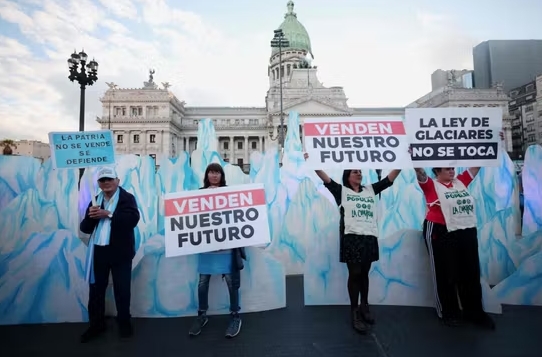
At the end of a marathon parliamentary session, Argentine deputies adopted, on Thursday, April 9, the so-called « glaciers » law (137 votes in favor, 111 against, 3 abstentions), thus amending a text dating from 2010 that protected glaciers and periglacial areas. The Senate had already given the green light on February 26 to this project carried out by the executive.
The stated objective of the text: to encourage productive activities in glacial and periglacial areas, where they were previously prohibited. In this federal state, it will now be up to the provinces to establish the criteria for preservation in the context of mining projects in particular. The text had the support of the mining provinces of the Andes, such as Mendoza, San Juan, Catamarca or Salta, in the northwest of the country.
« From now on, our country regains true environmental federalism and an intelligent and sovereign policy for the exploitation of its resources, » said ultraliberal President Javier Milei in a statement published after the vote. Upon the approval of the Senate, the president elected in 2023, who denies human responsibility for climate change, assured that the new text « would guarantee the right to a healthy environment without giving up the rational use of natural resources » and « eliminate ideological distortions and artificial obstacles that prevented progress », boasting « clear rules ».
The result of the vote « is serious and desperate because once a glacier is destroyed, it is irreversible. The deputies have delivered the glaciers and periglacial areas of our country to the large international mining companies, » accuses Enrique Viale, president of the Argentine Association of Environmental Lawyers. « Flaciers and periglacial areas are our water reservoirs, this is where a large part of the rivers of our country are born, which bring life and work where they sink; 70% of the territory is crossed by rivers that are born in the mountain range or the pre-cordillera and feed on glaciers, » continues the lawyer.
Tax benefits
According to various environmental associations, including Greenpeace Argentina, the reform « endangers the access to water of more than 7 million people [for a total population of 46 million], by affecting entire watersheds and deepening already existing territorial conflicts ». The consequences on access to water extend to provinces without glaciers, via watersheds or groundwater, also argues the statement published the day before the vote in the Senate.
According to the national glacier inventory, dating from 2018, Argentina has nearly 17,000 ice packs, representing nearly 8,500 square kilometers of ice, or 0.3% of the territory. A little more than two-thirds are located at the Andes Mountains, the rest in the South Atlantic. « This represents as much a privilege as a great responsibility, given that Argentina is one of the countries with the largest glacial area in the world, » continued the inventory drawn up by the Argentine Institute of Nivology, Glaciology and Environmental Sciences.
The mining industry applauds the reform and anticipates the windwind, mainly for the copper sector. « Normost 70% of copper projects were waiting for this reform to be implemented, » says Roberto Cacciola, president of the Argentine Chamber of Mining Industries. The employer’s representative dreams big. Argentina « could become the sixth or even fourth largest copper producer in the world within six to seven years, with an annual production of 1.2 to 1.3 million tons, » he estimates. « We are not going to destroy glaciers, but combine productive development and environmental protection, » says Mr. Cacciola According to his calculations, the hoped-for mining boom could generate 110,000 direct and indirect jobs for the construction phase of the projects, about 80,000 for the operation phase.
The mining industry can also count on very generous tax and customs benefits for large investments: the « incentive for large investments » (RIGI), introduced in 2024. According to the Center for Legal and Social Studies, an NGO, « the combination of the Glacier Act and the RIGI can create a point of no return for glaciers and the future of life in large areas ». The organization denounces the « legal and environmental irreversibility » underlying this alliance, while the RIGI provides in particular for a non-increase in taxes for the projects concerned over thirty years.
In a country where the defense of the environment has no political representation, the amendment to the glacier law has aroused strong opposition. More than 100,000 people had registered to speak at the public hearings on March 25 and 26 in the Chamber of Deputies. Only a handful were able to speak out. Various environmental organizations, including the Argentine Association of Environmental Lawyers, announced that they would challenge this reform in court.