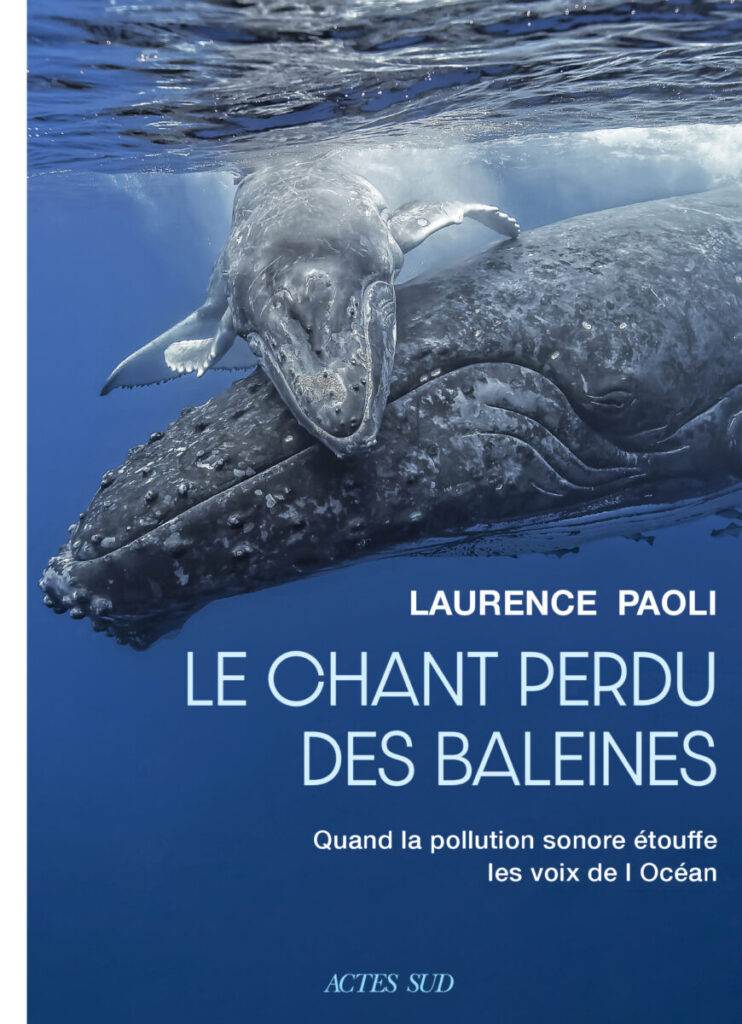
Fishing, shipping, water sports, military exercises… In The Lost Song of the Whales, an in-depth investigation, Laurence Paoli reveals how marine wildlife is affected by the constant noise of human activity.
Noise pollution is already an underestimated threat to human health – the second-largest environmental risk factor in Europe after air pollution, according to the World Health Organization. In The Lost Song of the Whales (Actes Sud, 352 pages, €23.50), Laurence Paoli, author of popular science essays on nature, presents a dense and precise investigation into the even more harmful impacts of human noise on marine creatures, from shrimp to blue whales.
The book immerses the reader in the emergence of underwater bioacoustics and its major scientific discoveries over recent decades. One example is the SOFAR channel – short for Sound Fixing and Ranging channel. Located 150 meters deep, between two water layers, this channel “traps” sound waves due to increasing pressure and propagates them extraordinarily far, allowing whales to communicate across thousands of kilometers.
Within this scientific framework, the author details how cetaceans produce and perceive sounds at frequencies largely imperceptible to humans, using them “to feed, deter predators, find mates, navigate, and communicate,” notably through echolocation. This ability allows them to locate food by analyzing the echo returned by a target while creating a mental map of the ocean.
Sonars and seismic surveys
It is precisely these abilities that are fatally threatened by human activities, primarily the low-frequency sonars used by military navies.
Source: Le monde