

As the European Commission conducts its fifth inspection to assess Vietnam’s efforts against illegal, unreported, and unregulated (IUU) fishing, Quang Ngai province (Central Vietnam) is stepping up its vigilance. Between increased monitoring of non-compliant fishing fleets, stricter penalties, and rigorous traceability, local authorities are mobilizing on all fronts to definitively lift the « yellow card » that hangs over national fish exports.
A European Commission (EC) inspection delegation carried out its fifth review of the fight against illegal, unreported and unregulated fishing in Vietnam from March 10 to 19, 2026. This step is considered crucial for the future of the national fishing industry.
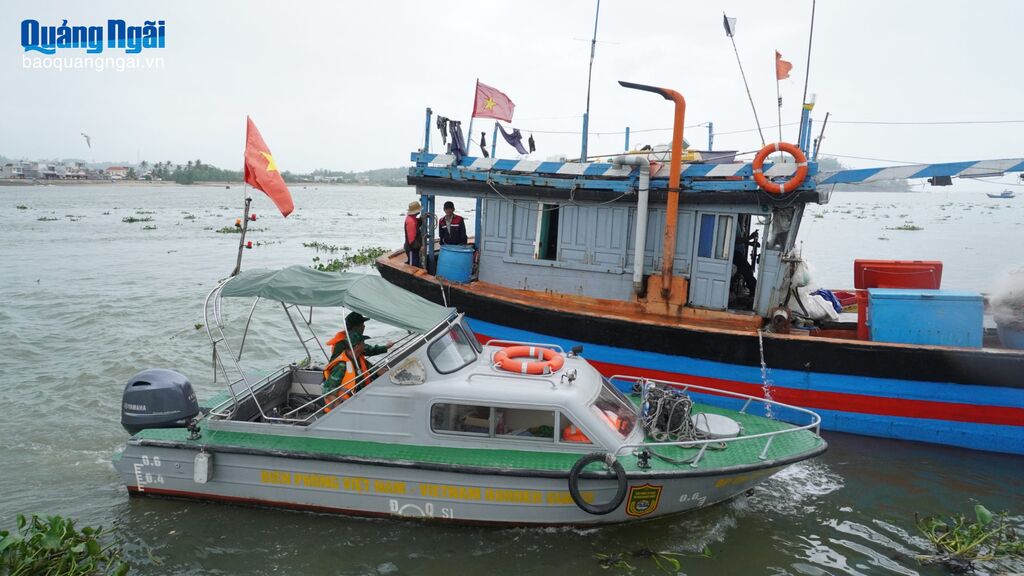 |
| Officers from the border guard post at the port of Sa Ky (Quang Ngai province) are reinforcing patrols along the coastline. |
| Photo: QN/CVN |
Quang Ngai province has made unprecedented efforts to strengthen its fleet management and maritime law enforcement.
One of the top priorities for local authorities is to closely monitor vessels that do not meet operating requirements, particularly those operating without registration, license, or license. Statistics indicate that the province still has approximately 80 such vessels, primarily concentrated in An Phu commune and Sa Huynh ward. To ensure that none of these boats sail illegally, a personalized monitoring system has been implemented, assigning each administrative officer direct responsibility for monitoring specific vessels.
In Dong Son, Ms. Vo Thi Nhan, a specialist with the local economic bureau, ensures rigorous oversight through ongoing contact with owners’ families and physical inspections at anchorages, such as the port of Tonh Hoa. The situation is more complex in Sa Huynh, where 28 non-compliant vessels frequently anchor in other provinces. To address this, an intersectoral cooperation mechanism involving banks, law enforcement agencies, and border guards has been established. Verification teams are even dispatched to neighboring provinces to locate these vessels and collaborate with local authorities to prevent them from setting sail.
Administrative sanctions
In parallel, Quang Ngai has intensified the enforcement of administrative sanctions, in accordance with the EC’s five pillars of inspection: legal framework, fleet management, vessel control, product traceability, and law enforcement. Law enforcement agencies maintain a continuous, 24/7 presence in fishing ports to check the logbooks and licenses of each vessel.
The province has a zero-tolerance policy for past irregularities. Regarding the flaws detected in the issuance of catch certificates (SC) and certificates of conformity (CC) for a shipment of swordfish destined for a company in Khánh Hòa, the Department of Agriculture and Environment has ordered strict disciplinary sanctions against those responsible at the port of Sa Huynh. Furthermore, the provincial police, in coordination with the Provincial Inspectorate, have conducted thorough investigations to definitively resolve these cases and restore the credibility of the control system in the eyes of European inspectors.
From a technological standpoint, the satellite-based Vessel Monitoring System (VMS) has become the cornerstone of the fight against IUU fishing. Between 2024 and the end of 2025, more than 800 violations were penalized. Since the beginning of 2026, six cases of disconnection or maritime boundary crossings have been identified, three of which have already resulted in fines totaling 500 million VND. Regular audits are also conducted on companies exporting to the European market to ensure the integrity of the supply chain.
According to Nguyen Dinh Trung, director of the provincial fishing port administration, the control process is now completely airtight. All data related to vessel movements is digitized and cross-referenced with VMS beacons. Traceability certificates are issued only after a thorough verification of the fishing zone’s legality. These sustained efforts aim not only to meet EC requirements but, more importantly, to build a sustainable, transparent, and responsible fishing industry for the future of Quang Ngai province.
source : Le courrier

