
Kpler, the company that maps the flow of oil and raw materials in real time around the world.
The company, created by two French engineers in 2014, gained influence after the Covid-19 pandemic and is gaining notoriety with the war in the Middle East, the first to be followed in real time on animated maps.
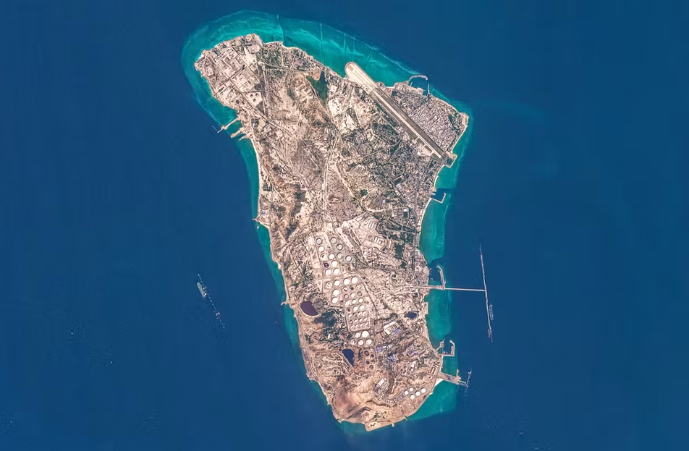
Satellite image, dated March 2, 2026, of the Iranian island of Kharg, in the northern Persian Gulf, home to Iran’s main crude oil export terminal and handling the vast majority of its oil shipments to the rest of the world. ESA/AFP
The 1990 Gulf War is remembered as the first to be broadcast live on television worldwide. The current war between the United States and Israel in Iran may well be remembered as the first to be followed in real time on animated maps, thanks to millions of data points detailing the infrastructure under attack, the number of ships blockaded, their cargo, their origin, their destination, the flag under which they are registered, and even the identity of their owners.
Behind this data lies the company Kpler, founded in Paris in 2014 by two Frenchmen, Jean Maynier and François Cazor. Few articles about the blockade of the Strait of Hormuz fail to mention it, as is the case whenever a crisis plunges the global economy into uncertainty. A symbol of its success, since 2025 it has been among the so-called « secondary » sources consulted by the Organization of the Petroleum Exporting Countries (OPEC) to verify the production figures provided by its member countries and to help it set its quotas.
The company, with an annual turnover of 300 million euros, likes to define itself as a « Bloomberg of the physical world, » providing real-time information on ship routes, cargoes, raw material stocks, refinery utilization rates, and port congestion risks. To achieve this, it aggregates nearly a thousand data points, from handwritten reports by port agents to ship positioning signals, as well as images taken by satellite or drone.
“Our platform functions like a refinery, transforming raw data into high-value information,” explains Mr. Cazor. Kpler’s algorithms calculate the amount of oil transported by a ship based on its waterline, measured by the hull’s shadow on the sea, or the time spent in port for loading and unloading. The flows of nearly 40 raw materials are mapped instantly. No more customs reports three months late.
“Kpler gives us eyes on the market; we see how the barrels move, sometimes we can even guess who’s moving them,” explains Charles Percheron, a trader at Gapuma, a trading company based in Geneva. “The only limitation is temporal, meaning the information stops at the present, whereas a broker knows, for example, if a ship has been booked to transport raw materials in the coming weeks.” The platform, whose 800 employees are spread across Houston, New York, Paris, London, Dubai, and Geneva, thus provides a real-time view of the balance between supply and demand, allowing traders to anticipate market movements. This information comes at a high price: several tens of thousands of euros per year.
Mapping everything is not easy.
The proliferation of crises has accelerated the company’s growth. First came the port congestion and chaos of global trade during the Covid-19 pandemic, then the accidental blockage of the Suez Canal by the container ship Ever-Given in 2021, and finally the Houthi rebel attacks on ships in the Red Sea in 2023. These events highlighted the vulnerability of the value chains that span the globe. « Entire industries realized they could grind to a halt due to supply disruptions, which led them to pay close attention to the issue, » acknowledges Mr. Cazor. Factories want to know exactly where their raw materials are located and in what quantities.
The platform’s 11,000 clients also include traders, insurance companies, international organizations, and governments. With recent Western sanctions on Russian oil, information on the origin of hydrocarbons has become crucial. Kpler understood that this information was also of interest to journalists. It gained visibility by giving them access to its analyses and databases, notably the marinetraffic.com portal , which tracks ship movements worldwide.
But mapping everything isn’t always easy. Ghost ships that clandestinely transport Russian oil, under Western sanctions, have taken to switching off their transponders to disappear from radar screens. « When a ship stops transmitting its position, we can still track it using imagery, because we have almost all of their visual identities, » explains Mr. Cazor, « but it’s a game of cat and mouse because new camouflage techniques are constantly emerging. » The latest involves revealing the position and identity of another ship by hacking its signal.
Other players in the shipping industry dislike transparency, such as billionaires who would like their yachts removed from Kpler charts for fear they will become targets of Iranian attacks. Is the marinetraffic website used by the Revolutionary Guard? « Iran certainly consults it, and that gives us a certain responsibility, but we are not the only ones providing this information, » explains Mr. Cazor.
Kpler has the appearance of a start-up… without quite being one, since it isn’t losing money and has never raised any funds. Twelve years after its creation, the company, founded by two French engineers and still more than 50% owned by them and their employees, is no longer French. It is a subsidiary of a holding company registered in Belgium, a country known for offering a favorable tax regime on dividends and capital gains on shares.
source : Le monde