

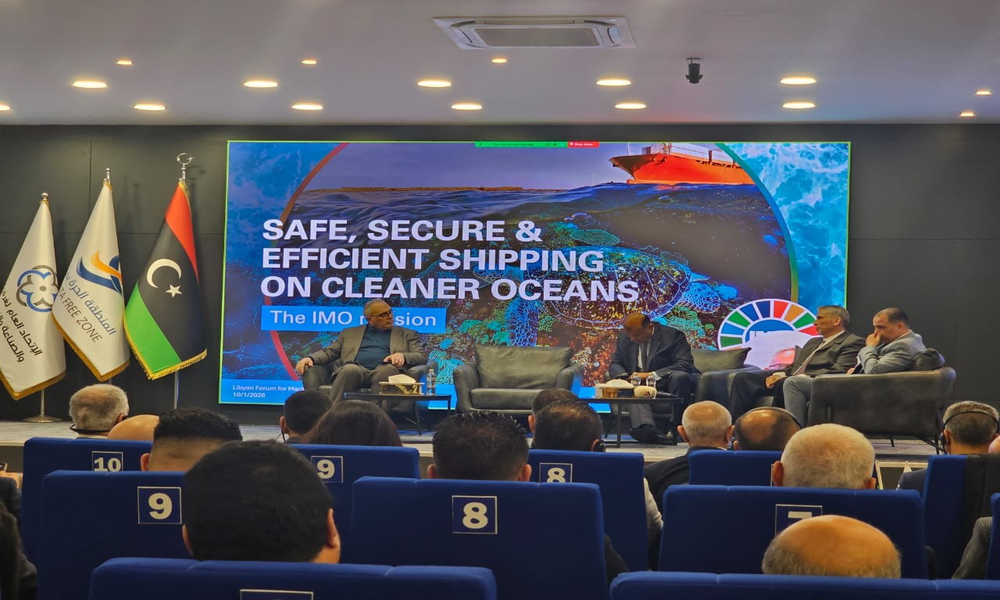
Libyan officials and international experts gathered in the Misrata Free Zone to launch a forum dedicated to the blue economy, presented as a strategic driver for maritime trade and investment in Libya.
The activities of the Libyan International Forum on the Blue Economy began on Saturday in the Misrata Free Zone, organized by the General Union of Chambers of Commerce, Industry and Agriculture, in cooperation with the Libyan Trade Network and the Arab Academy for Science, Technology and Maritime Transport. The event is taking place within the Misrata Free Zone, one of the country’s main logistics hubs.
The opening ceremony was attended by Libya’s Minister of Economy and Trade, Mohammed Al-Huweij, as well as senior institutional and economic officials. Among them were Ismail Abdel Ghaffar, President and CEO of the General Union of Chambers of Commerce; Mohsen Al-Suqutri, President of the Arab Academy for Science, Technology and Maritime Transport; the Chairman of the Misrata Free Zone Board; and Khaled Hanafi, Secretary General of the Union of Arab Chambers of Commerce, alongside international maritime experts and specialists.
According to the organizers, the forum aims to highlight the role of the blue economy in supporting international trade and developing maritime transport systems and logistics services. Discussions focus on port chains, service platforms, maritime training, and regulatory frameworks through roundtables and contributions from international speakers, with the goal of expanding investment opportunities.
The debates will also examine ways to strengthen Libya’s position as a regional hub for maritime activities, leveraging its Mediterranean coastline and existing port infrastructure.
Organizers believe that improving logistics governance and developing human resources are priority areas to attract international partnerships.
On the sidelines of the forum, a cooperation agreement was signed between the General Union of Chambers of Commerce and the Arab Academy for Science, Technology and Maritime Transport.
The agreement provides for exchanges of expertise, support for specialized training programs, and the exploration of opening an Academy branch in Libya to support the development of the national maritime and logistics sector.

