
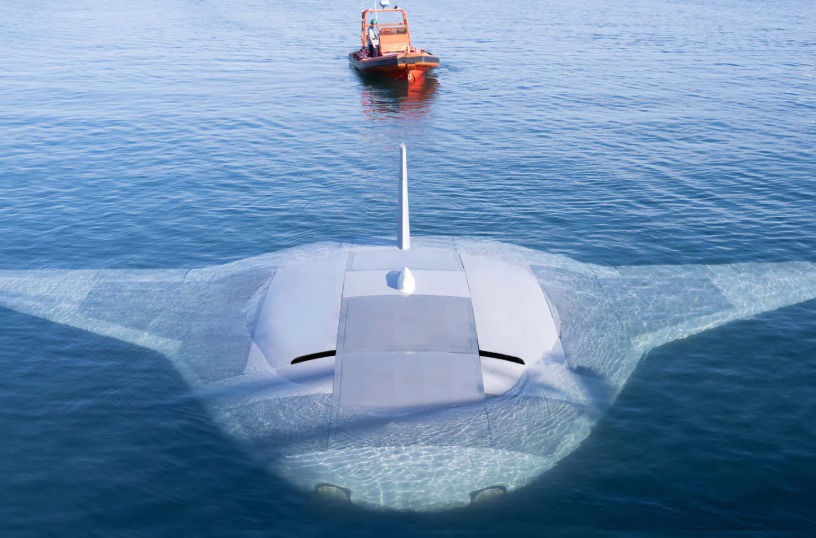
Northrop Grumman has completed a series of tests for a sleek prototype autonomous underwater vehicle. Part of DARPA’s Manta Ray program, the project aims to develop a new generation of submarines capable of conducting long-duration, long-range missions for the U.S. Navy.
The Manta Ray program, launched in 2020 by the Defense Advanced Research Projects Agency (DARPA), seeks to create autonomous underwater vehicles (UUVs) that can operate for extended periods and distances without human intervention. The project is led by Northrop Grumman and PacMar Technologies. The latest tests, carried out by Northrop Grumman, validated the prototype’s hydrodynamic performance under real-world conditions.
An impressive drone that even scares sharks
Between February and March of this year, Northrop Grumman’s “extra-large” underwater vehicle underwent full-scale sea trials off the southern California coast. These tests demonstrated the Manta Ray’s ability to operate submerged using multiple propulsion and steering methods, including buoyancy, propellers, and control surfaces.
According to Kyle Woerner, Manta Ray program manager at DARPA, “These large-scale tests confirm the vehicle is ready to move toward operational deployment after being quickly assembled in the field from modular sub-sections.” The Manta Ray is designed to move efficiently through water using buoyancy-based propulsion and features multiple payload compartments of varying sizes and types, allowing it to carry out a wide range of naval missions.

Among the objectives of the project are demonstrating new energy management techniques for UUV operations, developing low-energy, high-efficiency underwater propulsion systems, and testing methods for low-power detection and classification of underwater threats.
Maritime drones like the Manta Ray provide a cost-effective solution to enhance U.S. Navy capabilities while reducing risks to sailors. In an era where China is seen as the primary competitor, these technologies offer a way to strengthen U.S. presence in the Pacific region without endangering military personnel.
Chief of Naval Operations Admiral Lisa Franchetti views robotic systems and emerging technologies as a means to “add more players on the field.” Last December, the Navy received Boeing’s first Orca XLUUV for additional testing. This 85-ton, 26-meter-long diesel-electric submarine underwent sea trials to evaluate its capabilities both above and below the surface.
The Manta Ray program aligns with this vision of a hybrid fleet combining manned and unmanned vessels. DARPA, in collaboration with the Navy, is exploring new technologies such as artificial intelligence and autonomy to achieve this goal. The agency recently announced contracts with several specialized contractors to build prototypes of large underwater drones.