
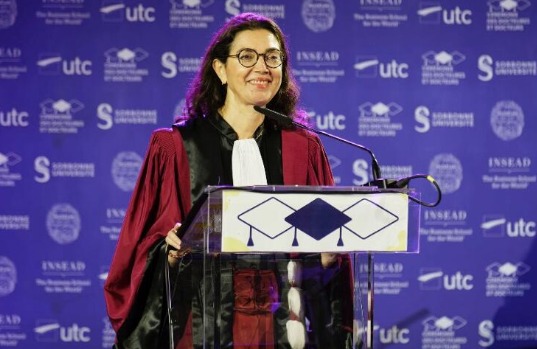
Just appointed director of the Ocean Institute, succeeding Christophe Prazuck, Marina Lévy is a CNRS research director of exceptional class within the Laboratory of Oceanography and Climate: Experiments and Numerical Approaches (LOCEAN), affiliated with Sorbonne University. She has devoted her career to exploring and understanding the complex interactions between the ocean, climate, and biodiversity.
“I have always loved science, which naturally led me to preparatory classes after high school,” recalls Marina Lévy. A graduate of École Polytechnique, she then followed an atypical path. Unable to limit herself to a single discipline, she discovered her vocation during an initial internship in geophysics, followed by another in oceanography. “What drew me to the study of the ocean was its interdisciplinary nature: understanding this immense machine requires knowledge of physics, chemistry, biology, and a strong foundation in mathematics.”
In the early 1990s, as the first IPCC reports highlighted the ocean’s crucial role in climate regulation, Marina Lévy decided to focus on this issue through marine biogeochemistry. She began a PhD at Sorbonne University (then Paris VI), which led to a postdoctoral fellowship at Columbia University in the United States.
The Meeting of Ocean and Space
Marina Lévy then joined CNRS and engaged in international research projects. “I worked with teams in Japan, at MIT in Boston, in India, and even in the United Arab Emirates. Each project allowed me to explore new aspects and deepen my understanding of the ocean.”
Her involvement with the French Space Agency (CNES) marked another key stage in her career. Leading the TOSCA committee group, dedicated to space oceanography, she helped promote the use of satellites to better understand ocean dynamics. “The first expertise I acquired was modeling: I worked on ocean turbulence, pushing the capabilities of existing numerical models to resolve fine spatial scales in currents, which are essential for marine life and biodiversity. Space technology then opened new perspectives.”
Using cutting-edge tools, including Japan’s Earth Simulator supercomputer, she positioned herself at the forefront of global research, earning the CNRS Bronze Medal. “We were among the first to use very high-resolution models requiring immense computing resources. This work laid the foundations for current studies on ocean biogeochemical cycles, biodiversity, and climate change impacts. Reaching this point was exhilarating: it required coordinating national and international communities and building an interdisciplinary research team by seeking new skills.”
A Scientific Voice on the International Stage
Marina Lévy’s affiliation with LOCEAN, the oceanography laboratory of the Pierre Simon Laplace Institute for Climate and Environment, connected to Sorbonne University, has involved her in scientific cooperation with several “Global South” countries, including Senegal, India, Peru, South Africa, and Morocco.
In 2016, she became deputy director of the Ocean, Climate, and Biodiversity Department at IRD, a position she held for eight years. In this role, she promoted a transdisciplinary approach, central to the institute, incorporating social science to address sustainable development challenges.
Since 2024, Marina Lévy has served as Ocean Advisor to the IRD presidency, representing the organization at international events, such as the United Nations Ocean Conference in Nice from 9 to 13 June. Simultaneously, she continues her research: “I am currently studying the impacts of climate change on ocean biogeochemical cycles, particularly deoxygenation—loss of oxygen in marine waters—and carbon cycle modifications. These phenomena have major consequences for marine ecosystems and the services they provide to humanity.”
Teaching and Inspiring
Marina Lévy’s commitment goes beyond research. She is keen to pass on knowledge to the next generation of scientists. “I work with several PhD and postdoctoral students. What motivates me is giving them the tools to pursue this demanding but exciting path.”
Her dedication to education also extends to the general public. Marina Lévy believes that understanding ocean functioning is crucial to protecting our planet. “We need to understand the world around us almost philosophically. The ocean is a pillar of our environment, essential for climate regulation and biodiversity. Without understanding how it works, we cannot grasp the extent of the impact we can have on it.”