

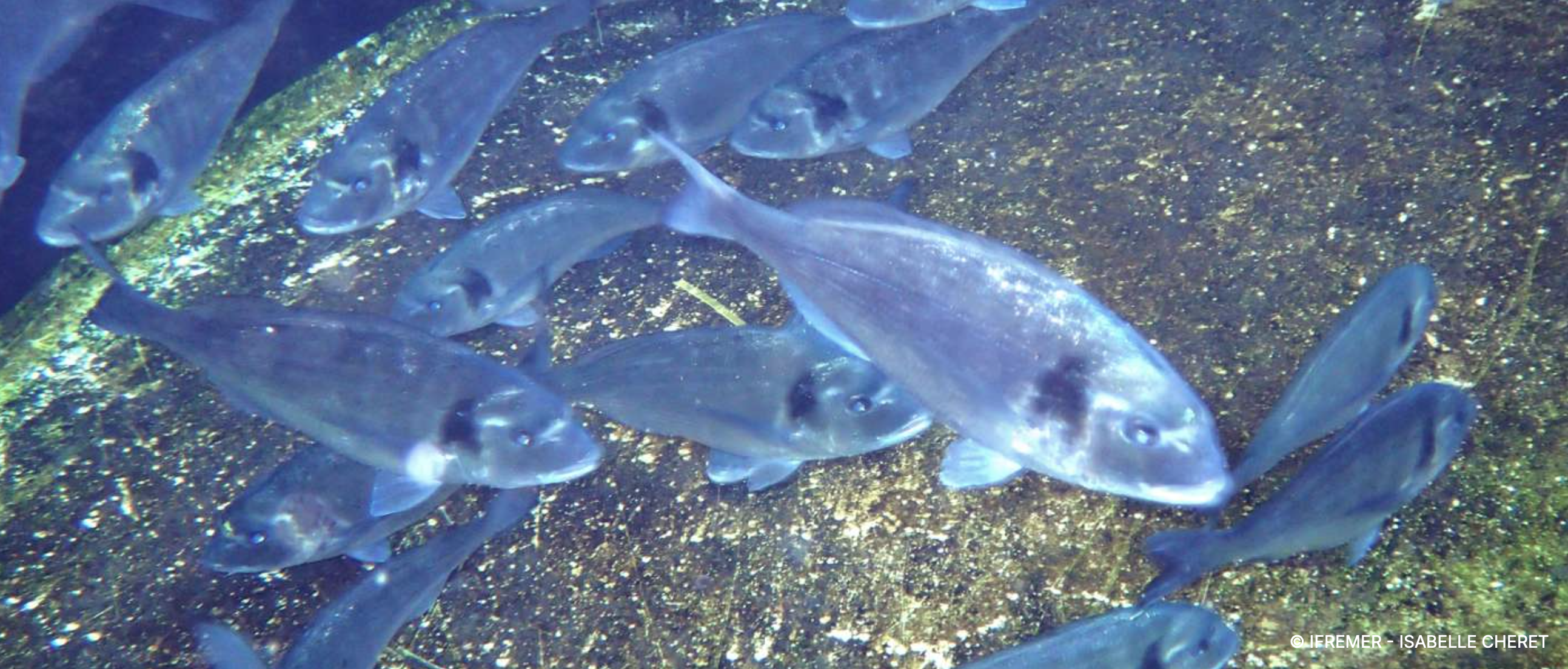
An emblematic species of the Mediterranean, particularly popular for artisanal and recreational fishing, sea bream (Sparus aurata) occupies a central place in the economic balance of the Mediterranean professional sector. A new study published in the journal Movement Ecology reveals that this species travels far greater distances than previously thought. If they are faithful, year after year, to their Gulf of Lion lagoons to feed, they all migrate in the fall and gather off Marseille to reproduce, with the exception of some who rally a second still unknown site located in Spanish waters. This new understanding of the spatial ecology and connectivity of this exploited species reveals crucial issues for the sustainable management of its populations.
During their life cycle, animals, whether they evolve in land or marine, move at various spatial scales, in various environments and for specific motivations. In the Mediterranean, the sea bream (Sparus aurata) migrates with the seasons, especially to reproduce or feed. Despite the ecological and economic importance of this species, its « breeding migrations », a key phase of its life cycle, remained very little known until now.
Conducted as part of the CONNECT-MED and RESMED projects, in partnership with all the marine protected areas in the area – including the Calanques National Park, the Côte Bleue Marine Park and the Gulf of Lion Marine Natural Park, this study is based on an exceptional acoustic telemetry device put in place: 222 sea breams were individually monitored for three years (2019-2022) thanks to small acoustic transmitters, and more than 180 underwater acoustic receivers also called « listening stations », deployed from Spain to the Calanques of Marseille, from the lagoons to the offshore. This device makes it possible to record each passage of an individual marked near a receiver and thus to know his position on a specific date. In total, more than 700,000 detections have made it possible to trace the movements of these fish on nearly 400 kilometers of coastline spread across the two countries.
Daurades faithful to their lagoons to feed
As already demonstrated in a previous study conducted in the Prévost lagoon (Hérault), these new results confirm that the sea bream adopts a well-marked seasonal life rhythm on the scale of all Mediterranean lagoons. From April to September, it stays mainly in lagoons and coastal areas to feed. In the fall, a massive and synchronized departure is observed: sea breams leave the lagoons to join breeding areas at sea, where they gather from October to December before returning to their lagoon of origin. This behavior is repeated from one year to the next, a sign of strong loyalty to their feeding and breeding site.
The coastal area around Marseille: an essential breeding site for the populations of the Gulf of Lion
Among the key sites identified, the coastal area around Marseille, including the Calanques National Park and the Côte Bleu Marine Park, appears to be a major breeding area.
« Our results suggest that the vast majority of sea bream in the Gulf of Lion are concentrated from October to early December in the Marseille region to reproduce. This is a phase of their life cycle essential for the renewal of the population during which they are very vulnerable to professional and recreational fishing. It would therefore be necessary to limit sampling in this area and at this time by setting up a thoughtful management based on this new knowledge, « says Jérôme Bourjea, researcher in fisheries and conservation biology at Ifremer in Sète and head of the Connect-Med project.
A connection with Spain revealed for the first time
If the monitoring of the sea bream in the Salses-Leucate lagoon, located in the Gulf of Lion Marine Natural Park that extends to the Spanish border, showed that two-thirds of them rally the Marseille breeding site, scientists were surprised to observe that a third of the sea sea trees migrate in the opposite direction full south to another breeding site located in Spanish waters and which remains to be identified exactly. This species also being taken in Spain, these results underline the need for coordination between the two countries in the processes of managing the populations of this species as is generally the case for other shared populations of large pelagics such as bluefin tuna or swordfish.
By revealing the invisible routes taken by the royal sea bream, this study also demonstrates the potential of regional acoustic telemetry networks to track connectivity – that is, the links between populations of marine animals, ensured by their movements between different areas of the ocean – coastal species of interest such as here the sea bream or the wolf (Dicentrachus labrax), and, tomorrow, to understand the impact of the deployment of offshore wind turbines on fish communities.
« Our results show that the management of sea bream in the Mediterranean cannot be limited to a single site or a single season. It is essential to take into account the connectivity of the habitats used by coastal fish throughout the year at the level of the Occitanie and Provence-Alpes-Côte d’Azur regions but also in Spain and, probably, in Italy, to develop thoughtful strategies for managing the fisheries of these coastal migratory species, « concludes Jérôme Bourjea.
source : mer et marine