
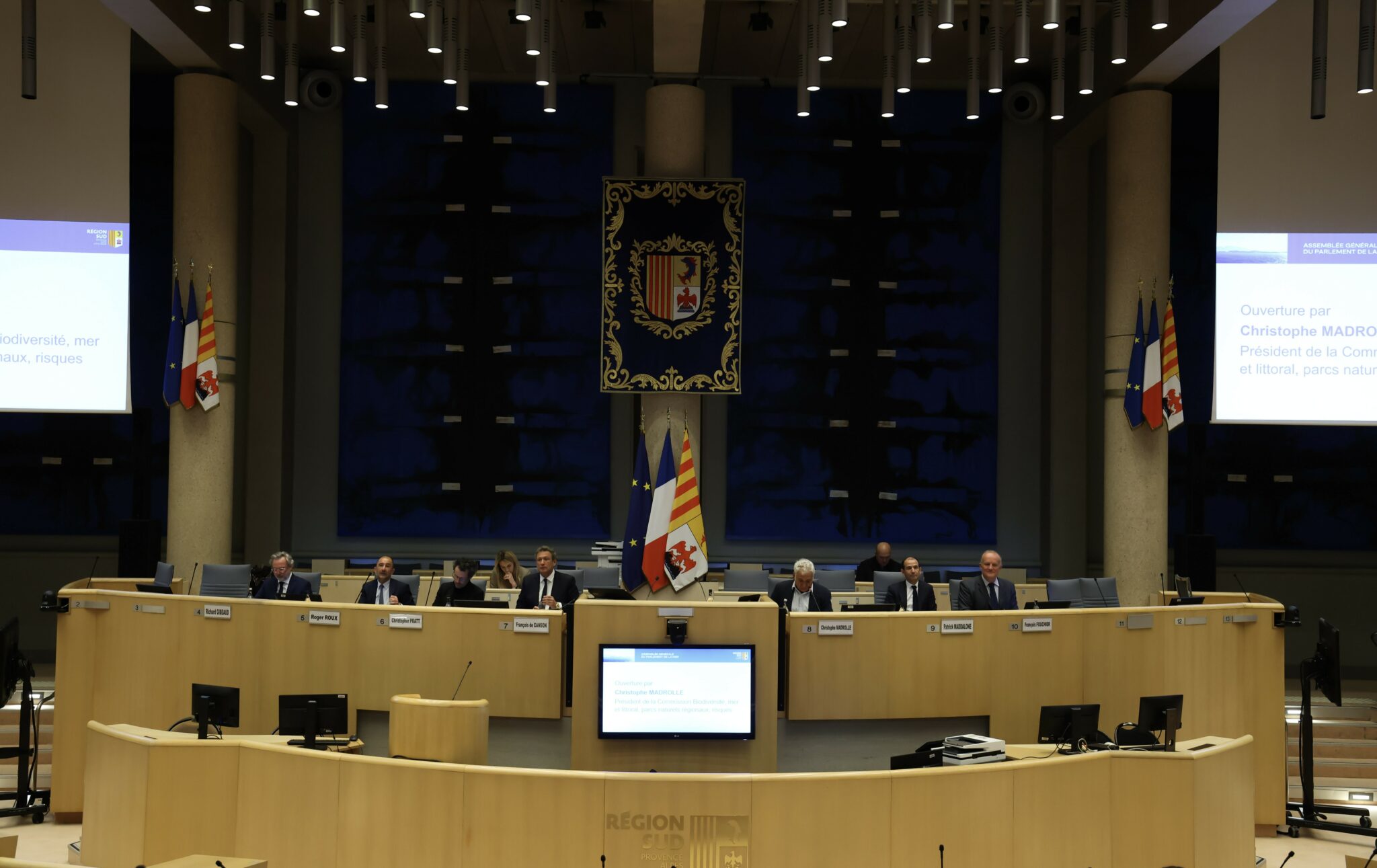
The South Region has just convened the general assembly of the Parliament of the Sea in Marseille, three years after the creation of this consultation body devoted to major maritime issues. Chaired by Renaud Muselier – represented by the president of the Biodiversity, sea and coastal Commission, Regional Natural Parks, Risks, Christophe Madrolle, in the presence of François de Canson, vice-president of the Region in charge of economic development, attractiveness, tourism and the prevention of major risks, Roger Roux, regional councilor delegated to marinas and François Fouchier, regional delegate of the Conservatoire du Littoral Provence-Alpes-Côte d’Azur – the session made it possible to take stock of the actions undertaken since 2022 and to outline the next steps of a regional strategy that aims to make the Mediterranean a laboratory of solutions.
Behind the figures and the devices presented, a watchword was imposed throughout the plenary: there is no longer any question of opposing economic development and environmental protection. The line defended by the regional executive is that of an articulation between the two, on a coastline where wealth, uses, tensions and vulnerabilities are concentrated. In the balance sheet paper, Renaud Muselier summarizes this philosophy by stating that « economy and ecology are not opposed, they move forward together« .
A body created to coordinate a regional maritime policy
Created in 2022, the Parliament of the Sea brings together economic, scientific, associative, cultural and institutional actors involved in the maritime field. With its 1,000 kilometers of coastline, its 120,000 direct jobs linked to the sea and a particularly valuable biodiversity, the South region fully claims its maritime identity. Organized around four commissions – pleasure/fishing-aquaculture, tourism and sports, marine biodiversity, economy of the sea – Parliament aims to structure a coherent regional strategy.
This logic was reaffirmed on Wednesday, April 1, in a context where the Mediterranean appears more and more as a fragile space. Small semi-closed sea, more vulnerable than others to the effects of climate change, it has seen the average temperature of its coastal waters increase by about 1°C in thirty years. The Region now presents it as a « model ocean », a concentrate of all global challenges: pollution, overexploitation of resources, demographic pressure, climate change and biodiversity erosion.
Marine biodiversity: the Regional Guard and municipalities on the front line
Among the most highlighted measures is the Marine Regional Guard, created in 2023 and co-financed by Europe through the European Fund for Maritime Affairs, Fisheries and Aquaculture. Every summer, about thirty guards come to strengthen the surveillance of the 18 marine protected areas of the region, for a regional investment of 300,000 euros per year.
At the rostrum, Jeanne Chaumont, scientific manager at the initiative PIM association (Petites îles de la Méditerranée), gave flesh to this device. On the island of Grand Rouveau, of which his association shares the management, these seasonal reinforcements have made it possible to conduct nautical patrols, to raise awareness among boaters of the ecological challenges of the site, in particular to the preservation of posidonia herbariums, but also to strengthen links with boat rental companies, diving clubs and other users. For her, the Marine Regional Guard is both a concrete support for surveillance and a lever for professionalization: she herself started as a guard before being hired permanently.
Another project strongly highlighted: the AFNOR certification « Territories committed to the Mediterranean », created in March 2025 to support coastal municipalities in the construction of a global maritime policy. The first certified municipality was La Londe-les-Maures in June 2025. The regional investment devoted to this approach amounts to EUR 80,000. The mayor of La Londe-les-Maures, François de Canson insisted on the interest of this approach, which he does not consider as « one more standard« , but as a tool for transformation. According to him, it makes it possible to give political coherence to actions hitherto dispersed, by structuring the work of the services around three priorities: maritime identity, the sustainable preservation of resources and the development of the maritime economy. This method, he insisted, should make it possible to move « from an addition of actions to a real strategy« .
Posidonia, beaches and coastline: nature-based solutions
The balance sheet also highlights several less visible but essential actions. The charter « For character beaches« , co-financed by Europe through an Interreg Med project, encourages municipalities to keep posidonia benches on beaches to fight erosion. Twenty-two municipalities have already signed it, or more than 50% of the municipalities concerned, and a working group has been set up to support this change in practices.
Behind this file is an issue that is as ecological as it is cultural: to make it accepted that beaches left more natural can also be better protected. During the plenary session, François de Canson insisted on this logic of « solutions based on nature« , recalling that these posidonia benches are far from being a waste but on the contrary constitute a response to the rise in erosion and the rise in sea level.
The Region also contributed to the development of the Regional Biodiversity Strategy, in which 33 actions concerning the sea and the coast were identified, 11 of which were considered a priority. They focus in particular on ecological restoration, the integration of land-sea constraints in urban planning documents, the creation of marine zones of strong protection and awareness of the effects of climate change.
At the same time, the Mon Littoral approach continues its work on the retreat of the coastline: information days, platform dedicated to maritime actors, support of intermunicipalities in the production of exhibition maps, support for local strategies for integrated coastal management, acquisition of satellite data. During the exchanges, the answer to a question from the room was clear: the work undertaken does not stop at 2030, but is already part of the 2050 or even 2100 horizons.
Clean ports: a regional standard that has become a global standard
Another long-hailed success: the rise of the Clean Ports approach, which has reached a new milestone with its inclusion in an ISO standard published in June 2024. The South region and Monaco now have 77 ports that hold this standard, the result of work begun in 2008 and which has gradually made school at European and then worldwide. Since 2015, more than 14 million euros have been invested by the Region for the modernization of marinas.
At the rostrum, Véronique Tourrel Clément, general delegate of the Union des ports de marinance Provence-Alpes-Côte d’Azur (Upaca), described this ISO 18725 standard as a « success story » born here before being exported. His speech gave the measure of the scale of the work: two years of international consultation, consultation of all stakeholders, opposition from some countries in Northern Europe or Canada, and even the abstention of the United States, which made it possible to avoid a blocking veto. In his eyes, the scope of this standard goes beyond technology. « It supervises the management of ports – fairing areas, wastewater, toxic waste – but it also engages a broader vision of the public good, health and biodiversity. »
The debate also slipped on water consumption in ports and shipyards. Several speakers highlighted the progress made, especially in Antibes, with the development of desalination systems or recycling of rinse water. All insisted on the same point: at the time of restrictions, the use of drinking water to clean boats becomes difficult to defend, both for the environment and for the image of the sector. The regional director of the Water Agency also indicated that her establishment was now ready to financially support water saving projects in ports.
Fishing, aquaculture and short circuits: the sea also under the label « Southern Values »
The Parliament of the Sea also focuses on the enhancement of local fishing and aquaculture. The regional desire is to integrate seafood into the « 100% Values of the South » approach, with the installation of signage on doch sales sites and the creation of a website promoting short circuits and local production.
This strategy aims to support fishermen while guaranteeing consumers better traceability. It is accompanied by the launch of a fisheries-aquaculture sector contract, in coordination with the two regional GALPAs, and a specific reflection on blue crab, an invasive species whose proliferation on the coasts and in the ponds of the region now mobilizes scientists, fishermen and processors. The objective is to develop adapted capture equipment and to achieve the enhancement of this species in economically viable conditions.
During the plenary session, Richard Galy insisted on the pragmatic nature of the work carried out in this committee, going so far as to say that certain communication actions had been abandoned to redeploy the credits towards actions deemed more effective. A remark that reflects well the state of mind claimed by the body: to produce concrete more than announcement effects.
Yachting and water sports: supporting the transition of uses
The balance sheet is not limited to biodiversity or professional sectors. It also covers yachting and water sports. The Region recalls its lobbying with the State to develop a bioethanol sector and approve conversion kits, as well as the creation of a bioethanol station on the Old Port of Marseille. It also highlights the work carried out on the ecological and energy transition of boating, on new uses and on safety at sea.
On the water sports side, the Region underlines the effort under the Sailing and Boating Plan: 4.2 million euros voted between 2018 and 2024 to support the investment of sailing clubs, i.e. 971 financed boats, to which are added nearly 3.2 million euros for the creation or modernization of clubs and nautical bases. Support for the Pôle France Voile de Marseille, the regional Espoirs poles and high-level athletes is part of the same logic, as is the sailing system in high school.
Sustainable tourism: regulate without closing
There is also a sharper turn towards sustainable tourism. Several emblematic coastal sites were accompanied as part of the SITEX scheme (Exemplary tourist sites), for an amount of 565,212 euros, including the Fort d’Entrecasteaux in Marseille, the Salins des Pesquiers in Hyères, the Domaine du Rayol or the Rocher de Roquebrune.
The Calanques served as an example in terms of regulation, with the quotas put in place in Sugiton, which allowed a decrease in attendance of about 80% over the test period. The deployment of VisitFlux, intermodal passes, the enhancement of the Côte Bleue TER line, the rise of the coastal cycle route and the creation of a maritime heritage route are part of this desire to better distribute traffic and organize access rather than suffer it.
The region also recalls the rise of environmental labels, the « Change your plan » campaigns and the creation of the seasonal South intervention framework, which has already made it possible to accompany a 28-bed project for seasonal workers in Bormes-les-Mimosas, with 400,000 euros of regional aid out of a total cost of 1.2 million.
Economy of the sea: decarbonization, floating wind and deep sea
In the economic field, the Region insists on the double requirement assigned to maritime industries: economic performance and environmental performance. The file presented to the general meeting recalls that the operation of regional interest « Economy of the sea » articulates several axes: port infrastructure, logistics, shipbuilding industry, offshore wind, underwater activities, marine biodiversity and deep seabed.
One of the most developed points during the plenary concerned the decarbonization of maritime activities, against the background of the Zero Smoke Stopovers plan and the electrical connection of ships at the doch. Some 30 million euros have been invested by the Region in this context, but the exchanges have made it possible to clarify the scale of the Marseille construction site: 30 doch stations available by 2028, 14 of which have already been announced in the short term, and the expected particularly significant pollution reductions, whether SO2, fine particles, NOx or CO2.
The other major issue remains the offshore offshore wind. The Provence Grand Large pilot farm, put into operation in 2024 off Port-de-Bouc, is presented as a first in the Mediterranean. Christine de Jouette, director of Provence Grand Large, who came to testify at the tribune, recalled that its three floating wind turbines, installed 17 kilometers from the coast of Port-Saint-Louis-du-Rhône, 100 meters deep, have been connected to the grid since the fall of 2024 and fully operational since June 2025. Their annual production of 80 gigawatt hours (GWh) is equivalent, according to her, to the electricity consumption of a city of 45,000 inhabitants. It also announced the next step: after the success of Provence Grand Large, its group was selected as part of the call for tenders No. 6 for a 250 megawatt farm, or a capacity ten times higher. For her, these projects must be supported at a time when tensions over fossil fuels are increasing.
Nevertheless, the subject remains sensitive. Several speakers recalled the persistent concerns of some fishermen, in particular about landing areas and cohabitation at sea. Answers were provided, emphasizing the work carried out upstream with the maritime prefecture, professionals and users to avoid exclusion logics. Here again, the Parliament of the sea wanted to be a place of defusing more than head-on confrontation.
Another emblematic file: the emergence of a pole of excellence on the deep sea, launched in December 2025 with the State, Ifremer, the Group of Naval Construction Industries and Activities and the Mediterranean Sea Pole. The Region intends to play a central role in this strategic area, at the crossroads of scientific knowledge, sovereignty and industrial innovation.
In addition, the project carried out by Naval Group in La Londe-les-Maures around a test center for autonomous systems and underwater drones, presented as an example of reindustrialization controlled on an old wasteland, with a strong focus on the integration of the project in its environment and local acceptability.
The same political matrix: making worlds that were unknown work together
Over the course of the plenary, an idea came back with insistence: the Parliament of the sea only makes sense if it is used to connect universes that spoke little or even looked at each other with suspicion. Three years after its creation, the Parliament of the Sea thus appears less as a simple institutional showcase than as a tool of method. A place where compromises are built, sometimes with difficulty, between elected officials, fishermen, ports, industrialists, scientists and associations. A place also where the Region seeks to demonstrate that in the Mediterranean, the transition can no longer only be proclaimed: it must now be organized, financed and shared.
source : destimed