What happens to a plastic once it leaves our hands? In Banyuls-sur-Mer, Plastic at Sea helps companies measure the real impact of their materials on the environment, thanks to tests carried out as close as possible to natural conditions.
In a laboratory in Banyuls-sur-Mer, seawater flows without interruption. She arrives from the sea, crosses glass aquariums, then leaves. Nothing extraordinary on the surface. And yet, this is where some of the most sensitive issues of our daily lives are played out. What do plastics contain? What do they release in the environment? And what do they do to the living?

Blouse on the back, precise gesture, Anne-Leïla Meistertzheim, marine biologist specializing in ecotoxicology and founder of the company Plastic at Sea, supervises the in vivo tests in progress. For several months, his team has been focusing on a very concrete subject: microplastics present in drinking water.« We tested domestic filtration systems, the same ones that can be installed at home on a tap, » explains the doctor. We wanted to know if it really worked, under normal conditions of use. »
And the results fell: up to 76% of microplastics filtered and removed according to the devices. « We are told: 76% is not huge. Yet it is three quarters. And it works on the smallest particles, the ones we feared the most. »

This work announces a major project for the company: the creation of a new laboratory by the end of 2026, dedicated exclusively to the quantification of microplastics. Drinking water, rivers, agricultural soils, fish, food… » We find them everywhere, but today, we don’t really know how many microplastics a person ingests. There have been high-profile figures. We are talking about five grams of plastic microparticles, hidden in our food – the equivalent of a credit card – ingested each week by an individual… These are estimates, but scientifically, we still lack solid data. »
From start-up to international-oriented company
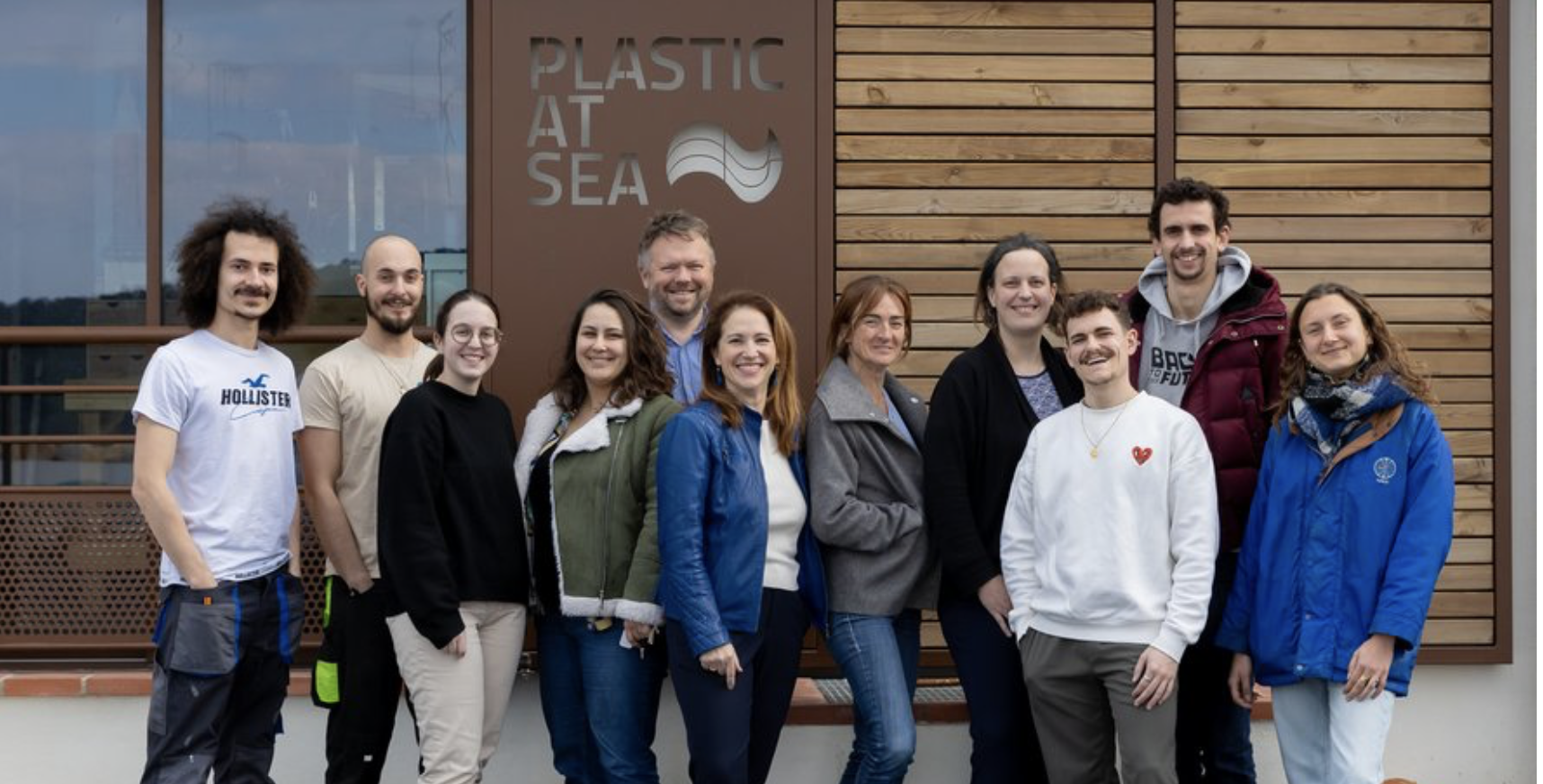
Plastic at Sea was born in 2018, in the incubator of the Oceanological Observatory of Banyuls-sur-Mer. At the time, the start-up would hold within a few square meters. « We were a very small structure with a simple idea: to use life to understand the toxicity of plastics, » says the founder. Six years later, Plastic at Sea has 17 employees, has left the incubator to move to new premises on the port, and works with a French and international clientele.
However, his core business remains unchanged. That of assessing the biodegradability and toxicity of plastic materials. « And accompany economic actors towards responsible choices. Today, 95% of our customers come from the industry. » Large groups such as Bic or L’Oréal, but also start-ups that develop « the plastics of the future ». « Our job is to verify precisely whether these materials are really biodegradable, especially in marine environments, one of the most complicated to analyze. » Plastic at Sea also intervenes directly on industrial sites to identify microplastic leaks. « We always start with very concrete things. Where does the water go when it rains, where are the slopes, where is the nearest river… Then, we measure. These figures then allow them to improve. »
A hub dedicated to the blue economy
Renowned for having « transformed a children’s revolt against sea pollution into a scientific struggle », Anne-Leïla Meistertzheim campaigns for the creation of a future pole dedicated to the blue economy on the Côte Vermeille. « The blue economy is not just about exploiting a resource. We must also preserve it. » An approach that links marine biotechnology, maritime decarbonization and of course water management. « Before arriving at the sea, there is always a river. And before the river, there is the mountain, » recalls the biologist. Hence the idea of thinking about these activities on the scale of an entire territory. «

Despite a sometimes discouraging environmental context, the founder refuses catastrophism. « We’re not going to solve the plastic problem overnight. But there are solutions that work, less toxic materials, efficient filtration systems. These are small steps. » Small steps, put end to end, that end up counting. And that make the invisible… visible.
source : lindependant