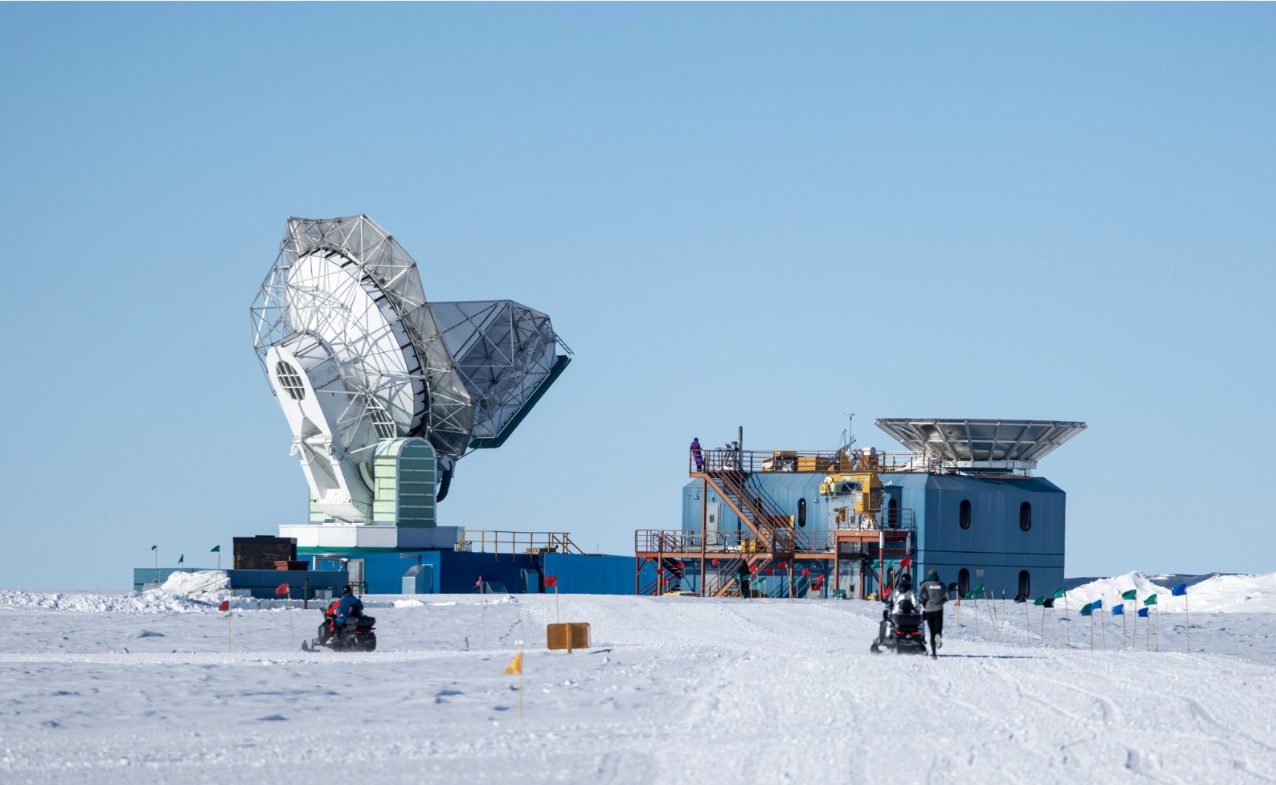
The South Pole is a great place to do research. The air is pure and clear (despite the exhaust fumes from our vehicles and other generators). The research is not affected by Earth rotations and our two seasons, the 4-month summer and the 8-month winter, our long day and night, allow for uninterrupted observation of the sky. The sun can be hunted for a hundred hours without interruption. To facilitate science, the area around the station has been divided into four sectors that restrict human activity.
The « Clean Air Sector » where the winds blowing in the direction of the Atmospheric Research Observatory (ARO) are studied. The moving air, the wind, is virtually untouched by pollution and is probably the cleanest air on Earth.
The « dark » sector is protected in summer and winter against any light and electromagnetic contamination.
The « Quiet » sector is dedicated to seismology and radio sensing. Radio emissions and the movement of people and vehicles are limited as much as possible so as not to affect the quality of detections. An auxiliary seismic station detects surface or underground nuclear tests as part of a nuclear testing treaty.
Finally, the « Downwind Sector » is an obstacle-free area, ideal for weather balloon releases and for the station’s flight operations.

Detecting neutrinos
The leading project for 2025-2026 was the extension of IceCube, our neutrino detector. Basically, neutrinos are almost invisible particles that come to us from space, from far, far away, that pass through everything: our body, our cup, our coffee. There are no side effects to deplore and you can live very well without having heard of it. Smaller than atoms, with a tiny mass and no electric charge, they move at the speed of light, through everything. Trillions of neutrinos pass through our bodies every second… They come from the sun, from supernovas, from cosmic rays that hit the atmosphere. There are three neutrino detectors in the world. One in Canada, in one of the deepest mines in existence. The local rock was modified after it was hit by a comet of some kind a long time ago, making it an ideal detector. The second is in Japan. A mountain produces meltwater, ice of maximum purity, in which collectors have been immersed. Finally, there is the South Pole and its pure ice. 2.5 km wells are dug with a pressurized hot water system into which strings of sensors are inserted. Neutrinos pass through the ice without distortion, some collide with an atom here and there and are « captured » by the sensors, which transmit the data needed by scientists to understand the evolution of the universe, what happens when a supernova explodes or how stars « work« .
Cosmic Ray and Biceps
In the series of things that come to us from space, we also have the CosRay(Cosmic Ray) which, for more than 60 years, has been absorbing neutrons and other protons that come to us mainly from solar explosions or the aurora australis in winter. These rays sometimes create geomagnetic storms that affect radio transmissions. The tracking and analysis of these neutron rains makes it possible to understand the phenomenon and to anticipate solar cycles. We have a giant radio telescope – BICEPS – that allows us to study the nature of the universe and the origins of the Big Bang thanks to the cosmic microwaves it captures. And also the SPT, the giant telescope of the South Pole. No, I’ll stop you right now, there is no optical monocular with which our scientists look at the planets. It is a very sensitive and super-cold radio telescope, which allows it to detect and analyze the smallest sources of heat in the universe. By creating a « map » of hot and cold spots, the system allows a visualization of space, galaxies, the famous « black hole » where it all began. The telescope is mobile and rotates 360 degrees, slowly, scanning the sky, translating the microwave waves it captures into pixels. All this « flies » high above my head and sometimes I wonder if I am the only one who does not understand anything. It’s cool, it allows you to have beautiful photos of the South Pole, it employs lots of well-educated people who tell each other scientific jokes that are incomprehensible to the average person, and sometimes even laugh about it for too long. Thanks to them, I too have the opportunity to live and work in Antarctica. In three weeks, I’ll go back to the North, to a world where all this matters little or nothing.
source : marine-oceans