

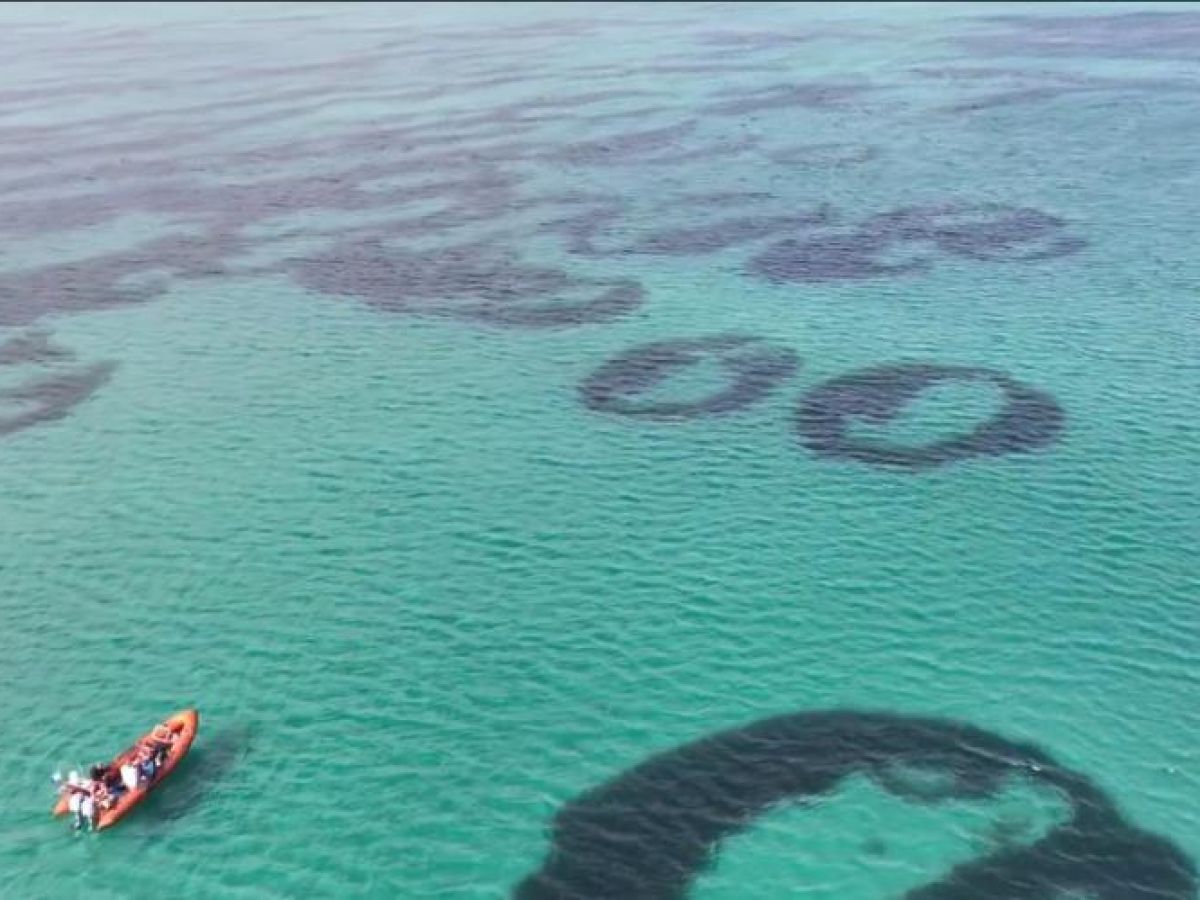
This is an extremely rare phenomenon that had never been filmed in Scottish waters: NatureScot agents spotted « fairy circles » formed by seagrass trees.
It is a rare spectacle that has offered itself in the eyes of the agents of NatureScot, the agency for Scottish nature. Off the islands of the Outer Hebrides, « fairy circles » of marine herbariums have formed. In a statement, the agency explains that such training is very rarely observed. The team took the opportunity to capture some images.
« To our knowledge, this is the first video of fairy circles formed by seagrass in Scottish waters, » said Sarah Cunningham, head of marine protected areas and marine restoration at NatureScot, in a statement published on January 20, 2026. Our marine surveillance team calls them seagrass donuts, but whatever their name, they are spectacular. We were delighted to see them and to have been able to take superb aerial images! »
These circles, made up of groupings of flowering plants (marine grasshers are not algae), always retain their share of mystery. Indeed, « scientists do not know how they are formed, » says the press release.
Habitats in danger
If seagrass were previously common in Scotland, this is no longer the case. In parallel with the publication of its video on fairy circles, NatureScot published a report called « Balance of the decline of Scottish seagrass« . It highlights the loss of these precious habitats for fauna and flora during the 20th and 21st centuries.
Several causes explain this decline. Already in the 1930s, an epidemic caused a significant loss of seagrass. Even today, some affected areas have not recovered, such as the Shetland archipelago. But that’s not all: human activities have also brought their lots of disruptions. NatureScot mentions in particular « pollution and poor water quality, especially near cities, coastal development, such as the construction of dikes and mechanical damage caused by the dredging of scallops« .
A recovery that also benefits humanity
However, the report also points out that when threats are contained and water quality improves, seagrass herbs can recover. Good news observed in particular at Loch Ryan, the Gulf of Solway, the Montrose Basin or the Forth estuary.
And this recovery greatly benefits humanity. Indeed, Sarah Cunningham recalls that the leaves and roots of seagrasses absorb carbon, « thus contributing to the fight against climate change« . It should also be noted that these underwater meadows can « improve water quality, reduce the contamination of seafood and constitute a first line of coastal defense by attenuating the energy of the waves, thus protecting populations from the growing risks of floods and storms« .
source : sciences et avenir