Faced with a rapidly growing population in West Africa, aquaculture emerges as one of the key solutions to strengthen food security and limit the decline of freshwater fish stocks. However, the intensification of this activity brings major challenges: disease outbreaks, water pollution, and the spread of antimicrobial resistance. Such intensification threatens not only aquatic ecosystems but also the health of local populations.
As part of the IRN ASACHA project (Agroecology for Sustainable Aquaculture in a Context of Global Changes), the research aims to better understand how fish diseases, pollution, and farming practices interact in the main aquaculture systems of West Africa. This has enabled the study of 20 agroecological zones where aquaculture is practiced in Côte d’Ivoire and Senegal, through close collaboration with Université Jean Lorougnon Guédé (Côte d’Ivoire), Université Cheikh Anta Diop and Université Gaston Berger de Saint-Louis (Senegal), as well as with aquaculture associations such as the Union of Fish Farmers of the Zoukougbeu Department and the National Association of Actors in the Aquaculture Sector of Senegal.
To understand which diseases truly affect fish, it is not enough to observe clinical symptoms. The same signs can be caused by different pathogens, and some infections remain invisible for long periods. It is therefore essential to accurately identify the responsible agents to implement effective prevention and treatment measures. In this context, we implemented, together with partner teams, a molecular diagnostic strategy using quantitative PCR (qPCR). On-site, water physico-chemical parameters and fish health were documented, and samples were collected and sent to partner laboratories for analysis. In the laboratory, qPCR was used as a diagnostic tool to detect bacteria and viruses in farm samples, with sufficient sensitivity to identify pathogens even at very low concentrations.
In addition to producing precise data on pathogen presence in the visited farms, this approach served as a platform for training and knowledge exchange with partners in Côte d’Ivoire and Senegal, strengthening their skills and autonomy in molecular diagnostics and health monitoring of aquaculture systems.
At the same time, socio-economic surveys conducted in French and local languages (notably Senoufo and Wolof) helped to better understand the realities of aquaculture farms: labor organization, farming practices, animal movements, as well as the use of antibiotics, antiparasitics, and pesticides, and how farmers perceive these practices. This information helps to link field practices to their potential effects on fish health, water quality, and the environment. By combining these data with biological and environmental results, this integrated approach—linking biological, social, and environmental sciences—aims to provide a comprehensive picture of production dynamics and health risks associated with aquaculture, and to co-develop realistic management strategies with local actors tailored to the West African context.
The research has already yielded several key insights. Molecular analyses revealed the presence of bacteria from the genera Aeromonas, Edwardsiella, Streptococcus, and Lactococcus in several farms, some potentially zoonotic, sometimes in fish showing no clinical signs, indicating silent circulation of infectious agents. Surveys show a wide diversity of farming practices, frequent use of antimicrobials without veterinary supervision, and a strong agriculture–aquaculture integration, while biosecurity measures remain poorly implemented due to socio-economic constraints. Reported mortality rates vary from a few percent to more than half of the fish depending on the site, and the combination of field and molecular data highlights conditions favorable to the emergence or spread of diseases and antimicrobial resistance, even as fish farmers strive to adapt practices toward more sustainable aquaculture models.
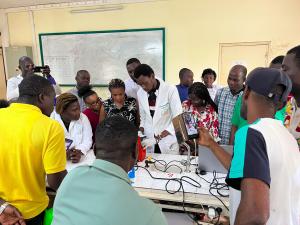
A major focus of the activities has been capacity building and training of aquaculture research and development actors. Two training sessions were organized at Université Jean Lorougnon Guédé (UJLoG) in Côte d’Ivoire and Université Gaston Berger (UGB) in Senegal. These theory-and-practice sessions, organized in partnership with the UFR Environment of UJLoG for Côte d’Ivoire, and the UFR of Agronomic Sciences and LaBAAM, in collaboration with the Microbiology Laboratory of UFR2S for UGB, trained around forty participants, including PhD students, young researchers, and technicians, in molecular biology techniques, sequencing, and phylogenetics.
Additionally, results were shared with aquaculture stakeholders, particularly in Côte d’Ivoire, to foster dialogue between researchers, fish farmers, and policymakers on aquaculture’s health and environmental challenges.
Ultimately, this approach aims to promote more sustainable, resilient, and safer aquaculture for both ecosystems and human and animal populations. By strengthening local capacities in diagnostics, monitoring, and infectious risk management, it lays the foundations for true integrated health practices in African aquaculture.
Source: IRD