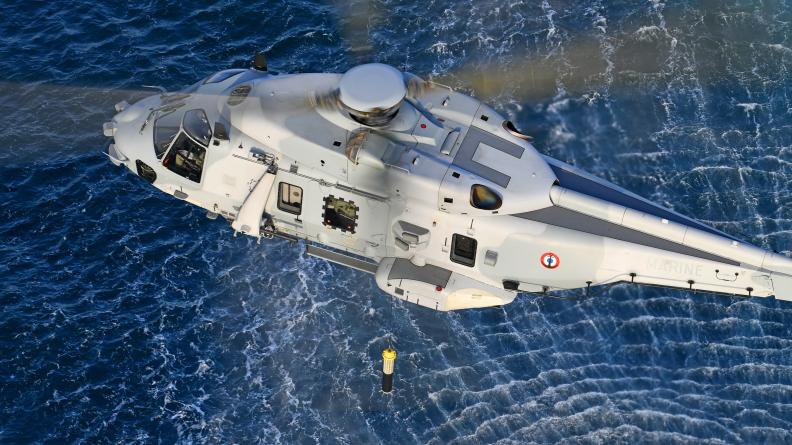
In the seas and oceans, acoustic waves are a key: they both characterize the environment
and to detect sound signatures, friendly or enemy The quality of propagation of these waves depends
of three physical parameters of the environment: temperature, salinity and pressure – the latter varying
with the depth.
A modification, even subtle, of oceanographic conditions can significantly change
the scope, precision and, ultimately, the reliability of the detections.
Under water, if electromagnetic waves are quickly absorbed. The sound propagates remarkably well. When we don’t « see », we listen. Sonar systems, both civil and military, are based precisely on this propagation of acoustic waves. However, their effectiveness depends on the ability of sound to travel long distances, to reflect on structures, or on the contrary to diffuse according to the nature of the environment. A modification, even subtle, of oceanographic conditions will have an impact on the range, accuracy or reliability of detections.
With global warming, the temperature and salinity of the seas and oceans are changing, on the surface but also in depth, which is not without consequences on the spread
underwater acoustic waves and sonar performance.
Oceans in climate change
According to the latest scientific results, the trend is towards an increase in sea and ocean temperatures, with + 0.5°C of water warming since the 1980s on a global scale. But, in reality, disparities exist depending on the areas considered. For example, in the high polar latitudes, near the Norwegian Svalbard archipelago, where the surface waters of the North Atlantic Ocean plunge deep, the trend has been cooling in recent years, contrary to the planetary trend. Elsewhere, the waters are warming but not at the same speed: if the Baltic Sea warms to + 0.5°C per decade, the Mediterranean Sea only gains + 0.3°C per decade.
Similarly, variations in salinity are heterogeneous, with an intensification of historical trends, both at the surface and in depth: a salinity that increases in already salty regions, and a softening of regions with low salinity, under the combined effects of melting ice and an intensification of rainfall regimes. Specifically, the Pacific Ocean and the high latitudes of the North Atlantic are softening, while the middle latitudes of the Atlantic are becoming saltier.
The conjunction of all these phenomena changes the way sound propagates in these changing oceans, both on the surface and at depth: when the temperature rises, the sound propagates faster. Similarly, with high salinity, the water is denser which can also increase the speed of propagation. Some regions of the world will be strongly impacted by these changes in the coming decades, to the point that some scientists speak of « acoustic hotspots« , especially in the Greenland Sea and south of the Labrador Sea, in the Northwest Atlantic.
Poorly or not taken into account, these developments can have consequences on the performance of sonar and acoustic detection capabilities.
Climate change and noise pollution
These profound changes to the internal structure of the oceans will also allow the emergence of new « acoustic corridors », where ambient noise can be trapped in certain layers and travel over hundreds of kilometers with very few losses. According to scientific research, a new « corridor » should emerge in the North Atlantic. It could increase the average intensity of underwater noise in the first 200 meters by about 7 decibels by the end of the century.
NATO invests in acoustic observatories
In parallel, beyond physical changes in temperature and salinity, the development of maritime traffic and oil or mining activities in high latitudes leads to a change in the ambient soundscape. These activities are now made possible by the melting of ice and the evolution of the polar regions due to climate change; they are, in any case, bound to develop in the coming decades. However, they are also sources of noise in historically isolated and silent regions, whose depths were preserved from noise pollution by layers of ice buffers on the surface. The listening quality in these regions can be altered. This is why NATO’s Centre for Maritime Research and experimentation (CMRE) is now installing permanent acoustic observatories off Svalbard to record and characterize these new ambient noises. It will then be easier to locate them in an acoustic signal and not to confuse them with a defense interest signature.
The upcoming changes promise to be major and will be decisive. However, the projections of evolution of the physico-chemistry of the oceans still lack high-resolution, regionalized data, which would make it possible to finely characterize this phenomenon, whose military implications are central. In our regions of strategic interest, such as the North Atlantic or the Arctic Ocean, these changes are difficult to predict, because changes in temperatures and salinity in these regions also depend on the evolution of currents (such as AMOC, Atlantic Meridional overturning circulation) and the melting of ice. Observations, as well as additional in situ measurements, are also essential to begin to adapt infrastructure on the surface and at depth.`
source : defense