

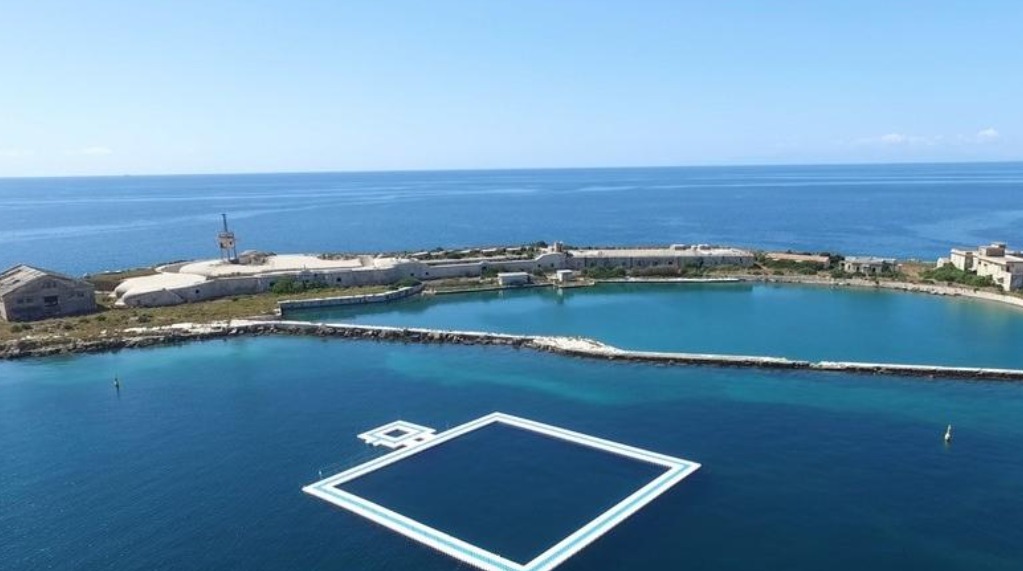
“For us, it is essential to create a new model for managing dolphins in a natural yet still controlled environment,” Carmelo Fanizza, head of the “San Paolo Dolphin Refuge,” told AFP.
Located off the city of Taranto, in the Apulia region, the refuge—the first marine sanctuary of its kind in the Mediterranean—still requires one final interministerial authorization before it can welcome its first dolphins.
But the site itself is ready: the offshore facilities will be completed by the end of the year, and the first residents could arrive “by May or June 2026 at the latest,” according to Carmelo Fanizza.
A site “sheltered and protected from the sea”
Marine parks have been closing across Europe and beyond in recent years, due to declining public interest, while new legislation—particularly in France and Canada—now bans the captivity of cetaceans.
The fate of these animals, many of which can live for decades and have known nothing but captivity, making a return to the wild impossible, has become a pressing issue for animal-rights advocates and governments alike.
In development since 2018, the “San Paolo Dolphin Refuge” project was officially launched in December 2023, after obtaining from the Italian state a maritime concession for its installation over a seven-hectare area in the Gulf of Taranto, near San Paolo Island.
The location was selected after extensive studies identified a site “sheltered and protected from the sea, from the winds, and from dominant marine currents,” Fanizza explained, assuring that the “environmental conditions” are optimal.
A coastal industrial city, Taranto has in recent years been shaken by a pollution scandal linked to the presence of one of Europe’s largest steelworks, the former Ilva plant, now operating at reduced capacity while awaiting a buyer.
“Improvements have been made to the facilities so that the quality of the breathable air, the water column, and the sediments in the area currently pose no risk to the animals’ health,” Fanizza added.
The construction of the San Paolo refuge has been funded largely through the resources of Jonian Dolphin Conservation—the research organization behind the initiative—with additional support from private donors, including the ‘Fondazione con il Sud’, and European public funds.
A natural environment
Given “the square meters of available marine space, we could legally accommodate up to 17 animals in Italy,” Fanizza noted, “but the number will absolutely not be that high.” He stressed the importance of the dolphins’ well-being.
“Our goal at this stage is not to take in a large number of animals, but to identify a group that—given its medical conditions, behavior, and social structure—would be ideal for launching such a project,” he continued.
Located about 4 km from the coast, the structure consists of several natural enclosures formed by floating pontoons on the surface and underwater fencing: a main 1,600-m² pool, a smaller pool for potential animal transfers, and a veterinary pool for quarantine cases.
A floating laboratory, staff accommodations ensuring 24/7 monitoring, and a food-preparation area complete the offshore section.
Sensors at sea
The site is also equipped with both underwater and surface video-surveillance systems, as well as a network of marine sensors that continuously transmit data to the sanctuary’s control room, located onshore in Taranto.
“There is nothing richer than the natural environment,” said Muriel Arnal, president of the French animal-rights organization One Voice, which has long advocated the creation of marine sanctuaries for cetaceans and supports another project—for orcas and belugas—in Nova Scotia, eastern Canada.
According to her, Europe currently has around sixty dolphins in captivity, not counting future births or deaths.
“Once you have a model that works well, you can replicate it,” she added, expressing hope that the San Paolo refuge will eventually be able to welcome dolphins from France.

