

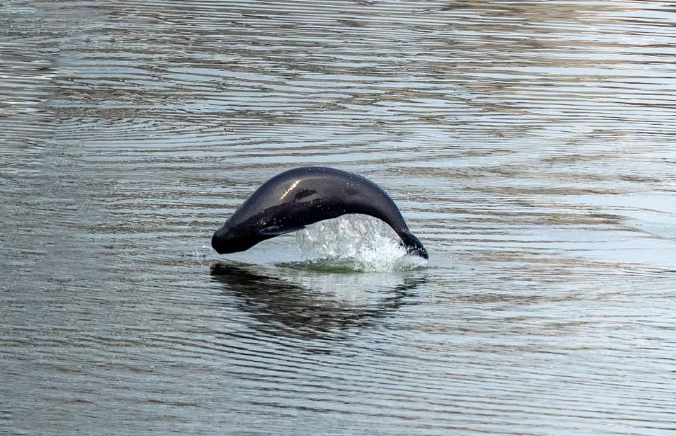
The Yangtze finless porpoise, China’s last freshwater cetacean, saved from extinction thanks to a fishing ban along the entire river
Nicknamed the “smiling angel of the Yangtze,” this porpoise—endemic to China, with a short upturned snout and no dorsal fin—has likely inhabited the river for 25 million years. It is the last remaining freshwater cetacean in China.
Its population had declined sharply in recent decades, coming close to extinction five years ago. But it is now recovering. The latest census, released in late January, estimates the population at 1,426 individuals—an increase of 177 compared to the previous count in 2022, when an initial rebound had already been observed.
According to the World Wide Fund for Nature (WWF), the Yangtze porpoise suffers from overfishing, water pollution, and the impact of the massive Three Gorges Dam, operational since 2006, which disrupts the migration of fish it feeds on.
Its relative, the white-bodied baiji dolphin, has officially gone extinct. An attempt to create a sanctuary for it in a side channel of the river in 1995 ended in failure: the only female introduced there was found dead, caught in a fishing net after just seven months. A six-week international expedition equipped with advanced sonar surveyed the Yangtze in late 2006 without detecting any signal. The species was then officially declared extinct.
A ten-year commercial fishing ban
To prevent a similar fate for the porpoise, a fishing moratorium had been proposed that same year by Cao Wenxuan, a professor at the Chinese Academy of Sciences. The goal was to preserve fish populations—the porpoise’s main food source—and reduce accidental catches.
Initially, only monitoring programs and large-scale fish releases were implemented, with little success. On January 1, 2021, China finally introduced a ten-year ban on commercial fishing along the entire length of the river.
Around 220,000 fishermen—representing as many families whose livelihoods had depended on the river for generations—were forced to retrain. But the effort paid off: a 2023 study published in Science found that total fish biomass in the Yangtze had increased by 209% since the ban, while species diversity rose by 13%.
As a result, the annual population decline of 13.6% in porpoises has been halted. The latest census (January 2026) confirms their number at 1,426 individuals. Coordinated by the Ministry of Rural Affairs with support from the WWF, the survey covers the river’s middle and lower reaches, Dongting Lake, Poyang Lake, and several tributaries.
Beyond visual counts from riverbanks, bridges, and boats, fixed sonar systems are deployed at strategic points for continuous monitoring. In Wuhan, for example, porpoise signals were detected nearly every other day over 603 days of acoustic monitoring. Scientists have also begun analyzing environmental DNA in water samples, detecting traces from skin cells, mucus, waste, and urine.
Noise pollution remains a threat
In 2025, ports along the river handled more than 42 billion tons of goods. The fishing ban has not been accompanied by restrictions on commercial shipping, which remains a major source of noise pollution. The porpoise relies on echolocation—clicks and whistles—to navigate murky waters and find prey.
However, large textile factories once located near Wuhan, Nanjing, and Chongqing—which discharged heavy metals and solvents into the river—have been closed or relocated over the past decade, reducing chemical pollution.
The Chinese government has also unveiled an “Action Plan for the Conservation of the Yangtze Finless Porpoise (2026–2035),” aiming to reach a population of 2,000 individuals by 2035. The plan focuses on creating semi-natural sanctuaries away from shipping traffic and expanding captive breeding programs. The goal is both to protect porpoises from immediate threats and to strengthen their genetic diversity before reintroduction into the wild.
source : Le monde

