

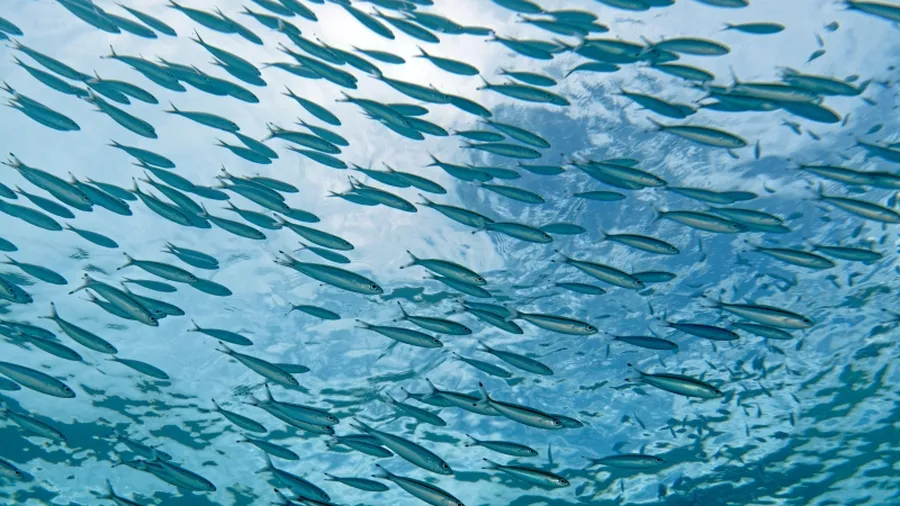
In a study published on March 6, researchers from the University of Montpellier, the CNRS and the IRD found that the amount of predatory fish decreased by 120% worldwide due to human pressure. And marine protected areas do not fundamentally change the game.
The protection of coral reefs does not compensate for the decades of decline of reef fish, » is the title of the work published on March 6, 2026. Researchers from the University of Montpellier, the CNRS and the IRD analyzed data collected on fish in more than 2,800 tropical reefs, from Australia to the Caribbean via Tanzania and the Galapagos.
If there are study points in New Caledonia, Polynesia, Wallis and Futuna, « there are quite few points in the French Overseas Territories, » warns Ulysse Flandrin, a doctor in marine ecology who did his thesis on the subject at the University of Montpellier.
Questioned by Outre-mer la 1ère, he nevertheless points out that the results are similar « depending on the regions » and that there is « no French exception« : « This is a fairly general observation of, globally, how reserves react on a global scale and what is the impact of man on reefs. »
« We can’t compensate for the damage we’ve done »
The observation is alarming: the protections put in place such as nature reserves or marine protected areas do not preserve species enough, unless they are strict and have existed for a long time. Thus, the amount of predatory fish has decreased by more than 120% worldwide due to human pressure. Ditto for the amount of fish consumed, which has decreased by almost 40%. « We are rather in the best of cases, » adds Ulysse Flandrin.
Because these figures are primarily estimates from a mathematical model. He and his colleagues correlated the amount of fish in different maritime areas to multiple factors (water temperature, salinity, coral cover, fishing pressure, existence of a protected marine area, etc.) By adding or removing one of the factors, for example the presence of man or a nature reserve, they managed to estimate the amount of fish there should be.
Even in parks, reserves and conservation areas, the results are worrying: « current measures would only compensate for about 29% of the losses » of fish destined for consumption « and barely 5% of the decline of large predators« . « Reserves have positive effects, we do not deny it at all and it shows, » says the doctor in marine ecology. On the other hand, even within the reserves, we cannot compensate for the damage we have done. »
Through this study, he actually wanted to compare what was comparable: « When we make a reservation and see a positive effect after a few years or a few decades, we compare with what is next to it, what is not protected. And we think that there is still a strong effect of the reserve. But if we compare the interior of the reserve to the state it was a few decades ago, in the end, the reserve can only compensate a little bit of the surrounding degradation. »
« Not monitored or no particular rule »
The researcher points out an exception: that of strictly protected marine areas – where any form of fishing is prohibited – for more than 10 years. They « show significant benefits for biodiversity and for human populations. However, this type of reserve remains marginal on a global scale, » warn the researchers.
France and the European Union have nevertheless set objectives by 2030 to protect 30% of their maritime area, including 10% strictly. The State boasted of having already reached the first objective in 2023, with 33.4% of its maritime areas under protection, of which 4.8% are strictly regulated.
« You should know that France is particularly bad in strictly protected marine areas, » warns Ulysse Flandrin. In the marine environment, there is a tendency to create a lot of reserves to achieve the 30% protection goals. In fact, often, these reserves are so-called paper reserves, that is to say that there is no real regulation in them. Either they are not monitored, or there are not even particular rules or really very permissive rules. »
Change our consumption and types of fishing
If he has no example at the head of overseas paper reserves, he also points out that « France also benefits » from its overseas territories to make large areas very strongly, unlike France, which in 2025 housed only 0.1% of the spaces in full and high protection. After the TAAF in 2022, the creation of a marine protected area over almost all of Polynesia by mid-2026, including 900,000 km2 under strict protection, will boost the percentages: 78% of French waters will be placed under protection and 14.8% will be strongly.
« It’s good to keep these reefs which are relatively intact. But often, they are also reserves that are not very expensive to set up, » explains the researcher. « These are reserves » located « very far from human populations » and the strongest pressures « and which are quite unbinding« .
For the authors of the study, we clearly need to change the paradigm. « If we try to [strictly] protect 10% while we destroy the rest, it will not be sustainable, » summarizes Ulysse Flandrin. So if we really want to preserve marine ecosystems, we will have to change the type of activity, consumption and types of fishing. »
Key figures
97% of the French maritime space is overseas.
1941: creation of the 1st nature reserve in France. This is Leprédour Island in New Caledonia.
2023: there are 589 marine protected areas (AMP) in France, including 153 in Overseas, which cover more than 7.2 million km2, almost the size of Australia.
2025-2026: creation of the world’s largest AMP in Polynesia. With a size of 4.8 million km2, it covers almost the entire archipelago. Announced in 2025 with implementation by mid-2026, it is placed under minimal protection while part of this area (900,000 km2) is recognized as so-called strict protection, where all activity is prohibited.
source : la 1ere


