A floating island to explore the abyss without returning to port.
The Chinese are dreaming big (as usual) with a new project for a scientific laboratory placed in the middle of the sea, capable of staying there for weeks, sometimes months, without making trips back and forth to the coast.
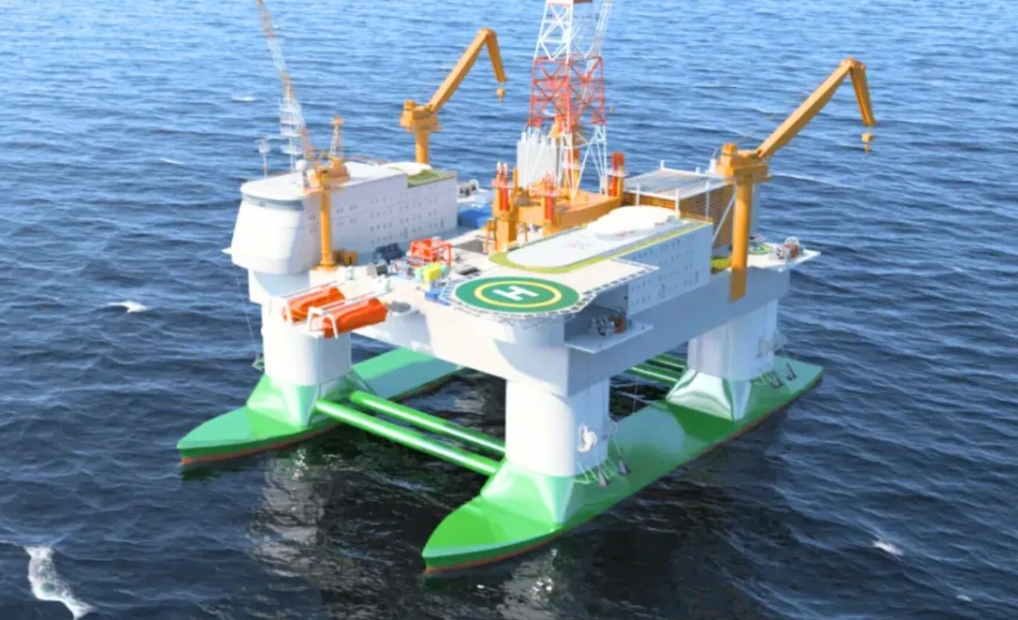
It would not be a simple ship, nor a classic oil platform, but rather a kind of mobile artificial island, designed to withstand storms and plunge its instruments into the most extreme depths.
The project was developed by Shanghai Jiao Tong University, an institution already very active in the field of marine research, and its full commissioning is planned for 2030, with the objective of making it a permanent testing site for deep-sea technologies.
A mobile artificial island designed as a true scientific ecosystem
Besides its colossal size and resistance to storms, what makes this project so fascinating is how it could be designed.
Rather than creating a simple research vessel, the engineers envisioned a complete and modular system, organized around three complementary elements.
- a central floating platform
- a fleet of mobile laboratory ships
- land-based support infrastructure
At the heart of the system, the platform adopts a particular architecture with a semi-submersible double hull.
By filling or emptying water tanks located within the structure, the platform can adjust its buoyancy.
One could almost say that it goes from « boat » mode to « island » mode.
In practical terms, this means that part of the structure is submerged underwater, which lowers the center of gravity and greatly improves stability, even when the sea becomes rough, like a kind of giant buoy.
This stability is essential, as the platform is designed to handle equipment weighing several hundred tons.
Working at a depth of 10,000 meters without leaving the surface
The platform is designed to support extreme scientific missions, some of which are intended to venture to depths of approximately 10,000 meters, where the pressure becomes extreme and sunlight no longer penetrates at all.
The platform itself obviously does not descend to that depth but would act as a launchpad for specialized equipment such as:
- underwater robots,
- drilling systems,
- or scientific sensors.
Rather than bringing this equipment back to shore after each mission, researchers would be able to test, adjust and immediately relaunch their experiments directly at sea, significantly accelerating research cycles.
A tool for understanding the ocean and anticipating disasters
Beyond the engineering aspect which will make more than one person dream, this floating island could play a major role in understanding our oceans.
Researchers hope to leverage this technology to better analyze the variations of marine ecosystems across seasons, the interactions between ocean currents and climate, and any other conditions that lead to the occurrence of certain extreme phenomena.
Among the most concrete applications is the improvement of typhoon forecasting models.
These weather phenomena depend largely on ocean temperature and surface dynamics. By collecting data directly at sea over long periods, scientists can refine their models and improve their ability to predict natural disasters.
A strategic element in the race to explore the oceans
By August 2025, China had already deployed a veritable armada of five icebreakers in the Arctic, with ships like the Xue Long 2 capable of breaking through more than a meter and a half of ice continuously, accompanied by buildings bristling with sensors, drones and robots capable of descending to depths of up to 7,000 meters.
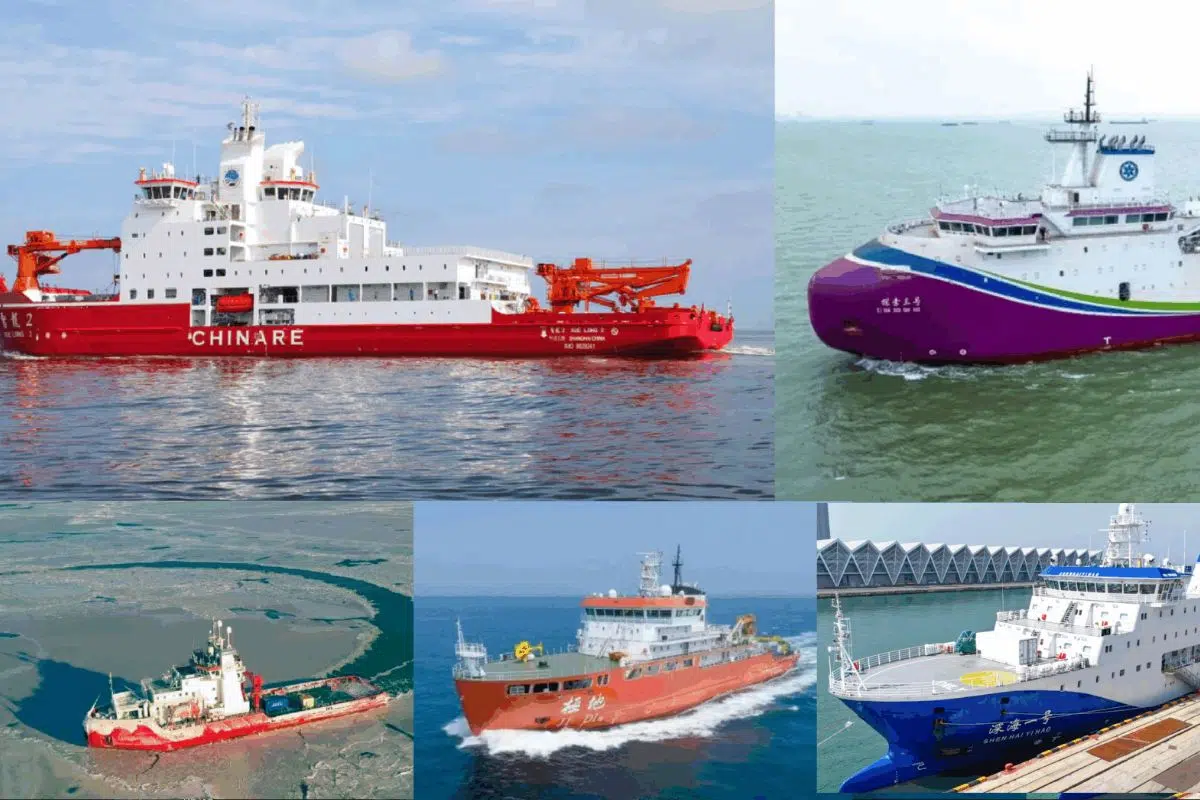
The Chinese icebreakers Xue Long 2, Tan Suo San Hao, Zhongshandaxue Ji Di, Ji Di, and Shen Hai Yi Hao. (Sources: PRIC, Chinese state media, Sun Yat-sen University, Chinese Ministry of Natural Resources, CFP)
It is therefore clear that this floating island did not come from nowhere and is part of a coherent plan by the Middle Kingdom to have a whole arsenal dedicated to the exploration and understanding of our oceans.
There is the scientific aspect of course, but also the economic and geopolitical aspect, which consists of positioning oneself in particular on areas rich in resources, hydrocarbons or rare minerals in particular, or on potential new maritime routes that are emerging with the melting of the ice.
China intends to become a true thalassocracy of extreme environments!
source : Média 24